Scheduled Maintenance for Industrial Hydraulic Presses in Mansfield
What determines the right time to maintain an industrial hydraulic press? The machine’s documented requirements, operating demands, and condition matter more than a calendar date alone. Unplanned downtime can interrupt production, while early signs of fluid or component problems can be easy to miss. A practical plan for scheduled maintenance for industrial hydraulic presses in Mansfield helps teams organize inspections, record changes, and coordinate work with production.
Presses differ in design and use, so maintenance intervals and specifications should follow the manufacturer’s documentation and reflect how each machine operates. This guide covers a machine-focused checklist, from fluid and component observations to controls and developing issues. It also explains how to plan maintenance around production and use inspection records to guide follow-up.
Ms. Hydraulics LLC provides detailed industrial plant maintenance schedules and on-site diagnostic services in Mansfield and the wider DFW region. With over 22 years of experience servicing heavy equipment and tractors, the team offers practical maintenance advice for industrial equipment, including guidance on equipment care and oil costs.
Key Takeaways
- Build the maintenance plan around each press’s requirements and production demands, rather than applying one schedule to every machine.
- Organize checks by system, including hydraulic fluid, filters, hoses, cylinders, pumps, controls, and electrical components.
- Record inspection methods, findings, responsible roles, and follow-up actions so changes are easier to track.
- Use manufacturer documentation as the starting point for scheduled maintenance for industrial hydraulic presses in Mansfield, then review the plan against operating conditions and inspection findings.
- Ms. Hydraulics LLC provides detailed industrial plant maintenance schedules and on-site diagnostics to help inform maintenance and repair decisions.
Why Scheduled Maintenance Matters for Industrial Hydraulic Presses in Mansfield
An unexpected press failure can interrupt planned work, delay the next production step, and require a maintenance response at an inconvenient time. A schedule helps teams plan inspections around the press’s documented requirements and operating demands instead of waiting for a problem to stop production. Effective scheduled maintenance for industrial hydraulic presses in Mansfield gives teams a consistent way to decide what to inspect, what to record, and when a concern needs further attention.
Maintenance planning cannot prevent every failure. Its value is in making condition changes more visible and follow-up more organized. Operators might notice a leak, unusual noise, rising heat, or a change in cycle behavior before the press stops working. Recording when and how a change occurs gives maintenance personnel useful context, but it does not identify a failed part on its own.
What can change when a hydraulic press is neglected?
Pressure fluctuations, inconsistent force, slower cycles, and jerky ram movement can indicate a change in press performance. Each symptom can have more than one cause, so none proves that a particular component has failed. Record the conditions, including whether the change occurs during a specific part of the cycle, and compare the observation with earlier records. Appropriate diagnosis can then help distinguish a developing hydraulic issue from another operating or control concern.
Why Mansfield plants need a schedule that fits production
A useful schedule reflects the machine’s documented requirements and the demands placed on it. Consider production windows when planning work, and record operating conditions and inspection findings so the schedule can be reviewed as the press’s use changes. Mansfield is part of the DFW-area service context for local industrial customers. The related Heavy Equipment Maintenance in Cleburne & North Texas guide also discusses maintenance planning for equipment serving the region.
Use the press manufacturer’s documentation for service intervals and specifications, then make the schedule practical for production:
- Identify what operators should report during normal use, such as visible leaks, unusual sounds, or a changed cycle.
- Assign inspections and servicing to the appropriate maintenance personnel.
- Record findings consistently, noting changes from previous observations.
- Plan qualified maintenance or diagnostic assessment when findings need further investigation.
Routine observations can surface changes, but they do not replace technical assessment or authorize work beyond an employee’s role. Hydraulic presses use fluid power to generate force, as outlined in the Hydraulic Press Wikipedia overview. Specific system designs and service needs vary by machine. On-site diagnostics can help inform maintenance and repair decisions when an inspection identifies an issue that needs closer assessment.
For Mansfield plants, the goal is a maintenance process tied to real production conditions, not a generic calendar alone. Records of observed changes and completed follow-up give the team a clearer basis for planning the next maintenance window. A schedule cannot guarantee zero downtime, but organized inspections can help reduce avoidable surprises and support more informed responses.
What to Include in an Industrial Hydraulic Press Maintenance Schedule
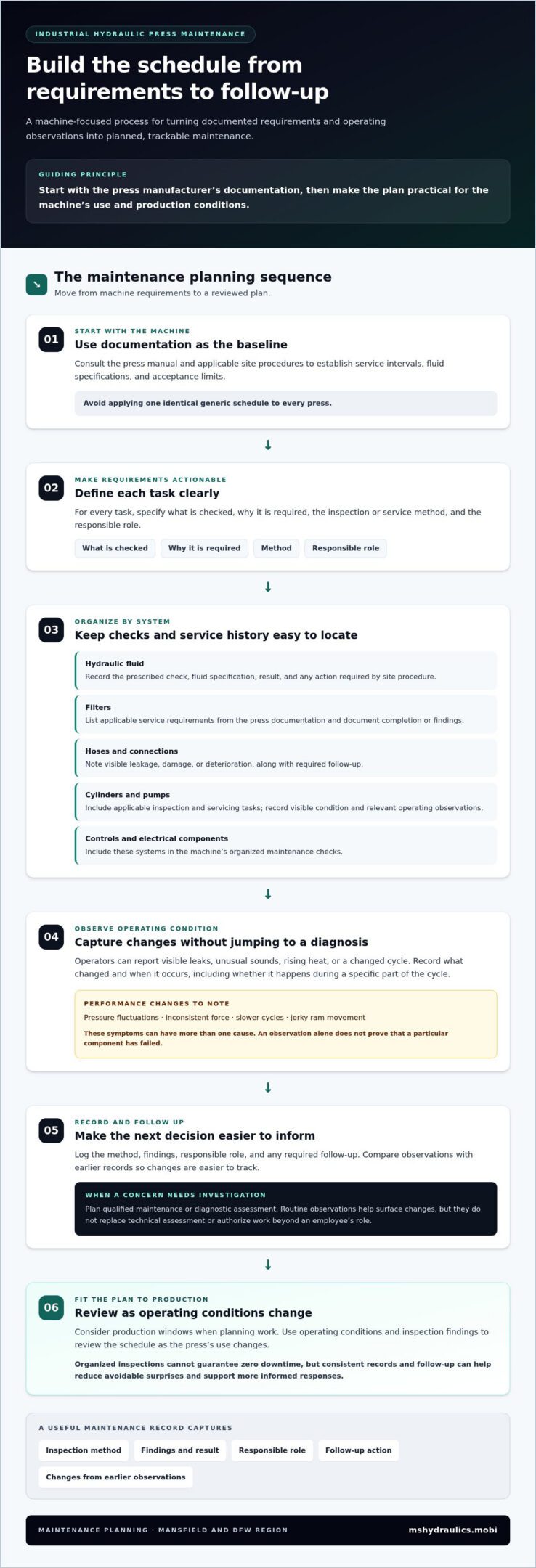
A useful schedule turns maintenance requirements into tasks that can be assigned, completed, and reviewed. Start with the press manual and applicable site procedures. Use them to establish service intervals, fluid specifications, and acceptance limits, then organize the tasks by system so findings and service history are easy to locate. The schedule should reflect the machine’s documented requirements and operating conditions, not a generic checklist applied identically to every press.
For each task, record what is being checked, why it is required, and what was found. Specify the inspection or service method, responsible role, result, and any required follow-up. This makes it easier to distinguish a completed check from an unresolved concern and gives the next inspection a useful point of comparison.
Hydraulic fluid, filters, hoses, and cylinders
- Hydraulic fluid: Record the prescribed check, fluid specification, result, and any action required by site procedure.
- Filters: List applicable service requirements and document completion or findings.
- Hoses and connections: Note visible leakage, damage, or deterioration, and identify required follow-up.
- Cylinders: Record visible condition and relevant operating observations for later review.
- Pumps: Include the inspection and servicing tasks specified for the pump and press configuration.
Press controls, electrical components, and operating observations
Include control and electrical-system checks required by the press documentation and site procedures, and assign each task to the appropriate role. Operator records can capture changes in pressure behavior, cycle consistency, unusual noise, or visible leakage. These observations can inform diagnosis, but they do not establish which component has failed. Make each record specific: describe what changed, when it was noticed, and whether it recurs, then route it for suitable assessment.
Keep the schedule usable on the plant floor. Separate routine observations from technical inspections or service, and provide space to record dates, findings, responsibility, and follow-up status. If a finding needs investigation, record the next step rather than marking the task complete without resolution. This structure supports scheduled maintenance for industrial hydraulic presses in Mansfield by connecting machine-specific requirements with consistent records and production-aware planning.
For plants developing a maintenance plan, industrial maintenance schedule support can help organize tasks around equipment requirements and inspection findings.
How Often Should Mansfield Hydraulic Presses Be Serviced?
There is no single service interval for every hydraulic press. Machines can differ in design, operating duty, environment, and maintenance history, so using the same calendar schedule across a plant may overlook important differences. Start with the press manufacturer’s service instructions and site procedures, then review the plan against documented operating conditions and inspection findings.
Maintenance frequency depends on the press manual, operating duty, condition, and recorded history. That keeps the schedule anchored to the machine rather than a generic rule of thumb. For scheduled maintenance for industrial hydraulic presses in Mansfield, establish a defensible plan for each press and review it when its use or condition changes.
Factors that should shape service timing
Consider how intensively the press operates, its working environment, fluid-condition records, and findings from previous maintenance. A press with different operating demands from another machine may need a different planning approach, even if both are on the same production floor. The manufacturer’s instructions should guide specified service tasks, fluid requirements, and intervals. Site procedures add the plant’s established inspection and documentation process.
- Production intensity: Record relevant workload or use changes so the schedule reflects actual operating demands.
- Operating environment: Note conditions that may affect the machine and review them alongside its service requirements.
- Fluid condition: Track checks and findings according to the manufacturer’s method and plant process.
- Maintenance history: Use recurring observations and completed follow-up to inform the next schedule review.
Review the plan when operating demands change materially or inspections identify a new concern. A review does not justify changing a manufacturer-prescribed interval without a sound basis. Instead, confirm that assigned tasks remain appropriate, findings receive follow-up, and the plan still reflects the press’s documented requirements.
Fixed intervals versus condition-led follow-up
These approaches work together. Keep fixed intervals for tasks specified by the manufacturer or plant procedure. Alongside them, record routine operator observations and planned technical inspections, then use the findings to determine when additional assessment is warranted. For example, a new noise or a change in cycle behavior is a reason to document and assess the change, not to diagnose a failed component from one symptom.
A practical planning sequence is to:
- Enter prescribed service tasks and their source into the schedule.
- Assign routine observations and planned inspections to the appropriate roles.
- Record findings consistently and compare them with previous records.
- Assign condition-led follow-up when an observation calls for further assessment.
This creates a maintenance rhythm that respects required intervals while allowing new information to guide decisions. It also gives maintenance teams a clear reason for each scheduled task and a record to support future reviews, rather than assuming every press needs attention at the same time.
A Practical Checklist for Planning Press Maintenance Around Production
A checklist is useful when it guides work from planning through closeout. Start with the press documentation and site procedures, then turn each requirement into a task with an owner, a record, and a follow-up path. This makes scheduled maintenance for industrial hydraulic presses in Mansfield easier to coordinate with production and less dependent on informal notes or individual memory.
Build a usable checklist before assigning tasks
Gather the press manual, existing service records, and applicable site maintenance procedures. Use them to identify required checks, service instructions, and acceptance criteria. Avoid adding universal intervals or limits that the documentation does not support. For each task, record its source, responsible role, how results will be documented, and where an unresolved finding should go.
Review production requirements with the people responsible for scheduling the equipment. Identify suitable maintenance windows and coordinate planned work with the production plan, without assuming every task requires the same amount of time. Keep routine operator observations distinct from technical maintenance or diagnostic work, and assign each according to the person’s role and the site’s process.
- Gather references: Collect the press manual, maintenance history, and site procedures.
- Define tasks: List each required inspection or service item and identify its source.
- Assign responsibility: Separate routine observations from work requiring qualified maintenance or diagnostic assessment.
- Plan the window: Coordinate planned work with production requirements.
- Set up the record: Provide fields for findings, actions, and outstanding issues.
Review findings and close maintenance actions
Use a maintenance log that identifies the press and captures the date, observations, actions taken, and any unresolved issues. A note such as “unusual noise during operation” is more useful when it also records when the noise occurred and whether it was noticed again. Record visible leakage, inconsistent operation, and relevant maintenance findings without treating an observation as proof of a specific fault.
Review open items so they do not disappear between inspection cycles. Assign follow-up, record whether the action was completed, and retain unresolved concerns for appropriate assessment. If observations point to a hydraulic or control issue that needs closer investigation, diagnostic assessment can inform the next maintenance or repair decision. Ms. Hydraulics LLC’s On-Site Diagnostic Services for Heavy Equipment in Cleburne & North Texas provides related diagnostic context for equipment maintenance.
Closeout matters. A completed task should show what was done and whether further action remains. An open concern should have a clear next step. Over time, those records help the team recognize recurring observations and review whether the plan still reflects the press’s use. For help developing a detailed, production-aware maintenance schedule, get industrial maintenance schedule support from Ms. Hydraulics LLC.
Plan Industrial Hydraulic Press Maintenance in Mansfield with Ms. Hydraulics LLC
A checklist is a useful starting point, but a working maintenance plan also reflects the equipment, its operating demands, and inspection findings. Ms. Hydraulics LLC provides detailed industrial plant maintenance schedules and expert equipment-maintenance advice to help plants organize planned work and follow-up. For Mansfield operations, that means using press documentation and current observations as a practical basis for maintenance decisions rather than relying on a generic schedule.
Ms. Hydraulics LLC serves the DFW region and surrounding areas, including Mansfield, and brings over 22 years of experience servicing heavy equipment and tractors. Its maintenance advice can help plants consider equipment care, equipment life, and oil costs as part of broader planning, without assuming one approach or interval suits every press.
What maintenance-schedule support can help a plant organize
A detailed plan can connect each task to its source, responsible role, production considerations, and recorded findings. Press manuals and site procedures establish equipment-specific requirements. Operating demands and maintenance history help teams plan when work should happen and what needs follow-up. If a recorded observation raises a concern, on-site diagnostics can help inform whether further assessment or repair planning is appropriate.
Diagnostic work is useful when symptoms do not point to one clear cause. A change in operation or recurring observation can be documented and assessed alongside the machine’s history, helping maintenance decisions rely on more than an isolated symptom. Ms. Hydraulics LLC provides on-site diagnostic services and industrial hydraulic services to support this assessment. The related On-Site Diagnostic Services for Heavy Equipment in Cleburne & North Texas article offers additional context on diagnostics for equipment maintenance.
Schedule planning can also bring maintenance records into clearer view. When tasks, observations, and follow-up are documented consistently, plant teams have a better basis for reviewing recurring needs and refining future plans. Expert maintenance advice can include practical consideration of oil use and costs, without promising a specific reduction or equipment outcome.
Move from a checklist to a practical maintenance plan
Before developing or revising a schedule, Mansfield plant teams can gather the press manual, existing service records, site procedures, and recent maintenance observations. Note the press identification and separate routine operator observations from concerns that need qualified maintenance or diagnostic assessment. This gives the maintenance discussion a concrete foundation: equipment requirements, current condition notes, and unresolved items are ready for review.
Ms. Hydraulics LLC can help organize detailed industrial maintenance schedules and provide relevant equipment-maintenance advice. If a finding needs closer assessment, on-site diagnostics and industrial hydraulic services can inform the next maintenance or repair decision. The plan remains grounded in the manufacturer’s documentation and the plant’s operating context.
For scheduled maintenance for industrial hydraulic presses in Mansfield, bring your documentation and current observations together, then discuss a practical maintenance plan with Ms. Hydraulics LLC.
Put Your Press Maintenance Plan Into Action
A maintenance schedule is most useful when it becomes part of the plant’s ongoing equipment decisions, rather than a document that sits unused after it is written. Give the plan an owner and a place in production planning so equipment observations can inform the next maintenance discussion. Over time, consistent records help teams make deliberate decisions about the press while keeping the manufacturer’s requirements at the center.
For Mansfield plants, the next step is to make maintenance planning a practical, machine-specific process. Ms. Hydraulics LLC provides detailed industrial plant maintenance schedules and expert advice, with over 22 years of experience servicing heavy equipment and tractors across the DFW region and surrounding areas, including Mansfield, Cleburne, Alvarado, Granbury, Crowley, Arlington, Waxahachie, and Cedar Hill.
Discuss scheduled maintenance for industrial hydraulic presses in Mansfield with a team that can help connect equipment requirements and current findings to a workable plan. Discuss industrial press maintenance planning with Ms. Hydraulics LLC and take a clear next step toward more deliberate maintenance.
Frequently Asked Questions
How often should an industrial hydraulic press be serviced?
Follow the service intervals in the press manufacturer’s documentation and applicable site procedures. There is no universal interval for every machine. For scheduled maintenance for industrial hydraulic presses in Mansfield, record changes in workload, operating environment, and condition so the maintenance team can review whether the plan still fits. If the manual specifies a task at a particular interval, do not change it based only on informal observations.
What should be included in a hydraulic press maintenance checklist?
Include the equipment identification and documented requirements for its hydraulic, mechanical, control, and electrical systems. To make the checklist useful at shift handoff, include space for the date, observation, person recording it, and whether further action is pending. For example, a note about a cycle change is more useful when it identifies the press and operating context than when it simply says performance seemed different.
Can a hydraulic press keep running if it has a small oil leak?
Do not treat a small leak as automatically safe to ignore. Follow the plant’s operating and safety procedures, report the leak, and have it assessed by the appropriate maintenance personnel. Do not touch or attempt to tighten a pressurized hydraulic connection. The leak’s location, whether it is worsening, and any effect on press operation can help determine the appropriate response. A visual estimate alone cannot establish the underlying condition.
How can a plant tell whether hydraulic press oil needs attention?
Use the manufacturer’s specified fluid-check method rather than judging oil condition by appearance alone. Track fluid level and inspection or sampling results over time, and note changes from previous records. A drop in level or a finding outside documented acceptance criteria warrants follow-up under plant procedures. Do not add fluid without following the equipment specification and site process, since the correct fluid and handling method matter.
Does every industrial hydraulic press use the same maintenance schedule?
No. Press design, operating duty, site conditions, and maintenance history can differ, so one plant-wide interval may not suit every machine. Presses used for different production demands may have different inspection priorities, even within the same facility. Keep each machine’s requirements tied to its own documentation and service records, then review its plan if its use or condition changes.
Can scheduled maintenance help reduce hydraulic oil costs?
It can support better-informed oil management, but it cannot guarantee a specific saving. Recording leaks, fluid checks, and oil-related maintenance actions can help a plant identify avoidable loss or recurring issues and plan follow-up. Keep fluid-service decisions within manufacturer instructions and site procedures rather than extending intervals simply to use less oil. Mansfield and other DFW-area plants can include oil-use considerations in maintenance planning.