Hydraulic Hose Fittings in Fort Worth: A Technical Guide to Precision Selection
A single misidentified thread on a high-pressure line is not just a minor clerical error; it’s a calculated risk to your equipment’s structural integrity and your project’s timeline. You likely understand that even a marginal variance between JIC, SAE, or ORFS standards can result in catastrophic fluid loss and expensive environmental remediation. Selecting the correct hydraulic hose fittings in Fort Worth requires a disciplined, diagnostic approach to ensure every connection withstands the rigorous demands of North Texas industrial environments.
By mastering these technical specifications, you can eliminate the guesswork that leads to recurring leaks and system instability. This guide provides the engineering data necessary to identify correct fitting standards and establish a reliable partnership for on-site fabrication. We’ll examine the rigorous selection criteria required to meet SAE J 1273-2021 standards, ensuring your high-pressure systems maintain long-term operational integrity and peak performance across every industrial application.
Key Takeaways
- Master the three-part identification process—thread type, seat angle, and sealing method—to ensure a leak-free interface in high-pressure systems.
- Navigate the selection of hydraulic hose fittings in Fort Worth by differentiating between tapered NPT threads and parallel SAE/ORFS standards for specific industrial applications.
- Implement application-specific selection criteria for high-cycle heavy equipment like excavator cylinders to mitigate the risk of premature fitting failure.
- Develop a data-driven maintenance schedule based on duty cycles and environmental conditions to replace worn components before they lead to costly downtime.
- Leverage the technical advantages of on-site fabrication to achieve precise hose lengths and fitting orientations required for complex machinery configurations.
Industrial Hydraulic Hose Fittings in Fort Worth: The Foundation of System Integrity
In high-pressure fluid power systems, the connection point is often the most vulnerable link. For operators sourcing hydraulic hose fittings Fort Worth offers a diverse industrial environment where technical precision isn’t optional. Whether it’s a massive infrastructure project in Arlington or a high-output agricultural operation in Mansfield, the mechanical integrity of a fitting determines the system’s overall efficiency. These hydraulic fittings serve as the critical interface between flexible hoses and rigid mechanical components. They’re designed to withstand extreme pressure spikes and mechanical stress without compromise, ensuring that energy is transferred effectively throughout the machine.
Accepting a “close enough” match in thread pitch or seat angle is a significant risk to operational safety. In a 5,000 PSI system, even a microscopic misalignment creates a path for fluid bypass, which quickly erodes metal surfaces and leads to catastrophic failure. This precision selection process is a core pillar of our comprehensive guide to hydraulic parts in Cleburne & North Texas (2026). It highlights the necessity of matching components to exact manufacturer specifications rather than relying on visual approximations that often fail under load.
Common Causes of Fitting Failure on Texas Job Sites
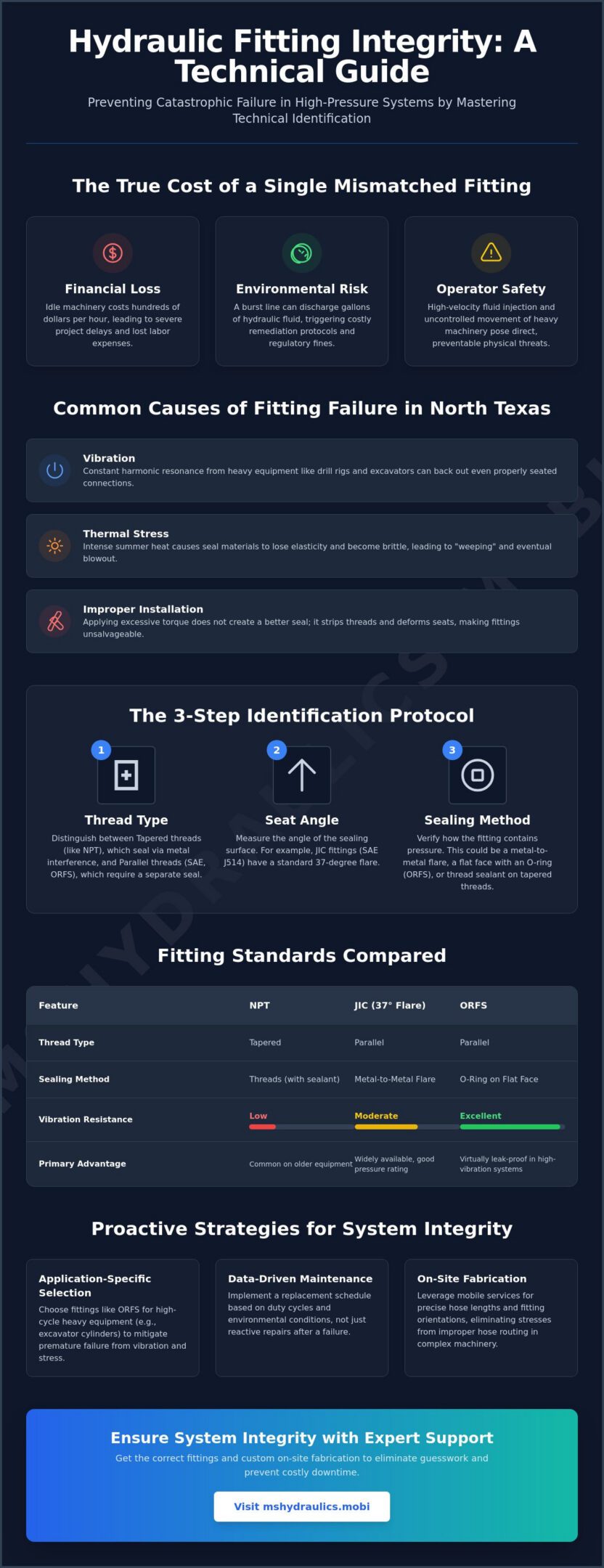
Vibration is a primary catalyst for failure on North Texas job sites. Heavy equipment, such as foundation drill rigs and large excavators, generates constant harmonic resonance. This movement can back out even properly seated connections if they aren’t matched with the correct locking mechanisms. Additionally, the local climate presents distinct thermal challenges. Intense summer heat causes seal materials to lose elasticity and become brittle. This degradation leads to “weeping” at the joint, a precursor to total seal blowout. Finally, improper installation remains a significant issue. Applying excessive torque doesn’t create a better seal; it strips threads and deforms seats, making the hydraulic hose fittings Fort Worth technicians encounter during repairs unsalvageable.
The True Cost of Incorrect Fitting Selection
The financial implications of a failed fitting extend far beyond the price of the replacement part. On large-scale construction projects, an idle machine can cost hundreds of dollars per hour in lost labor and delayed timelines. Beyond the balance sheet, environmental risks are substantial. A burst line can discharge gallons of hydraulic fluid into North Texas soil in seconds, triggering mandatory remediation protocols and potential regulatory fines. Most importantly, a fitting failure under load poses a direct physical threat to operators. High-velocity fluid injection and the sudden, uncontrolled movement of heavy mechanical arms are preventable hazards when the correct technical standards are strictly followed.
Technical Identification of Hydraulic Line Fittings
Accurate identification of hydraulic hose fittings in Fort Worth requires more than a visual inspection. It’s a three-step technical verification involving thread type, seat angle, and the sealing method. Technicians must first distinguish between tapered threads, like NPT, and parallel threads found in SAE or ORFS configurations. Tapered threads achieve a seal through metal-to-metal interference as the threads are tightened. In contrast, parallel threads serve only as a mechanical fastener, requiring a separate seat or O-ring to contain fluid pressure.
The SAE J514 standard defines the parameters for the Joint Industry Council (JIC) 37-degree flare fitting. This remains one of the most common connections in North Texas. However, modern machinery increasingly utilizes O-Ring Face Seal (ORFS) technology. ORFS fittings provide a superior seal in high-vibration environments by utilizing an elastomeric O-ring compressed against a flat metal face. This design eliminates the risk of flare cracking often seen in traditional metal-to-metal systems.
Measuring and Matching Fitting Threads
Field identification of hydraulic hose fittings Fort Worth technicians encounter demands precision tools. Using a pitch gauge and calipers is the only reliable way to determine thread count and diameter. A common point of confusion occurs between JIC 37-degree and SAE 45-degree flare fittings. While they appear similar, their seat angles are incompatible. Mixing them results in immediate leakage or component damage. Technicians also utilize the dash size system for standardization. A -08 fitting, for example, represents 8/16ths of an inch, or a 1/2 inch nominal diameter.
Sealing Technologies: Metal-to-Metal vs. O-Ring
Choosing between metal-to-metal and O-ring seals depends on the operational environment. Metal-to-metal seats are preferred for extreme temperature applications where elastomeric seals might fail. Conversely, O-ring seals are the standard for high-pressure, high-vibration equipment like skid steers. One frequent error in field maintenance is the reuse of O-rings. Once compressed, an O-ring loses its original geometry and may not provide a secondary seal if reinstalled. If you’re unsure of the specifications for your fleet, consulting a specialist in on-site diagnostic services can prevent costly assembly errors.
Application-Specific Fitting Selection for Heavy Equipment
Selecting hydraulic hose fittings Fort Worth operators can rely on involves analyzing the machine’s specific duty cycle. High-cycle applications, such as excavator bucket cylinders, subject fittings to relentless pressure pulses and mechanical vibration. These conditions demand a higher safety factor than stationary industrial systems. Adhering to established heavy equipment maintenance protocols ensures that fitting selection aligns with the original equipment manufacturer (OEM) performance curves. For specialized machinery like foundation drill rigs or high-tonnage industrial presses, the selection process must account for extreme peak pressures that can exceed standard operating ranges.
Following OSHA safety standards for hydraulic systems is mandatory for maintaining a safe job site. These guidelines emphasize that using incompatible fittings or failing to replace deteriorated components can lead to catastrophic injection injuries. Technical precision in the field prevents these risks while maintaining the machine’s intended hydraulic flow and thermal balance.
Excavator and Loader Hydraulic Connections
Earthmoving equipment frequently experiences hydraulic shock loads. These spikes occur when a bucket hits an obstruction or reaches the end of its stroke. Standard threaded connections might fail under these conditions. Code 61 and Code 62 flange fittings are the industry standard for these heavy-duty lines. Code 62 flanges are specifically rated for higher pressures, often up to 6,000 PSI. Proper alignment of these hydraulic hose fittings Fort Worth technicians install is essential. Utilizing swivel joints prevents hose twist, which is a leading cause of premature hose carcass failure in dynamic applications.
Agriculture and Specialty Equipment Fittings
In areas like Alvarado and Grandbury, mixed fleets are common. Standardizing fittings across different brands of tractors and implements simplifies inventory and reduces downtime. Quick-disconnect fitting selection is vital for operators who frequently swap attachments. Selecting the correct ISO standard for these couplers prevents cross-contamination and flow restriction between the power unit and the implement. Additionally, fittings used in agricultural applications must feature corrosion-resistant coatings to withstand exposure to fertilizers and pesticides. This technical foresight extends the service life of the connection and prevents the environmental hazards associated with slow, undetected leaks in the field.
Preventing System Failure: Maintenance and Replacement Protocols
Establishing a rigorous maintenance protocol for hydraulic hose fittings Fort Worth operations utilize is the most effective method for preventing unplanned downtime. Maintaining system integrity requires a methodical approach to component lifecycle management. For these critical interfaces, the transition from a functional part to a failure point is often subtle. A visual inspection checklist provides the first line of defense against system-wide contamination or pressure loss. Key indicators include localized fluid accumulation, visible oxidation on the fitting body, and evidence of thread galling.
Properly managing hydraulic hose fittings Fort Worth technicians encounter in the field involves more than just reactive fixes. Establishing a replacement schedule based on the machine’s specific duty cycle ensures that components are retired before they reach their fatigue limit. Before any physical inspection occurs, safety protocols must be strictly enforced. Technicians must depressurize the system completely to eliminate the risk of high-pressure fluid injection. Utilizing professional on-site diagnostic services allows for a deeper analysis of system health, identifying root causes like excessive vibration or pressure spikes that might be accelerating fitting wear.
Identifying the ‘Weeping’ Fitting
A “weeping” fitting is a technical red flag. It indicates that the primary sealing interface is compromised. While it’s tempting to simply tighten the connection, this often exacerbates the issue. If the leak is caused by a deformed seat or a cracked flare, additional torque will only lead to thread stripping or total component failure. Distinguishing between a loose fitting and a damaged sealing surface is critical. If fluid continues to bypass the seal after the initial torque check, the fitting must be replaced immediately to prevent a catastrophic blowout.
Environmental and Chemical Stress Factors
The North Texas climate imposes significant thermal stress on hydraulic systems. Extreme summer temperatures accelerate the hardening of elastomeric seals; this reduces their ability to conform to metal surfaces. On local construction sites, abrasive dust and limestone debris act as grinding media if they penetrate the fitting threads. Protecting these connections with specialized caps and sleeves is a necessary preventive measure. Implementing these safeguards ensures that environmental contaminants don’t compromise the mechanical bond between the hose and the machine.
For fleets operating in high-debris environments, scheduling a technical review through Ms. Hydraulics LLC ensures that every connection remains verified and secure.
Custom Hose Fabrication and Mobile Fitting Services in Fort Worth
While many providers rely on centralized retail counters, the technical requirements for hydraulic hose fittings Fort Worth industrial sites demand often require on-site intervention. Transporting a failed assembly to a remote facility introduces unnecessary downtime and the risk of measurement errors. On-site fabrication allows for exact precision in hose length and fitting orientation, ensuring the new assembly mirrors the original equipment manufacturer’s routing exactly. Ms. Hydraulics LLC maintains a comprehensive mobile inventory of JIC, NPT, and ORFS fittings, allowing for the immediate resolution of complex connection issues without the need for multiple trips or extended machinery idleness.
This capability is a core component of expert mobile hydraulic repair in Cleburne, TX. Our approach is rooted in technical integrity; we focus on repairing only the components necessary to restore full system functionality. This disciplined methodology ensures long-term reliability while maintaining cost efficiency for fleet managers. By conducting diagnostics at the machine’s location, we identify the specific stressors, such as improper routing or vibration, that led to the initial fitting failure.
On-Site Fabrication Process
The field fabrication process begins with precise measurement and cutting using portable, high-performance equipment calibrated to industrial standards. Technicians execute the crimp to specific OEM tolerances, ensuring the fitting is securely bonded to the hose carcass. A critical step in our protocol is the cleaning and capping of the new assembly. This prevents environmental contaminants from entering the hydraulic circuit during installation. Before the machine returns to service, a final pressure test verifies the connection’s integrity under actual operational loads, ensuring the system meets its rated PSI requirements.
Serving the Fort Worth and Johnson County Corridor
Our mobile units provide rapid response for emergency repairs across Crowley and Arlington. We also coordinate scheduled fleet maintenance for construction and industrial operations in Cleburne and the surrounding areas. For organizations requiring a reliable partner for hydraulic hose fittings Fort Worth, Ms. Hydraulics LLC provides the technical expertise and mobile infrastructure necessary to maintain peak operational availability. Contact Ms. Hydraulics LLC to discuss your specific custom fitting and hose solutions for your heavy equipment fleet.
Optimizing Operational Availability through Engineering Precision
Maintaining structural integrity in high-pressure systems requires more than simple parts procurement. It demands rigorous adherence to technical standards and a proactive approach to component wear. By implementing the identification protocols and maintenance schedules outlined in this guide, you can effectively mitigate the risks of catastrophic fluid loss and system contamination. Precision in selecting hydraulic hose fittings Fort Worth ensures that your machinery operates within its designed performance parameters, even under the extreme thermal and mechanical stresses common in North Texas.
Ms. Hydraulics LLC has been a dedicated partner for regional industrial players since 2021. We provide the technical expertise required for complex system maintenance, including expert on-site diagnostics and custom hose fabrication. Our mobile units are equipped to handle the specific demands of your fleet, ensuring that every repair adheres to the highest engineering standards. Request Mobile Hydraulic Fitting Service in Fort Worth today to secure your project’s timeline. We’re ready to support your most demanding high-pressure applications with disciplined, professional service.
Frequently Asked Questions
What are the most common hydraulic fitting types used in Fort Worth construction?
The most prevalent connections in North Texas include JIC 37-degree flare, NPT (National Pipe Tapered), and O-Ring Face Seal (ORFS) fittings. For heavy-duty earthmoving equipment, technicians frequently utilize Code 61 and Code 62 flange fittings to manage high-pressure lines. These standards ensure compatibility across a wide range of domestic and international machinery brands common on local job sites.
How do I identify the thread size of a hydraulic fitting in the field?
Accurate identification requires a digital caliper and a thread pitch gauge. Measure the outside diameter of the threads and then determine the number of threads per inch or the distance between threads for metric fittings. This data is then matched against a standardized dash size chart to identify hydraulic hose fittings Fort Worth operators need for their specific equipment.
Can I mix different brands of hydraulic hoses and fittings?
Mixing manufacturers is strongly discouraged by industry safety standards. Manufacturers engineer their hoses and fittings to work as an integrated system with specific crimp diameters and tolerances. Utilizing a fitting from one brand with a hose from another can lead to catastrophic failure, as the mechanical bond may not hold under peak pressure spikes.
What is the difference between JIC and SAE flare fittings?
The primary distinction lies in the seat angle. JIC fittings utilize a 37-degree flare, while SAE fittings feature a 45-degree flare. While they may appear similar to the naked eye, they are not compatible. Attempting to connect them will result in an improper seal and immediate leakage once the system is pressurized.
When should I choose O-Ring Face Seal (ORFS) fittings over JIC?
ORFS fittings are the preferred choice for high-vibration and high-pressure applications. Because they utilize an elastomeric O-ring compressed against a flat metal face, they provide a more resilient seal than the metal-to-metal contact of a JIC flare. This design significantly reduces the risk of leaks caused by harmonic resonance in modern heavy machinery.
Why is my hydraulic fitting still leaking after I tightened it?
A persistent leak usually indicates a damaged sealing surface, such as a cracked flare or a deformed seat. Over-tightening a leaking fitting often exacerbates the problem by stripping the threads or further crushing the metal seat. If a fitting continues to weep after reaching its specified torque, the component must be inspected for physical defects and replaced.
Does Ms. Hydraulics provide 24/7 mobile fitting repair in Fort Worth?
Ms. Hydraulics offers comprehensive mobile hydraulic repair and on-site fabrication throughout the region. You should contact our service team directly to verify current availability and response times for hydraulic hose fittings Fort Worth repairs. Our mobile units are equipped to handle a wide range of technical challenges directly at your project location.
How do I know if my hydraulic fitting needs a complete replacement or just a new seal?
Inspect the metal surfaces for any signs of pitting, erosion, or physical deformation. If the metal seat or threads are compromised, a complete replacement is mandatory to ensure system integrity. If the metal components are in perfect condition but the elastomeric O-ring is brittle or flattened, replacing the seal may be sufficient, though replacing the entire fitting is often a safer preventative measure.