Industrial Machinery Repair in Mansfield, TX: Expert Hydraulic & Heavy Equipment Services
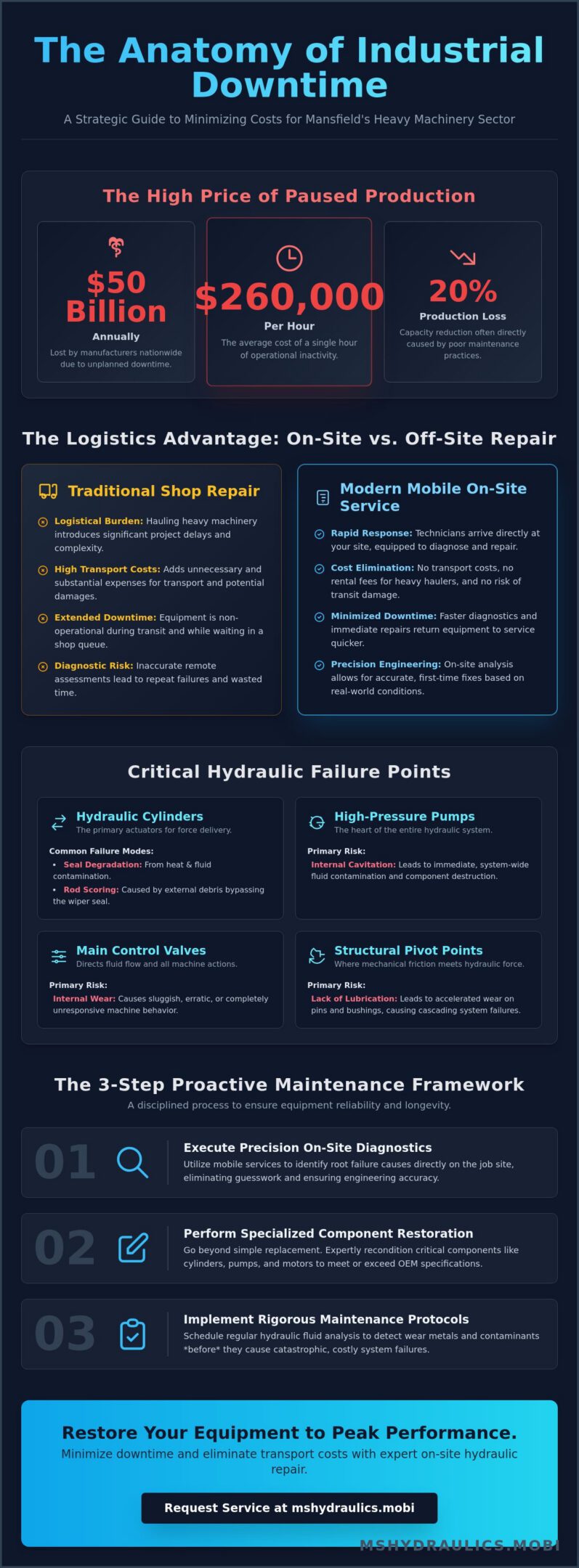
Unplanned downtime costs manufacturers approximately $50 billion annually, with GoCodes reporting an average cost of $260,000 per hour. For facilities operating in North Texas, these figures underscore the critical necessity for rapid, precise industrial machinery repair Mansfield. Equipment failure often results in cascading delays, yet the traditional approach of hauling heavy machinery to a distant shop introduces unnecessary transport costs and extended inactivity. You’ve likely experienced the frustration of inaccurate diagnostics that lead to repeat failures and additional logistical expenses.
This technical guide provides a strategic framework for minimizing downtime through specialized hydraulic restoration and mobile diagnostic services. We’ll examine how precision on-site maintenance and expert component reconditioning reduce logistical overhead while ensuring equipment returns to its verified operational status. By focusing on engineering expertise and mechanical parameters, you can eliminate the risks associated with equipment transport and restore your systems to peak performance specifications.
Key Takeaways
- Identify the logistical advantages of mobile repair strategies that eliminate the high transport costs and extended downtime associated with hauling equipment to a fixed shop.
- Analyze the specific mechanical failure modes of hydraulic cylinders, including seal degradation and rod scoring, to ensure precision restoration and component longevity.
- Execute a rapid return to operational status by utilizing specialized industrial machinery repair Mansfield services that prioritize on-site diagnostics and engineering accuracy.
- Implement rigorous maintenance protocols and hydraulic fluid analysis to detect wear metals and contaminants before they cause catastrophic system failures.
- Understand the technical requirements for expert hydraulic pump and motor repairs to maintain the performance standards of Mansfield’s heavy equipment fleets.
Industrial Machinery Repair in Mansfield: Minimizing Operational Downtime
Industrial machinery repair Mansfield involves the systematic restoration of high-pressure hydraulic systems and heavy mechanical assemblies to their engineered specifications. Within this technical discipline, repair isn’t merely a reactive measure to fix a broken component. It’s a precise process of identifying failure points in hydraulic pumps, valves, and cylinders to ensure the structural and operational integrity of the machine. In Mansfield’s industrial landscape, this specialized intervention is necessary for a wide array of equipment, including hydraulic presses, excavators, and heavy-duty material handlers.
Mansfield serves as a vital hub for the construction and agricultural sectors in North Texas. These industries provide the backbone of the local economy, but they remain vulnerable to the high costs of equipment failure. Research from GoCodes indicates that unplanned downtime costs manufacturers approximately $50 billion annually, with an average hourly cost reaching $260,000. When a primary excavator or an industrial press fails, the financial impact extends beyond the repair bill. Idle labor costs and the potential for missed project deadlines create a compounding deficit that can threaten the stability of a commercial enterprise.
The Economic Impact of Machinery Failure in North Texas
Quantifying the secondary losses of equipment failure is essential for maintaining project margins. In the DFW-Mansfield corridor, the speed of service directly correlates to financial recovery. A machine sitting idle on a job site represents lost revenue and potential liquidated damages from contract delays. Effective maintenance strategies protect these margins by ensuring that machinery remains in an operational state. For 2026 industrial operations, reliable industrial machinery repair Mansfield becomes the primary defense against the 20% reduction in production capacity that often accompanies poor maintenance practices.
Key Components of Industrial Mechanical Systems
Modern industrial machinery relies on a complex interplay between rigid mechanical structures and fluid power. This relationship means that localized wear on a single pin or bushing can lead to catastrophic hydraulic seal failure. Technicians must possess specific metallurgical knowledge and an understanding of fluid dynamics to diagnose these issues accurately. Identifying ‘critical path’ machinery—the equipment whose failure would halt an entire production line or job site—is a fundamental part of standardizing maintenance protocols across a fleet. Focus is typically placed on the following components:
- Hydraulic Cylinders: The primary actuators for force delivery, often subject to rod scoring and seal bypass.
- Main Control Valves: Critical for directing fluid flow; wear here leads to sluggish or erratic machine response.
- High-Pressure Pumps: The heart of the hydraulic system where internal cavitation can cause immediate system-wide contamination.
- Structural Pivot Points: Areas where mechanical friction meets hydraulic force, requiring consistent lubrication and monitoring.
By addressing these components through a disciplined repair framework, Mansfield operators can ensure their heavy equipment maintains the reliability required for large-scale industrial projects.
Specialized Hydraulic Component Restoration and Rebuilds
Precision is the standard for industrial machinery repair Mansfield when dealing with high-pressure fluid power. Hydraulic components are engineered to operate within extremely tight tolerances, where even microscopic deviations can lead to significant efficiency loss or total system failure. Restoring these components requires a disciplined approach to disassembly, inspection, and re-engineering. This process focuses on three primary areas: cylinders, pumps and motors, and control valves.
Hydraulic cylinders often fail due to three distinct modes: seal degradation, rod scoring, and barrel expansion. Seal failure is typically the result of thermal cycling or fluid contamination, while rod scoring occurs when external debris bypasses the wiper seal. A successful heavy equipment cylinder rebuild in Texas involves more than just replacing soft goods. It requires a comprehensive evaluation of the rod’s surface finish and the barrel’s internal diameter to ensure they meet original equipment manufacturer (OEM) specifications.
Cylinder Rebuilding: A Precise Engineering Process
The restoration process begins with strict disassembly and inspection protocols. Technicians measure the cylinder barrel for out-of-roundness and taper using precision bore gauges. Rod polishing and honing are critical steps; they restore the cross-hatch pattern necessary for maintaining a consistent oil film, which directly extends seal longevity. Once reassembled, final pressure testing is conducted. This verification step ensures the unit can withstand maximum load requirements without bypass leakage, confirming the integrity of the restored hydraulic cylinder.
Hydraulic Pump and Motor Diagnostics
Identifying internal leakage and cavitation is essential before these issues lead to catastrophic failure. Cavitation, caused by air entering the fluid stream or restricted suction lines, can erode internal metal surfaces in a matter of hours. During diagnostics, pressure testing reveals if a pump or motor is maintaining its volumetric efficiency. High-pressure industrial applications demand the use of OEM-spec parts to ensure the component survives the rigors of heavy-duty cycles. Restoring hydraulic flow to factory specifications often requires replacing wear plates, pistons, or vane sets that have exceeded their service limits.
Hydraulic valve repair plays an equally vital role in maintaining system control. Worn spools or weakened springs can cause erratic machine movement, posing a risk to both the equipment and the operator. Adhering to OSHA safety standards for heavy machinery requires that all control systems function with absolute predictability. Specialized industrial machinery repair Mansfield ensures that every valve, pump, and cylinder is verified for performance before it returns to the field.
Mobile vs. Shop-Based Repair: The Mansfield Logistics Advantage
Moving a 40-ton excavator or a stationary industrial press to a central facility isn’t just a physical challenge; it’s a significant financial burden. Heavy haul permits, specialized trailers, and fuel surcharges increase the total cost of ownership before a single mechanical intervention occurs. For many operators, expert mobile hydraulic repair in Cleburne and Mansfield offers a superior alternative by bringing precision engineering directly to the job site. This model eliminates transport logistics and facilitates industrial machinery repair Mansfield that occurs in the machine’s actual working environment.
On-site diagnostic services allow technicians to observe equipment performance under real-world load conditions. Identifying the root cause of a pressure drop or erratic actuator movement is more accurate when the machine is fully assembled. This prevents the inefficient practice of dismantling an entire system to find a localized fault. Precise troubleshooting ensures that only the failing component, such as a hydraulic valve or pump, is targeted for repair, which maintains the integrity of the surrounding mechanical systems.
When to Choose On-Site Mobile Repair
Non-ambulatory machines or those that exceed standard transport dimensions represent a high risk for secondary damage during hauling. Seized tracks or compromised structural pivots can lead to frame stress if the machine is forced onto a lowboy trailer. Mobile repair is also the preferred choice for hydraulic hose fabrication. Instead of waiting for pre-made assemblies to arrive from a warehouse, technicians fabricate high-pressure hoses on-site to exact specifications. This immediate capability is essential for industrial machinery repair Mansfield when project deadlines are at risk.
The Efficiency of Modern Mobile Tooling
In 2026, mobile service trucks operate as fully-equipped satellite shops. They feature advanced diagnostic software that interfaces directly with machine telematics, allowing for rapid troubleshooting of electronic-over-hydraulic control systems. These units also carry the necessary tooling for on-site hydraulic cylinder removal and pump testing. Integrated spill containment and fluid management systems ensure that all repairs remain compliant with environmental standards. This level of technical readiness transforms the job site into a controlled environment, ensuring that precision repairs are executed without the need for shop-based overhead.
Critical Maintenance Protocols for Heavy Machinery Fleets
Maintaining a fleet’s operational readiness requires more than reactive troubleshooting. It demands a rigorous, data-driven approach to component preservation. For operators in North Texas, implementing a formal heavy equipment maintenance schedule is the primary method for mitigating the high costs of industrial machinery repair Mansfield. Transitioning from a ‘run-to-fail’ model to a structured preventative framework ensures that mechanical systems operate within their engineered parameters for longer durations. This strategy reduces the frequency of emergency interventions and allows for planned repairs during scheduled downtime.
A preventative approach focuses on identifying minor issues before they escalate into catastrophic failures. Run-to-fail strategies often result in collateral damage; for example, a failed pump can send metal shards throughout the entire hydraulic circuit. This requires an extensive flushing process and the replacement of multiple valves and cylinders. By adhering to a disciplined maintenance protocol, you protect the core assets of your industrial operation and maintain consistent project timelines.
The Role of Fluid Analysis in Predictive Maintenance
Fluid analysis serves as the diagnostic foundation for predictive maintenance. By analyzing hydraulic oil for microscopic wear metals such as iron from pump gears, copper from bushings, and chromium from cylinder rods, technicians can identify internal component degradation before a total system failure occurs. Contaminants like water or silica accelerate seal wear and pump cavitation. Establishing a baseline for fluid health allows for the identification of trends, ensuring that fluid cleanliness levels remain consistent with international standards for high-pressure systems. This data-driven approach transforms maintenance from a guessing game into a precise engineering verification.
Scheduled Inspections for High-Use Machinery
Daily visual inspections are necessary to identify external signs of hydraulic integrity loss. Operators should be trained to recognize weeping fittings, frayed hose reinforcement, and scoring on cylinder rods. These issues often precede catastrophic leaks that can halt production. Proper lubrication of mechanical joints and pivot points reduces friction-induced heat, which can otherwise degrade hydraulic fluid properties. A consistent inspection checklist includes several critical points:
- Hose Routing: Verifying that high-pressure lines aren’t rubbing against structural frames to prevent abrasion.
- Fluid Condition: Checking reservoirs for signs of aeration, which appears as foam, or oxidation, which darkens the oil.
- Cylinder Rods: Inspecting for nicks or scratches that can tear internal seals during the stroke cycle.
- Valve Response: Testing for lag or sticking in the control levers, which suggests internal spool wear.
If your fleet requires professional verification of its hydraulic systems to prevent unplanned downtime, consider scheduling on-site diagnostic services to identify hidden wear patterns before they cause a failure.
Ms. Hydraulics: Precision Engineering for Mansfield’s Industrial Sector
Ms. Hydraulics provides the technical bridge between field necessity and shop-level precision. Our framework for industrial machinery repair Mansfield prioritizes engineering accuracy over temporary fixes. Through specialized on-site diagnostic services, we identify mechanical and hydraulic deviations at the source. This discipline ensures that every intervention meets the rigorous standards required by international industrial players operating in the DFW region. By deploying expert technicians directly to the machine’s location, we maintain the technical integrity of complex systems without the logistical delays of off-site transport.
Our commitment to technical excellence is reflected in our engineering-led approach. We don’t simply replace parts; we analyze failure modes to prevent recurrence. This objective methodology builds trust through factual accuracy and verified performance data. Whether the issue involves a drifting hydraulic cylinder or a loss of volumetric efficiency in a high-pressure pump, our team applies a disciplined diagnostic process to restore the equipment to its original design parameters.
Custom Hydraulic Hose Solutions in Mansfield
Reducing downtime requires the immediate availability of critical components. Our mobile hydraulic repair units feature integrated hose fabrication capabilities, allowing for the production of custom assemblies on the job site. We use only high-pressure rated fittings and hoses that meet or exceed industry standards for burst pressure and impulse cycles. Standardizing these assemblies across a fleet ensures reliability and simplifies future maintenance requirements. This on-site capability eliminates the need to source pre-made parts, which often leads to extended inactivity for critical path machinery.
Partnering for Industrial Success
Ms. Hydraulics functions as a serious partner for Mansfield’s construction, agricultural, and manufacturing sectors. Our approach combines transparent communication with a focus on physical and mechanical parameters. We serve a broad geographic area including Mansfield, Cleburne, and the greater North Texas region, providing a reliable resource for both emergency repairs and scheduled maintenance. Our service portfolio is strictly focused on high-value industrial needs:
- Hydraulic Component Repair: Expert restoration of valves, motors, and pumps to factory specifications.
- Cylinder Rebuilds: Precision honing and sealing for heavy-duty actuators.
- Mobile Field Service: On-site diagnostics and repair to minimize transport overhead.
- Hose Fabrication: Immediate production of high-pressure lines to exact tolerances.
For operations requiring professional industrial machinery repair Mansfield, Ms. Hydraulics offers the technical expertise and disciplined response necessary to protect project margins. Contact our team to coordinate scheduled maintenance or to request a diagnostic assessment of your heavy equipment fleet.
Optimizing Equipment Reliability and Performance
Maintaining the operational integrity of a heavy equipment fleet requires more than routine checks; it demands a sophisticated understanding of hydraulic parameters and structural mechanical loads. By integrating rigorous maintenance protocols and precision restoration techniques, Mansfield operators can significantly reduce the financial impact of unplanned downtime. The transition from reactive repairs to a structured diagnostic framework ensures that each component performs according to its original engineering specifications.
Ms. Hydraulics remains dedicated to providing the technical expertise necessary for complex industrial machinery repair Mansfield. Our specialized mobile hydraulic units and on-site diagnostic experts allow for the immediate identification of failure modes. With custom hose fabrication capabilities available directly at your location, we eliminate the delays associated with sourcing external parts. This objective approach to mechanical service protects project margins and extends the service life of your most critical assets.
Ready to restore your fleet to peak efficiency? Request Expert Industrial Machinery Repair in Mansfield to verify your equipment’s performance today. We look forward to supporting your long-term operational success.
Frequently Asked Questions
What types of industrial machinery do you repair in Mansfield?
We specialize in the repair of hydraulic-intensive equipment used across the construction, agricultural, and manufacturing sectors. This includes excavators, dozers, track loaders, and industrial presses, as well as specialized material handling units. Our focus is on the restoration of hydraulic systems and heavy mechanical components to ensure they meet original engineering specifications.
How quickly can a mobile hydraulic technician reach my job site in Mansfield?
Response times for a mobile technician depend on current scheduling and the specific location of your equipment. Our mobile units are positioned to provide industrial machinery repair Mansfield and throughout the North Texas region. You should contact our office directly to verify the current dispatch queue and coordinate the fastest possible arrival to your site.
Is it better to rebuild or replace a failing hydraulic cylinder?
Rebuilding is often the more efficient and cost-effective strategy if the cylinder barrel and rod remain within salvageable engineering tolerances. A precision rebuild involves replacing all seals and polishing the rod to restore the cross-hatch pattern necessary for fluid retention. If the structural integrity of the barrel is compromised, our technicians will evaluate if a replacement is required for safety.
Do you provide 24/7 emergency hydraulic repair for industrial clients?
You’ll need to check our current operational hours and technician availability for any emergency repair requirements. While we prioritize rapid response to minimize downtime for industrial machinery repair Mansfield, we don’t offer guaranteed 24/7 or after-hours service. Our team manages scheduling based on current capacity to ensure every client receives a high level of technical attention.
Can you fabricate custom hydraulic hoses on-site in Mansfield?
Yes, our mobile service trucks are equipped with specialized tooling for custom hydraulic hose fabrication directly at your location. This on-site capability allows us to produce high-pressure assemblies that match your machine’s exact requirements without the need for pre-made parts. It’s a critical service for reducing the duration of unplanned equipment inactivity.
What are the most common causes of hydraulic system failure in heavy equipment?
Fluid contamination is the primary cause of system failure, as microscopic particles can erode pump internals and damage valve spools. Other common failure modes include excessive heat, which degrades seal integrity, and aeration, which causes pump cavitation. Regular inspection of these mechanical parameters is necessary to prevent the sudden loss of hydraulic power in the field.
How does hydraulic fluid analysis prevent major machinery breakdowns?
Fluid analysis identifies wear metals and contaminants that indicate internal component degradation before a total system failure occurs. By monitoring levels of iron, copper, or chromium, we can determine which parts are exceeding their service limits. This predictive approach allows you to schedule maintenance before a minor wear issue turns into a catastrophic breakdown.
What information should I have ready when calling for industrial machinery repair?
Please provide the machine’s make and model, the specific symptoms you’re observing, and the location of the failing component. Details such as erratic actuator movement, visible fluid leaks, or unusual hydraulic noises help our technicians prepare the correct diagnostic tools. Having this data ready ensures a more efficient assessment when we arrive for your industrial machinery repair Mansfield.