Maintaining and Optimizing Hydraulic Equipment in Cleburne & North Texas
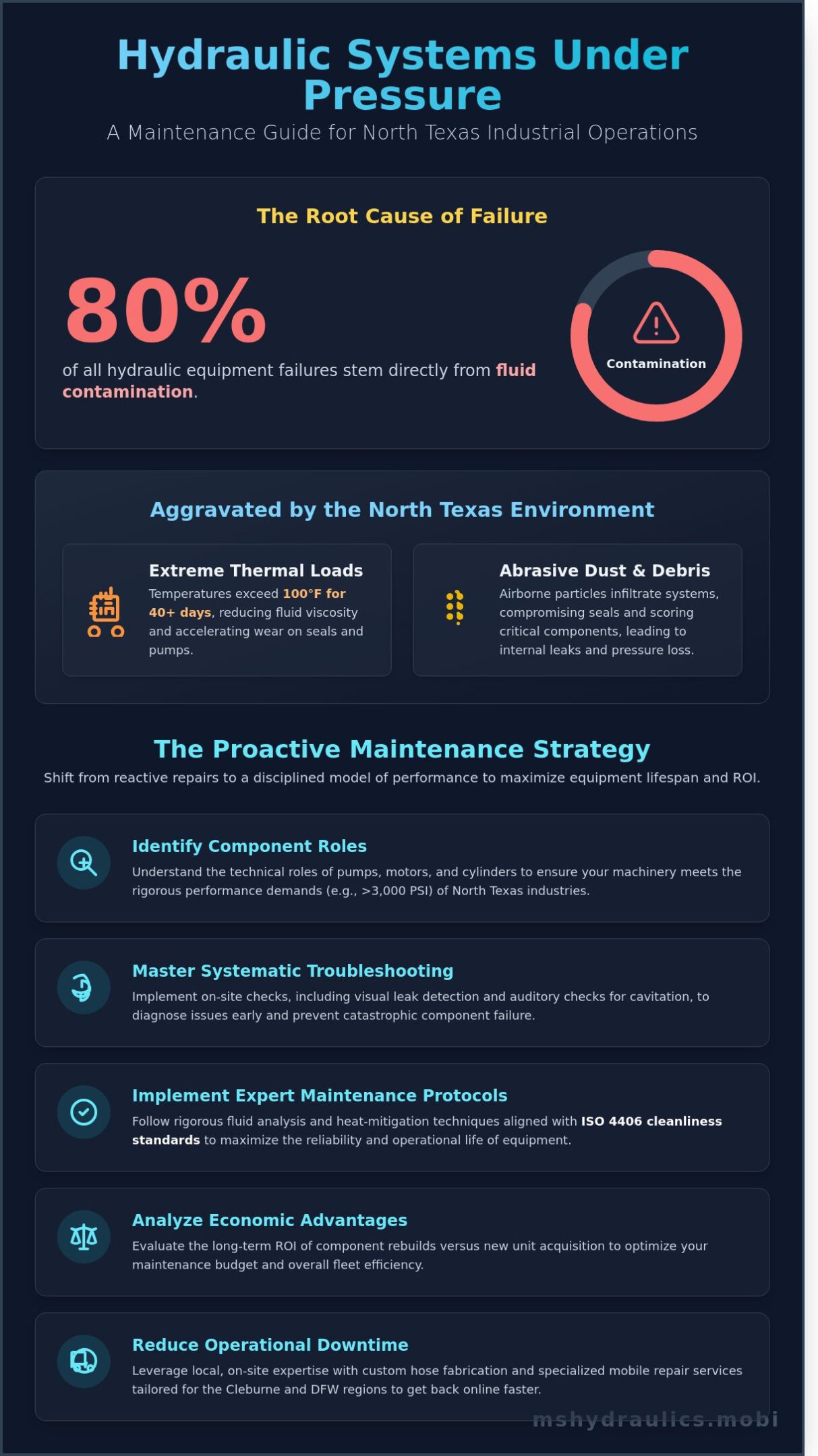
Did you know that 80% of mechanical failures in hydraulic equipment stem from fluid contamination, a risk that intensifies when temperatures in Cleburne exceed 100 degrees for more than 40 days a year? In the North Texas industrial landscape, the combination of extreme thermal loads and abrasive dust creates a volatile environment for high-pressure systems. You’ve likely seen how a single compromised seal can halt a project, leading to significant revenue loss during peak hours. It’s a challenge that requires more than just basic oversight; it demands a technical strategy rooted in engineering precision.
This guide provides the specific maintenance protocols and optimization strategies needed to maximize the lifespan of your machinery in these demanding conditions. You’ll discover how to implement rigorous fluid analysis and heat-mitigation techniques that align with ISO 4406 cleanliness standards. We’re examining the shift from reactive repairs to a disciplined model of performance that ensures your fleet remains operational when it matters most. By leveraging local on-site expertise, you can reduce downtime and maintain the high torque and pressure ratings your heavy-duty applications require.
Key Takeaways
- Identify the technical roles of pumps and cylinders to ensure your machinery meets the rigorous performance demands of North Texas industrial sectors.
- Master systematic troubleshooting techniques, including visual leak detection and auditory checks for cavitation, to prevent catastrophic component failure.
- Implement expert maintenance protocols designed to maximize the reliability and operational life of your hydraulic equipment in high-pressure environments.
- Analyze the economic advantages of component rebuilds versus new unit acquisition to optimize your long-term maintenance ROI and fleet efficiency.
- Reduce operational downtime by leveraging local custom hose fabrication and specialized mobile repair services tailored for the Cleburne and DFW regions.
Essential Hydraulic Equipment for North Texas Industries
Industrial operations in Cleburne and the surrounding North Texas region depend on the mechanical efficiency of pressurized systems to manage heavy workloads. In sectors like construction, agriculture, and energy extraction, these systems provide the necessary power density to move massive loads with precision. Hydraulic equipment is a system of pressurized fluid components designed for high-torque work. Without these high-pressure configurations, the heavy machinery used in local drilling and earthmoving wouldn’t have the force required for North Texas soil conditions.
The Mechanics of Power: How Hydraulic Systems Work
The operational foundation of modern industrial machinery rests on Pascal’s Law. This physical principle dictates that pressure applied to a confined liquid is transmitted equally in all directions, allowing for significant force multiplication. Within a standard circuit, a pump converts mechanical energy into fluid power. This pressurized fluid travels through valves and hoses to reach actuators, which then convert that energy back into linear or rotary motion. This process enables Hydraulic machinery to perform tasks that exceed the capabilities of purely mechanical or electrical drives. Reliability depends on maintaining specific parameters like displacement and system pressure to ensure consistent output during 12-hour shifts.
Common Hydraulic Equipment in Johnson County
Johnson County contractors rely on specialized machinery to handle regional geological challenges. The soil profiles in Alvarado and Grandbury often feature heavy clay and limestone layers that require high breakout forces. Excavators, skid steers, and drill rigs are the primary assets utilizing these systems. For example, a standard skid steer might operate at 3,000 PSI, but specialized attachments for land clearing often require high-flow kits to maintain torque. Drill rigs operating across North Texas utilize custom hydraulic solutions to manage the extreme rotational resistance encountered during deep-well penetration. These rigs must adhere to strict ISO standards to prevent catastrophic component failure under load.
Environmental factors in North Texas create unique maintenance demands. Summer temperatures frequently exceed 100 degrees Fahrenheit for 30 or more consecutive days. This extreme heat reduces the viscosity of hydraulic fluids, which leads to increased friction and accelerated wear on internal seals. Operators must monitor fluid levels and thermal stability to prevent a drop in volumetric efficiency. Using the correct ISO VG 46 or 68 oil is critical for equipment longevity in these conditions. If the fluid thins too much, it won’t provide the lubrication film necessary to protect pumps and motors from premature failure.
- Excavators: Critical for trenching and foundation work in dense clay.
- Skid Steers: Essential for versatile material handling and site preparation.
- Drill Rigs: High-torque systems designed for the regional energy sector.
Key Components: From Hydraulic Pumps to Custom Hoses
A hydraulic system functions as a cohesive unit where each component must meet specific engineering tolerances to ensure operational longevity. The pump serves as the “heart” of the hydraulic equipment, converting mechanical energy into hydraulic flow. Performance is defined by displacement, measured in cubic inches per revolution (CIR), and maximum pressure ratings that frequently exceed 3,000 PSI in heavy industrial applications. If the pump fails to maintain these parameters, the entire system loses its ability to perform work efficiently.
Cylinders act as the “muscle” of the machinery. These components convert fluid pressure into linear movement, allowing for the lifting and pushing of massive loads. Control valves and reservoirs manage the flow direction and thermal regulation. The reservoir isn’t just a storage tank; it’s a critical cooling area where air and moisture separate from the fluid. Because these systems operate under extreme tension, understanding the Safe Use of Hydraulic Systems is critical for preventing high-pressure injection injuries during maintenance or troubleshooting.
Precision Components: Pumps, Motors, and Valves
The choice between pump types depends on the specific demands of the machinery. Gear pumps are valued for their durability in rugged environments. Piston pumps offer higher volumetric efficiency and are necessary for variable displacement needs. Vane pumps provide quieter operation at lower pressures. Proper hydraulic service ensures that valve calibrations remain within manufacturer specifications. This prevents erratic machine behavior and protects the system from pressure spikes that could lead to catastrophic failure.
The Critical Role of Hydraulic Hoses and Fittings
Hoses are the most vulnerable part of the hydraulic equipment ecosystem. They are the “veins” that transport pressurized fluid. Custom fabrication is superior to “off-the-shelf” solutions because it accounts for specific bend radii and the abrasion resistance required for Texas-based fleets. Using a hose with an incorrect pressure rating or length can lead to premature wear or bursts.
- JIC (Joint Industry Council): Common 37-degree flare fittings used in various industrial applications.
- NPT (National Pipe Thread): Tapered threads that create a seal through metal-to-metal contact.
- ORFS (O-Ring Face Seal): These fittings use an elastomeric seal to prevent leaks in high-vibration environments.
Identifying these standards precisely is mandatory for maintaining system integrity. For immediate on-site needs, seeking hydraulic line repair near me minimizes downtime by providing exact-match replacements. Optimizing these components requires a partner who understands the mechanical demands of the North Texas terrain. You can view our full range of engineering solutions to learn more about system upgrades and preventative maintenance schedules.
How to Troubleshoot Hydraulic Equipment Failures on the Job Site
Systematic troubleshooting on the job site prevents minor component wear from escalating into total system failure. Operators should follow a rigorous five-step diagnostic protocol to maintain hydraulic equipment performance and longevity. First, perform a visual inspection to identify external fluid leaks or hose abrasions. Even small puddles indicate a breach in system integrity that compromises pressure. Second, listen for auditory cues. Pump cavitation produces a distinct sound similar to marbles rattling in a can, while valve chatter suggests erratic flow or mechanical fatigue within the assembly.
Third, monitor operating temperatures using infrared tools. Spikes above 180 degrees Fahrenheit often signal internal bypass or fluid degradation. Understanding the fundamentals of hydraulic systems is essential for interpreting these thermal signatures correctly. Fourth, utilize pressure gauges to isolate failing cylinders or pumps by comparing actual output against the manufacturer’s technical specifications. Finally, document every failure pattern. Tracking these variables helps identify recurring issues and technical trends before they cause unscheduled downtime.
Identifying the “Silent Killers” of Hydraulic Systems
Fluid contamination remains the primary threat in the dusty, high-heat environments of North Texas. Fine particulates enter through worn seals or during fluid changes; these particles act as an abrasive that erodes internal surfaces. It’s a proven industry fact that 70-80% of hydraulic failures are linked to fluid contamination. Aeration and cavitation also pose severe risks to hardware. When air enters the suction line, it compresses and collapses within the pump, causing micro-explosions that pit metal surfaces and destroy components from the inside out.
Field Diagnostics for Cleburne Operators
Every operator in the Cleburne area should carry a basic diagnostic kit containing an infrared thermometer and high-pressure gauges. These tools provide objective data that replaces guesswork with engineering facts. If you detect a sudden drop in cycle speed or hear metallic grinding, stop operation immediately. Continuing to run a compromised system leads to catastrophic “metal-on-metal” failure, which typically requires a full system flush and multiple component replacements. For complex issues that require specialized flow meters or electronic diagnostics, utilizing On-Site Diagnostic Services ensures that hydraulic equipment is repaired to precision standards without the need for costly transport or extended delays.
Repair vs. Replace: Evaluating Your Hydraulic Component Strategy
Choosing between restoration and procurement requires a rigorous analysis of lifecycle costs. For most operators of hydraulic equipment in Cleburne, the decision hinges on the ratio of restoration cost to new unit acquisition. Industry standards suggest that if a rebuild exceeds 60% of the cost of a new component, replacement becomes the logical engineering choice. However, financial metrics aren’t the only variables. Lead times play a critical role in maintaining project schedules. While OEM parts may face shipping delays of 10 to 20 business days, local fabrication and machining facilities often complete a full restoration within 48 to 72 hours. This reduction in downtime directly impacts the operational efficiency of North Texas industrial projects.
Environmental benefits also support the case for restoration. Rebuilding a cylinder consumes approximately 85% less energy than manufacturing a new unit from raw ore. By focusing on professional component restoration, fleet managers reduce their carbon footprint while maintaining high-performance standards. This approach aligns with modern sustainability goals without compromising the mechanical output required for heavy-duty applications.
The Technical Case for Cylinder Rebuilds
A professional rebuild involves more than just a seal swap. The process begins with honing the barrel to remove minor scoring and polishing the rod to a mirror finish. This restores the seal interface to original ISO specifications, ensuring optimal volumetric efficiency. Precision machining ensures that tolerances remain within the 0.001 to 0.003 inch range required for high-pressure applications. For a deeper look at the engineering requirements, consult the heavy equipment cylinder rebuild Texas guide. These technical procedures extend the service life of hydraulic equipment by restoring the component’s ability to handle rated pressure and torque without internal bypass.
When Replacement is the Only Safe Option
Structural failure dictates immediate replacement. Cracked housings or severe internal scoring that exceeds 0.020 inches compromise the component’s pressure-holding capacity. If the structural integrity of the barrel is lost, a rebuild is no longer a safe or viable option. Cleburne businesses often opt for factory-new “drop-in” replacements when the labor hours required for extensive machining exceed the price of a new unit. Safety remains the primary metric; a compromised cylinder rod can fail catastrophically under load, leading to equipment damage or site injuries. Engineering teams must evaluate the depth of chrome damage and the roundness of the barrel before committing to a repair strategy.
Assess your fleet’s current needs to request a technical evaluation for your hydraulic components from our engineering team.
Professional Hydraulic Equipment Services in Cleburne and DFW
Ms. Hydraulics provides specialized mobile repair solutions designed for the rigorous demands of Johnson County’s industrial sector. Our service model prioritizes technical precision and rapid deployment. We eliminate the standard 48-hour wait times often associated with traditional brick and mortar shops. By deploying fully equipped service units, we facilitate custom hose fabrication directly at your location. This on-site manufacturing capability reduces equipment downtime by an average of 65% compared to off-site sourcing. Our comprehensive maintenance plans target the specific failure points of high-pressure systems used in construction and industrial fleets. Operators in Crowley, Mansfield, or Waxahachie can schedule diagnostic visits to assess system performance and prevent catastrophic component failure before it occurs.
Mobile Repair: Bringing the Shop to the Job Site
Transporting oversized machinery to a central facility often incurs logistical costs exceeding $500 per haul for specialized towing. Our mobile units eliminate these expenses by bringing industrial-grade tools and diagnostic software to the job site. We equip our technicians for 24/7 emergency response to ensure that hydraulic equipment remains operational during critical production windows. For detailed service area coverage and response protocols, refer to our mobile hydraulic repair Cleburne TX pillar page. We maintain a fleet of service vehicles capable of handling high-torque and high-pressure system failures on demand. This approach minimizes the secondary costs of idle labor and missed project deadlines.
Integrity and Expertise in North Texas
Our engineering-grade repairs focus on restoring OEM specifications to ensure long-term reliability. We utilize ISO-certified components and rigorous testing protocols to validate every repair. By supporting the local economy through dedicated service to North Texas businesses, we help maintain the region’s industrial infrastructure. Our commitment to technical excellence ensures that your hydraulic equipment operates at peak efficiency under maximum load conditions. This disciplined approach to mechanical service creates a stable foundation for fleet managers who require predictable performance. We don’t just patch leaks; we optimize entire systems for durability. Contact Ms. Hydraulics for expert equipment repair today to secure your fleet’s performance and longevity.
Secure the Reliability of Your North Texas Operations
Maintaining peak performance for your hydraulic equipment requires a disciplined approach to mechanical integrity and proactive component management. Industrial operations across the 9,275 square miles of the Dallas-Fort Worth Metroplex rely on the precision of pumps, cylinders, and hoses to meet rigorous production schedules. It’s essential to implement a data-driven strategy for troubleshooting and evaluating component lifecycles. Whether you’re managing a fleet in Cleburne or a manufacturing plant in Fort Worth, technical precision remains the standard for avoiding costly downtime. Our team delivers on-site mobile diagnostics and repair directly to your location, ensuring your systems meet engineering specifications without delay. We specialize in custom hydraulic hose fabrication and expert cylinder rebuilds utilizing precision machining to restore original equipment manufacturer (OEM) performance levels. You don’t have to let mechanical failures dictate your project timeline. Trust in technical expertise to keep your machinery moving with efficiency and power.
Get Your Equipment Back to Work with Ms. Hydraulics
Frequently Asked Questions
What are the most common signs of hydraulic equipment failure?
The most common signs of hydraulic equipment failure include increased fluid temperatures, slow cycle times, and unusual auditory signatures. When internal temperatures exceed 180°F, the fluid’s viscosity drops, which damages seals and accelerates component wear. Industry data suggests that 80% of system failures originate from fluid contamination. If you notice a 15% decrease in actuator speed, it’s likely a sign of internal leakage or pump inefficiency.
How often should I change the hydraulic fluid in my heavy equipment?
You should typically change the hydraulic fluid in your heavy equipment every 1,000 to 2,000 operating hours, depending on the manufacturer’s specifications. Following ISO 4406 cleanliness standards is vital for maintaining system integrity. If a laboratory analysis shows a particle count exceeding the 18/16/13 level, you must replace the fluid immediately. Regular sampling every 500 hours ensures you don’t compromise expensive components like piston pumps or directional valves.
Is it better to rebuild or replace a leaking hydraulic cylinder?
It’s better to rebuild a leaking hydraulic cylinder if the internal bore and piston rod are within the original manufacturer’s tolerances. You should replace the unit if the cylinder barrel has scoring deeper than 0.010 inches or if the rod is bent beyond 0.002 inches per foot. Rebuilding with high-quality seals often restores 100% of the original performance. However, structural damage to the head or cap usually necessitates a full replacement.
Can you fabricate custom hydraulic hoses on-site in Cleburne?
MS Hydraulics provides on-site fabrication for custom hoses at our Cleburne facility to minimize your operational downtime. Our technicians assemble hoses that meet or exceed SAE J517 standards for various hydraulic equipment configurations. We maintain an inventory of multi-spiral and wire-braid hoses capable of handling pressures up to 6,000 PSI. Having these components built locally ensures a precise fit and immediate return to service for North Texas fleets.
What causes a hydraulic pump to make a whining or growling noise?
A hydraulic pump makes a whining or growling noise due to either aeration or cavitation within the system. Cavitation occurs when the pump can’t get enough fluid, creating vacuum bubbles that implode and erode metal surfaces. Aeration happens when air enters the suction line, often through a loose fitting or damaged shaft seal. These conditions can destroy a pump in less than 30 minutes if you don’t address the root cause promptly.
How does the North Texas heat affect my hydraulic system performance?
North Texas heat affects your system by significantly reducing the viscosity of the hydraulic oil, which leads to increased internal leakage and wear. When ambient temperatures reach 105°F in Cleburne, the operating temperature of the fluid can easily climb past the safe threshold of 180°F. This thermal stress degrades the chemical additives in the oil by 50% for every 18°F increase above its recommended operating limit.
Do you provide emergency hydraulic repair services in the DFW area?
We provide 24/7 emergency hydraulic repair services across the DFW Metroplex to support critical industrial and construction operations. Our mobile units are equipped to handle urgent failures, aiming for a response time that keeps project delays to a minimum. We understand that a single hour of downtime can cost a large-scale earthmoving operation thousands in lost productivity. Our technicians are certified to handle high-pressure systems and complex diagnostic tasks on-site.
What information do I need to provide for a custom hose assembly?
To create a custom hose assembly, you must provide the STAMPED specifications: Size, Temperature, Application, Material, Pressure, Ends, and Delivery. Specifically, we need the dash size, measured in 1/16th inch increments, and the maximum operating pressure in PSI. Identifying the specific thread type, such as JIC 37-degree or NPT, is essential for a leak-free connection. Providing the exact overall length ensures the hose won’t be under tension during operation.