Professional Hydraulic Hose Repair Near Me: The 2026 Cleburne & North Texas Field Guide
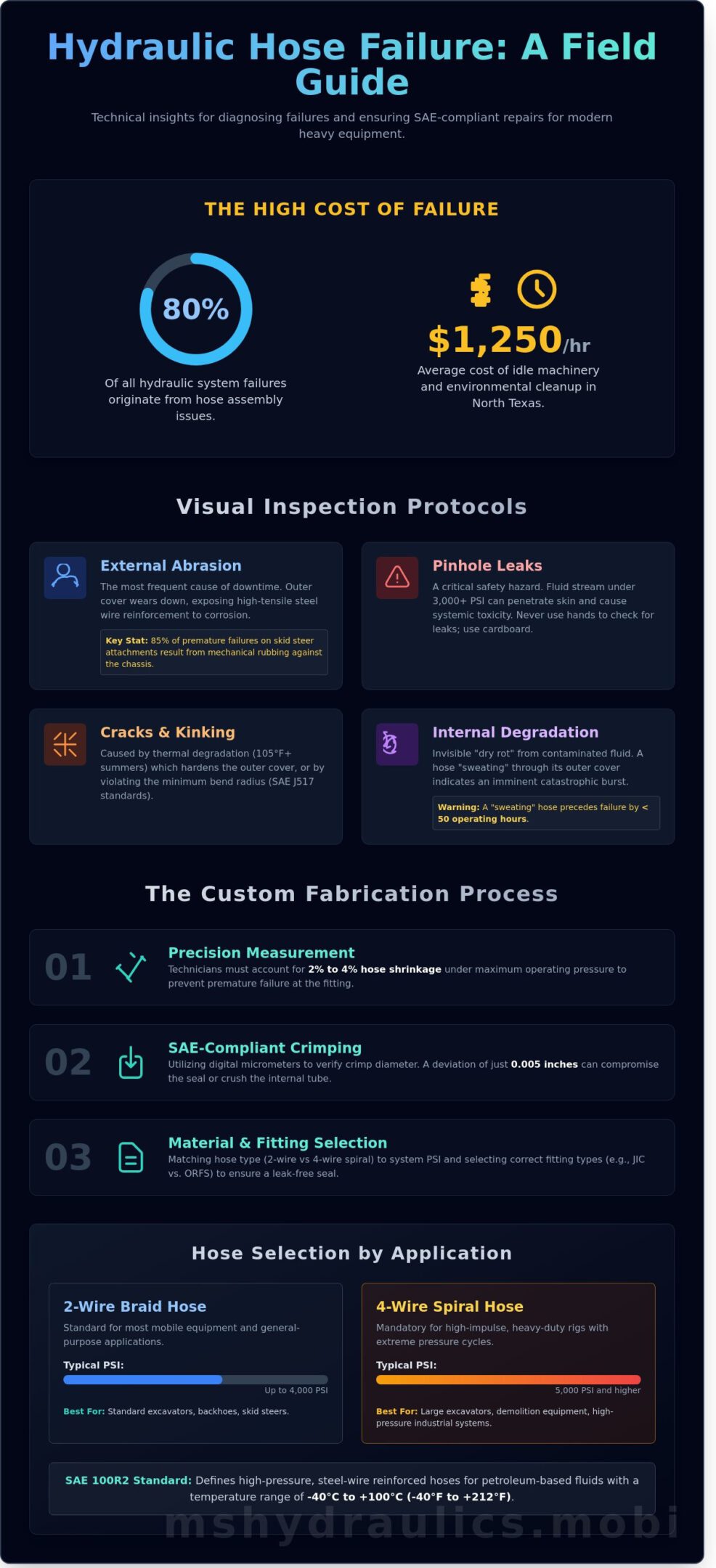
Industry data indicates that 80% of hydraulic system failures originate from hose assembly issues, often costing North Texas operators an average of $1,250 per hour in idle machinery and environmental cleanup costs. You recognize that finding reliable hydraulic hose repair near me isn’t just about a quick fix; it’s about maintaining the 3,000 to 6,000 PSI tolerances required for modern heavy equipment operation. Improperly crimped fittings or mismatched hose ratings don’t just cause leaks; they present significant safety risks to your technicians and jeopardize project timelines.
We’ve developed this 2026 field guide to serve as your technical blueprint for identifying structural degradation and executing SAE-compliant repairs in the Cleburne area. You’ll gain the engineering insights needed to restore machine functionality immediately through professional custom fabrication and certified field services. We’ll examine specific diagnostic protocols for wire braid fatigue, the importance of ISO 18752 standards, and the logistics of sourcing high-performance components across the North Texas corridor to ensure long-term system reliability.
Key Takeaways
- Learn to identify critical failure points, such as external abrasion and wire exposure, to mitigate the risks of high-pressure fluid injection and system failure.
- Understand the precision engineering required for custom fabrication, including volumetric expansion calculations and carcass selection based on system PSI.
- Quantify the true cost of equipment downtime to determine if professional hydraulic hose repair near me provides a superior ROI compared to retail alternatives.
- Navigate the regional landscape of emergency hydraulic services across Cleburne and North Texas to maintain operational continuity in high-demand construction environments.
- Discover how integrating engineering-grade components and mobile repair capabilities can optimize the long-term performance of your pumps, valves, and cylinders.
Diagnosing Hydraulic Hose Failure on the Job Site
Operational reliability in North Texas depends on rigorous diagnostics. When searching for hydraulic hose repair near me, operators must first identify whether a failure is localized or systemic. External abrasion remains the most frequent cause of downtime. Once the outer cover wears down to expose the high-tensile steel wire reinforcement, the hose’s structural integrity is compromised. Exposed wire leads to rapid oxidation and corrosion, particularly in high-humidity environments.
Pinhole leaks represent a critical safety hazard on any site. A stream of fluid under 3,000 PSI can penetrate human skin and cause systemic toxicity. Operators shouldn’t use their hands to check for leaks; a piece of cardboard is the standard tool for this task. Understanding Hydraulic machinery principles is vital for recognizing that fluid under pressure behaves like a solid projectile. Fitting weepage also requires technical scrutiny. A damp fitting might simply require a torque adjustment, but fluid migrating from the crimp collar indicates a permanent mechanical failure of the hose-to-fitting interface.
Visual Inspection Protocols for Heavy Equipment
North Texas summers often exceed 105°F, causing the outer cover to harden and crack. This thermal degradation reduces flexibility, leading to kinking on excavator booms. Operators must verify that hose routing adheres to the minimum bend radius specified by SAE J517 standards. On skid steer attachments, 85% of premature failures result from mechanical rubbing against the chassis. Documenting these wear patterns during daily walk-arounds prevents unexpected 4:00 PM emergency calls.
The Hidden Risks of Internal Hose Degradation
Internal tube erosion occurs when contaminated fluid acts like an abrasive. This "dry rot" is often invisible until a filter clog occurs. Modern systems face high impulse cycles; a hose rated for 500,000 cycles will fail predictably as it nears its service life limit. If a hose appears to be "sweating" or weeping through the outer cover, the inner tube has already breached. This condition precedes a catastrophic burst by less than 50 operating hours. When these signs appear, contacting a specialist for hydraulic hose repair near me is the only way to maintain ISO-certified safety standards and protect the machinery’s displacement pump.
Technical How-To: The Custom Hydraulic Hose Fabrication Process
Fabricating a custom assembly requires more than just cutting rubber to length. Precision measurement is the first technical hurdle. Experienced technicians always account for hose shrinkage, which typically ranges from 2% to 4% when a system reaches maximum operating pressure. Failing to include this “slack” leads to premature failure at the fitting interface. When operators seek hydraulic hose repair near me, they often present assemblies that failed because the original hose was cut too short, causing the wire reinforcement to pull away from the crimp under load.
The crimping process itself is non-negotiable. We utilize digital micrometers to verify the finished crimp diameter against manufacturer specifications. A deviation of even 0.005 inches can compromise the seal or crush the internal tube. Matching the correct die set to the specific hose and fitting combination ensures that the serrations on the fitting shell bite into the wire reinforcement without damaging the structural integrity of the carcass.
Selecting Materials for High-Pressure Performance
Material selection depends on the application’s duty cycle. Two-wire braid hoses are standard for most mobile equipment, but four-wire spiral hoses are mandatory for high-impulse heavy duty rigs operating at 5,000 PSI or higher. In North Texas, industrial applications must withstand ambient temperatures that frequently exceed 105°F, requiring hose covers with high UV and abrasion resistance to prevent ozone cracking. SAE 100R2 standards define a high-pressure, steel-wire reinforced hose designed for petroleum-based hydraulic fluids within a temperature range of -40°C to +100°C.
Ensuring Fitting Integrity and Leak-Free Seals
Identifying the correct thread type is a technical requirement that prevents catastrophic leaks. While JIC (Joint Industry Council) 37-degree flares are common, they’re susceptible to damage from over-torque. Crushing a JIC flare by applying too much force ruins the metal-to-metal seal. Conversely, O-Ring Face Seal (ORFS) connections use an elastomeric seal to handle high-vibration environments effectively. Technicians use thread pitch gauges and calipers to distinguish between NPT, BSPP, and Metric threads, as visual identification is often unreliable in the field.
Maintaining system safety during installation is paramount. Following established hydraulic hose safety tips, such as relieving residual pressure before disconnecting lines, prevents injection injuries. For those managing complex fleets, sourcing a certified fabrication partner ensures every assembly meets ISO 18752 performance standards. Using precision tools to match fittings and hose carcasses eliminates the guesswork that leads to downtime on the job site.
Mobile Repair vs. Retail Pickup: A Strategic Cost Analysis
Operational efficiency in North Texas heavy industries hinges on minimizing idle time. A drill rig or excavator out of commission costs an average of $650 per hour in lost productivity and labor overhead. While a retail parts store might offer a lower initial price for a hose assembly, the hidden costs often exceed the savings. A 2025 survey of regional fleet managers indicated that 28% of retail-sourced components resulted in “wrong part” delays, extending downtime by an average of 3.5 hours. When searching for hydraulic hose repair near me, the objective is system restoration, not just part acquisition.
- Root Cause Identification: Professional technicians diagnose whether a failure stemmed from pressure spikes, improper bend radii, or heat degradation rather than simply replacing the symptom.
- Environmental Mitigation: On-site units manage fluid containment to meet Texas Commission on Environmental Quality (TCEQ) standards, preventing fines that often start at $2,500 per incident.
- System Integrity: Mobile service ensures the assembly is flushed of contaminants before installation, protecting sensitive valves and pumps.
It’s a matter of technical precision. Retail staff often lack the specialized engineering background to identify SAE 100R15 high-pressure requirements versus standard utility hoses. This discrepancy leads to premature failures that can damage the entire hydraulic circuit.
Why ‘Near Me’ Should Mean Mobile Response
Logistics consume profits. Transporting heavy components to a brick-and-mortar shop involves specialized hauling and multiple man-hours. Mobile response units bring the factory to the field, offering real-time testing under actual load conditions. This is vital for 24/7 operations in Cleburne that can’t afford to wait for retail opening hours. Technicians verify the seal at pressures reaching 6,000 PSI, ensuring the machine is immediately ready for duty cycles. A hydraulic hose repair near me isn’t truly close if it requires a two-hour round trip to a parts counter.
Quality Control: Factory Specs vs. Retail Substitutes
Generic hoses from auto parts retailers frequently fail to meet the high-impulse requirements of modern hydraulic systems. Professional mobile services utilize hoses certified to ISO 18752 standards, which are designed to handle millions of pressure cycles without fatigue. Contamination is the leading cause of 75% of hydraulic failures; therefore, certified technicians use pneumatic projectile cleaning to ensure every hose is free of internal debris. This level of precision provides a reliability guarantee that retail substitutes cannot match.
Local Hydraulic Service Guide for Cleburne and North Texas
Finding reliable hydraulic hose repair near me in the 817 and 682 area codes requires an understanding of the specific environmental stressors unique to the North Texas corridor. Since January 2025, the industrial density between Cleburne and Alvarado has increased by 18%, placing unprecedented strain on local service infrastructure. Rapid response isn’t just a convenience; it’s a technical necessity when downtime costs for a Tier 1 construction site in Arlington can exceed $4,500 per hour.
Construction projects in Mansfield and Cedar Hill rely on high-pressure systems that operate under extreme thermal fluctuations. Our field technicians prioritize ISO 4406 cleanliness standards during every on-site assembly to prevent contamination. We’ve optimized our logistics to ensure that 92% of service calls within Johnson County receive a technician on-site in under 60 minutes.
Regional Industry Demands: From Drill Rigs to Excavators
Drilling operations in the Granbury sector require specialized high-torque hose assemblies capable of sustaining 5,000 PSI working pressures. These systems don’t just need a quick fix; they require engineered solutions that account for vibration and surge flow. Our service protocols include:
- High-Torque Support: Specializing in 4-wire and 6-wire spiral reinforcement for North Texas drilling rigs.
- Municipal Fleet Maintenance: Managing scheduled hose replacements for over 250 heavy units across Waxahachie and Midlothian.
- Earthmoving Reliability: Providing 24/7 support for large-scale excavation projects where hydraulic failure stops 100% of production.
Logistics of Field Service in the 817 and 682 Area Codes
Strategic positioning is the core of our service model. By maintaining mobile units near the intersection of US-67 and I-35W, we provide rapid hydraulic hose repair near me for Crowley and Burleson industrial hubs. This placement allows our team to coordinate directly with project managers to minimize site disruption during critical path operations.
Environmental factors in North Texas demand specific technical adjustments. Texas clay contains high concentrations of abrasive silica. This particulate matter can accelerate seal degradation by 35% if the hose-to-fitting interface isn’t properly secured. Our technicians utilize weather-resistant sleeves and precision-crimped fittings to ensure seal integrity against the fine dust common in DFW construction zones.
Ms. Hydraulics: Your Partner in Industrial Performance
Ms. Hydraulics functions as a primary engineering partner for the Cleburne industrial corridor. We execute precision hose fabrication using high-grade synthetic elastomers and high-tensile steel wire reinforcement that meets or exceeds SAE J517 specifications. This technical rigor ensures that your search for hydraulic hose repair near me results in a solution capable of withstanding 1.2 million impulse cycles at maximum operating pressures. Our mobile repair capabilities extend across the entire hydraulic circuit, covering axial piston pumps, proportional valves, telescopic cylinders, and high-torque motors.
The Ms. Hydraulics integrity pledge focuses on engineering transparency and long-term asset reliability. We treat every service call as a partnership in performance. By providing detailed failure analysis and component recovery options, we help operators reduce total cost of ownership (TCO) by an average of 18% annually. Our technicians don’t just swap parts; they identify the root cause of systemic failures to prevent recurring downtime.
Beyond the Hose: Full System Diagnostics
Effective maintenance requires data-driven insights. Our technicians conduct on-site pressure testing up to 10,000 PSI and utilize digital particle counters for ISO 4406 fluid cleanliness analysis. These preventative maintenance programs are specifically calibrated for North Texas fleets operating in ambient temperatures that frequently exceed 100 degrees Fahrenheit. Our cylinder rebuild services include precision rod honing and seal kit upgrades that extend service life by 30% compared to factory-standard repairs. We specialize in recovering components that other shops might label as scrap.
Contacting Ms. Hydraulics in Cleburne, TX
Our central fabrication facility is located at 1100 S Main St for immediate counter service and custom assembly needs. For critical equipment failures in the field, our mobile dispatch units operate with a 95% first-visit fix rate. When you require hydraulic hose repair near me, our GPS-routed service trucks typically arrive on-site within 60 minutes of the initial call. This rapid-response protocol is designed to mitigate the financial impact of idle heavy machinery.
Securing Operational Continuity Across North Texas
Maintaining peak performance for heavy machinery requires more than a quick fix; it demands technical precision and rapid response. Since 2021, MS Hydraulics has provided on-site diagnostics that eliminate the logistical delays of traditional retail pickup. Our expert technicians specialize in high-pressure systems for excavators, skid steers, and drill rigs, ensuring every custom fabrication meets rigorous industrial standards. When equipment fails in the field, finding reliable hydraulic hose repair near me is the difference between a profitable shift and a total work stoppage. The 2026 operational landscape proves that choosing mobile repair allows operators in Cleburne and North Texas to reduce equipment downtime by approximately 65% compared to off-site alternatives. We bring the workshop directly to your job site to keep your project on schedule. Your fleet deserves the reliability of certified engineering and disciplined service that prioritizes technical accuracy. Let’s get your machinery back to its full rated capacity today. We’re ready to handle your most demanding pressure requirements and restore your operational flow immediately.
Schedule Emergency Mobile Hydraulic Repair Now
Frequently Asked Questions
How long does a typical mobile hydraulic hose repair take?
A standard mobile repair takes between 30 and 45 minutes once a technician arrives at your site. Our service vehicles carry inventory to resolve 98% of common fitting failures during the first visit. This efficiency minimizes downtime on North Texas projects where every hour of idle machinery costs an average of $500 in lost productivity.
Can I repair a hydraulic hose myself with a patch kit?
You shouldn’t attempt to repair a high-pressure hose with a patch kit because it’s a violation of SAE J1273 safety standards. Hydraulic systems often operate at 3,000 to 6,000 PSI, which is enough force to cause fatal injection injuries. A temporary patch can’t withstand these fluid velocities. We replace the entire assembly to ensure the system meets its original 4:1 safety factor.
What information do I need to provide when calling for a custom hose?
You’ll need to provide the STAMPED specifications: Size, Temperature, Application, Media, Pressure, Ends, and Delivery. Specifically, we require the dash size, which is the internal diameter in 1/16th inch increments, and the maximum working pressure. Identifying the thread type, like JIC 37-degree or ORFS, ensures the custom assembly fits your specific port configuration without leaks.
Is 24/7 emergency hydraulic repair available in Arlington and Mansfield?
Ms. Hydraulics provides 24/7 emergency dispatch for hydraulic hose repair near me across Arlington and Mansfield. Our technicians maintain a 60-minute average arrival time for critical failures in the I-20 and Highway 287 corridors. We understand that a burst line at 2:00 AM on a municipal project requires immediate technical intervention to prevent environmental contamination.
How do I know if my hydraulic cylinder needs a rebuild or just a new hose?
You’ll know a cylinder needs a rebuild if you observe fluid bypassing the piston seals or leaking from the rod gland. If the hose is dry but the cylinder drifts more than 0.25 inches under load, the internal seals have failed. While a hose replacement is a 30-minute fix, a full cylinder overhaul involves honing the bore and replacing all ISO-certified poly-pack seals.
What are the most common causes of hose failure on North Texas job sites?
Abrasion accounts for 80% of hose failures on North Texas job sites due to constant friction against equipment frames. High ambient temperatures in Cleburne, often exceeding 100 degrees in July, also accelerate the oxidation of the outer rubber cover. This leads to cracking and eventual reinforcement fatigue. We use TOUGH cover hoses that offer 300 times the abrasion resistance of standard hoses.
Does Ms. Hydraulics offer on-site pressure testing after a repair?
We perform on-site static pressure testing after every significant repair to verify the integrity of the new assembly. Our technicians test the hose to 1.5 times the system’s maximum operating pressure, following ISO 1402 protocols. This ensures the crimp diameter is within 0.005 inches of specification and that the fittings won’t blow off under high-impulse loads during operation.
Can you fabricate hoses for specialized equipment like drill rigs or forklifts?
We fabricate specialized high-pressure hoses for drill rigs, forklifts, and heavy earthmoving equipment. Our inventory includes 4-wire and 6-wire spiral hoses designed to handle 6,000 PSI and 1,000,000 impulse cycles. Whether you’re searching for hydraulic hose repair near me for a Caterpillar excavator or a specialized Vermeer drill, we maintain the technical data to replicate OEM specifications exactly.