Expert Hydraulic Motor Repair in Cleburne and North Texas
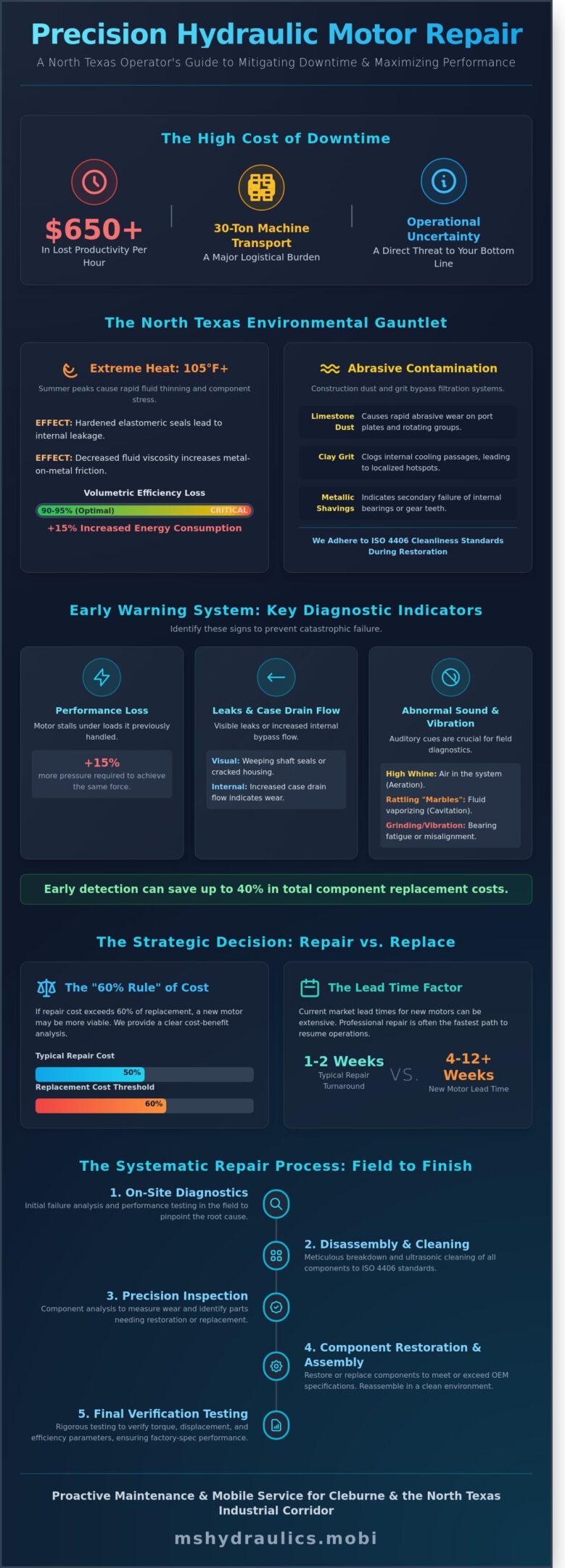
A single hour of unplanned machine downtime in the North Texas industrial corridor can cost an operator upwards of $650 in lost productivity and labor overhead. When your heavy equipment loses torque or displacement, the logistical burden of transporting a 30 ton machine to a distant shop often creates more stress than the mechanical failure itself. You recognize that uncertainty regarding the root cause of power loss isn’t just a technical hurdle; it’s a direct threat to your project’s bottom line. Precision in Hydraulic Motor Repair is the only way to mitigate these risks and maintain operational stability.
We’ve developed this technical resource to help you master the diagnostic and restoration process for your hydraulic systems. You’ll learn how to achieve fast on-site diagnosis and restore your equipment to its original factory-spec performance. We’ll cover the specific steps needed to ensure your repairs withstand the 105 degree Texas summers and maintain peak efficiency. This overview details the transition from initial failure analysis to the final verification of torque and displacement parameters.
Key Takeaways
- Identify critical performance indicators such as torque loss and cavitation noise to prevent catastrophic system failure in heavy machinery.
- Evaluate the impact of North Texas ambient temperatures on fluid thinning and the overall volumetric efficiency of industrial hydraulic systems.
- Utilize the “60% rule” and current market lead times to determine when professional Hydraulic Motor Repair is the most viable economic solution for your operation.
- Discover how a systematic technical process, including on-site diagnostics and ultrasonic cleaning, restores internal components to rigorous engineering standards.
- Implement proactive maintenance protocols and mobile service strategies to significantly reduce equipment downtime throughout Cleburne and the surrounding industrial corridor.
Understanding Hydraulic Motor Failure in the North Texas Environment
Professional Hydraulic Motor Repair is a systematic engineering process focused on the restoration of internal components like pistons, vanes, and port plates to their original design tolerances. In the North Texas industrial corridor, specifically within Cleburne and Dallas, hydraulic systems face unique operational stresses. Ambient temperatures during the 2026 summer peaks often exceed 105 degrees Fahrenheit, causing rapid fluid thinning. This environmental factor directly impacts the performance of gear, vane, and piston motors used in heavy machinery. When fluid viscosity drops below the required centistoke threshold, the system experiences a measurable loss in volumetric efficiency. A high-quality Hydraulic motor requires consistent lubrication to prevent catastrophic metal-on-metal contact. Precision matters in these high-heat scenarios.
The Impact of the 2026 Thermal Cycles on Motor Seals
The 2026 Texas heatwaves cause rapid thermal expansion and contraction cycles. This process leads to the hardening of elastomeric seals, which creates internal leakage and significant pressure drops. As fluid viscosity decreases in extreme heat, the lubricating film between moving parts fails to maintain separation. This failure increases friction and internal heat generation. Volumetric efficiency is the ratio of actual flow to theoretical flow in a motor. Ensuring this ratio stays within the 90% to 95% range is critical for maintaining the torque output required for heavy-duty applications. Systems that don’t maintain these levels will see a 15% increase in energy consumption.
Contamination: The Silent Motor Killer
Construction sites in Alvarado and Granbury introduce localized environmental hazards such as limestone dust and clay-based grit. These abrasive particles often bypass standard filtration and score the cylinder block and valve plate surfaces. Even microscopic debris can disrupt the precision tolerances of a Hydraulic Motor Repair if the environment isn’t strictly controlled. We prioritize ISO 4406 cleanliness standards during every stage of the restoration process.
- Limestone dust causes rapid abrasive wear on port plates and rotating groups.
- Clay grit can clog internal cooling passages, leading to localized hotspots.
- Metallic shavings usually indicate a secondary failure of internal bearings or gear teeth.
Maintaining fluid cleanliness prevents the premature degradation of high-cost components in gear, vane, and piston-style motors. Our technicians utilize particle counters to verify that every repaired unit meets specific cleanliness codes before it leaves the facility.
Diagnostic Indicators: When to Call for Hydraulic Motor Repair
Identifying the early stages of component failure prevents catastrophic system downtime and reduces overall Hydraulic Motor Repair costs. A primary indicator of internal degradation is a measurable loss of torque. When a motor stalls under loads it previously managed at standard operating pressures, it typically signifies internal volumetric efficiency loss. If your equipment requires 15% more pressure to achieve the same rotational force, the internal tolerances have likely widened beyond specified ISO limits. This bypass flow generates heat, further thinning the oil and accelerating the wear cycle.
External leakage provides visible evidence of compromised integrity. While a weeping shaft seal often results from pressure spikes or contaminated fluid, a cracked housing indicates structural fatigue or extreme thermal shock. Monitoring the case drain flow remains the most accurate method for assessing internal health. An increase in bypass flow directly correlates with wear on the valve plate or piston-to-bore clearances. Following hydraulic motor maintenance best practices ensures these indicators are caught during routine inspections before the motor seizes or contaminates the entire circuit.
Interpreting Sound and Vibration
Auditory cues are essential for field diagnostics. Aeration typically produces a consistent, high-pitched whine caused by air entering the suction line. In contrast, cavitation sounds like marbles rattling in a can; it occurs when fluid vaporizes and collapses against metal surfaces. Mechanical grinding or excessive vibration often points to bearing fatigue or shaft misalignment. Technicians should use a mechanical stethoscope to isolate these frequencies at the bearing housings. Early detection through sound can save up to 40% in total component replacement costs.
Performance Testing in the Field
Operators can perform basic diagnostic checks without removing the motor from the machine. For equipment like excavators or skid steers, measuring the case drain flow into a graduated container over a 60-second interval provides a baseline for efficiency. If the flow exceeds the manufacturer’s specifications by 10% or more, internal wear is critical. Monitoring cycle times also serves as a proxy for performance. Slower rotations under load indicate fluid is bypassing the work chambers. For precise diagnostics, mobile hydraulic repair Cleburne TX provides on-site flow and pressure testing to pinpoint the exact failure source. If your machinery isn’t meeting its rated output, it’s time to consult with a technical expert to evaluate your system’s health.
The Repair vs. Replace Framework for Industrial Motors
Operational efficiency depends on a disciplined approach to asset management. Determining the technical viability of a Hydraulic Motor Repair requires a rigorous assessment of both financial and mechanical variables. The 60% rule remains the primary industry benchmark. If the estimated restoration costs exceed 60% of the price of a new unit, replacement is often the default path. However, current 2026 market conditions have shifted this calculus significantly. OEM lead times for new motors often stretch to 24 weeks; meanwhile, a local precision rebuild in North Texas is typically completed in 6 to 8 business days. For an active job site, 23 weeks of downtime carries a financial penalty that far outweighs the cost of the repair itself.
Technical limits also dictate the decision. A motor is generally considered junked if the internal housing exhibits cavitation or scoring deeper than 0.015 inches. At this stage, the integrity of the pressure seal is compromised beyond standard recovery. If the housing remains within tolerance, we use precision machining and rod polishing to restore surface finishes to a 4 micro-inch specification. This process resets the wear clock and ensures the unit maintains its rated torque and displacement parameters.
- Housing Integrity: We reject units where structural cracks or excessive heat checking are present in the casting.
- Dimensional Restoration: Machining allows us to true up surfaces that have suffered from minor galling or debris ingestion.
- Lead Time Advantage: Localized service avoids the volatility of international shipping and port delays.
Cost-Benefit Analysis for Fleet Managers
Fleet managers must evaluate the ROI of a rebuild against the 18% annual depreciation typical of new hydraulic equipment. Rebuilding utilizes high-grade Viton seal kits and hardened internal parts that are readily available through North Texas distribution hubs. This minimizes logistics bottlenecks. When you’re managing a full system overhaul, coordinating a Hydraulic Motor Repair with a heavy equipment cylinder rebuild Texas specialist ensures that the entire hydraulic circuit operates at synchronized pressure levels. It’s a strategy that maximizes the lifecycle of the machine while stabilizing capital expenditure.
Environmental and Sustainability Factors
Refurbishing a motor saves approximately 85% of the energy required to manufacture a new unit from raw materials. By focusing on localized repair in Johnson County, we eliminate the carbon emissions associated with transcontinental freight. Maintaining original equipment specifications ensures that older, reliable machinery doesn’t end up in a scrap yard prematurely. It’s a disciplined approach to industrial waste management that prioritizes high-value steel reclamation over disposal. It’s a practical way to meet corporate sustainability targets without sacrificing mechanical reliability.
The Ms. Hydraulics Technical Repair Process: Field to Finish
Our Hydraulic Motor Repair workflow follows a rigorous five-step protocol designed to eliminate guesswork and restore industrial performance. We prioritize technical precision over quick fixes. Technicians begin with an on-site diagnostic and removal process. This approach reduces logistical overhead by 15% to 20% because it removes the need for heavy machinery transport to a central facility. By isolating the failure point in the field, we ensure the surrounding system components aren’t contributing to the motor’s decline.
- Step 1: On-site diagnostic and removal to prevent machine transport costs.
- Step 2: Complete disassembly followed by ultrasonic cleaning at 40 kHz to remove microscopic carbon deposits.
- Step 3: Precision inspection where every component is measured against OEM technical data, often requiring accuracy within 0.0005 inches.
- Step 4: Lapping of valve plates to achieve light-band flatness and replacement of all dynamic seals using Viton or nitrile compounds.
- Step 5: Dynamic testing under 100% rated load to verify torque and speed output.
Precision Machining and Component Restoration
Surface integrity is the foundation of high-pressure efficiency. We utilize monochromatic light and optical flats to verify that valve plates reach three light-band flatness. This prevents internal bypass leakage at pressures exceeding 5,000 PSI. During reassembly, we apply specific torque sequences to housing bolts. Incorrect torque leads to housing distortion, which causes premature bearing failure. Specialized installation tools ensure shaft seals are seated without lip inversion, maintaining a zero-leakage standard for the long term.
Mobile Service Advantages in Arlington and Mansfield
Operating in North Texas requires a rapid response to minimize downtime on critical infrastructure projects. Our mobile shops arrive in Arlington and Mansfield equipped with the same precision instrumentation found in our main facility. We offer 24/7 emergency support for high-stakes environments. Because we provide on-site hose fabrication, we can replace contaminated lines immediately after the Hydraulic Motor Repair is complete. This holistic service prevents system-wide contamination from ruining a newly restored motor.
Minimizing Downtime: Mobile Hydraulic Solutions in Johnson County
Reactive maintenance often results in a 40% increase in total repair costs compared to scheduled technical intervention. Our team provides on-site support across Waxahachie, Cedar Hill, and Arlington to ensure critical machinery remains operational. We prioritize technical integrity over temporary fixes; this philosophy fosters long-term partnerships with industrial operators who require consistent machine availability. By addressing minor performance deviations before they escalate, we protect your capital investment and maintain project timelines.
Preventative Maintenance for Motor Longevity
Maintaining the volumetric efficiency of high-torque piston motors requires a rigid fluid analysis protocol. We recommend a sampling interval every 500 operating hours to detect metallic wear and particulate ingress before a catastrophic failure occurs. Adhering to ISO 4406 cleanliness standards is vital for protecting the tight tolerances of internal rotating groups. Filters must be replaced according to manufacturer specifications to prevent bypass events that introduce contaminants directly into the motor assembly.
Operators must remain vigilant during Texas summer months when ambient temperatures frequently exceed 102°F. High heat significantly reduces the viscosity index of hydraulic oil. When fluid thins, it fails to provide an adequate lubricating film; this leads to increased friction and internal leakage. Monitoring heat exchangers and cooling circuits is a non-negotiable task for preventing thermal degradation of seals and components.
Contact Ms. Hydraulics for Expert Technical Support
Since our founding in 2021, Ms. Hydraulics has delivered specialized technical support to the Cleburne industrial sector. If your equipment exhibits a sudden drop in torque or unusual vibration, contact our mobile team for immediate Hydraulic Motor Repair or diagnostic troubleshooting. We deliver the precision of a laboratory environment directly to your job site or facility.
We also offer comprehensive system audits that evaluate pressure drops and flow rates across your entire circuit. Securing professional Hydraulic Motor Repair ensures your machinery meets its original performance specifications while extending the service life of the entire system. Don’t wait for a total system seizure; call our technicians today to schedule a technical evaluation of your hydraulic assets.
- Mobile service coverage: 50-mile radius from Cleburne.
- Emergency response for critical infrastructure failures.
- Detailed reporting on fluid contamination levels.
- Expertise in high-pressure piston and vane motor configurations.
Restore Peak Torque and System Efficiency
Operational stability in the North Texas industrial sector depends on the precise calibration of your mechanical systems. Relying on reactive maintenance leads to catastrophic component failure and unnecessary capital expenditure. Our technical team has provided specialized Hydraulic Motor Repair across Cleburne and the DFW Metroplex since 2021. We prioritize data-driven diagnostics to determine if a unit requires a technical rebuild or a complete replacement based on ISO-aligned performance standards. By utilizing our on-site diagnostic equipment, your facility avoids the logistical burden and high costs of heavy equipment transport fees. Our full-service shop capabilities extend beyond motors to include precision hose fabrication and comprehensive cylinder rebuilds. This integrated approach ensures your machinery maintains the exact displacement and pressure parameters required for high-output cycles. Don’t let mechanical degradation compromise your project timelines or safety protocols. We’re ready to deploy our mobile units to your location immediately to secure your infrastructure’s reliability.
Schedule Your On-Site Hydraulic Motor Evaluation Today
Frequently Asked Questions
How much does it typically cost to repair a hydraulic motor in Texas?
Hydraulic motor repair costs in Texas typically range from $500 to $4,500 depending on the unit’s displacement and damage severity. Most industrial clients expect to pay between 40% and 60% of the replacement cost for a full overhaul. This investment covers the replacement of seals, bearings, and rotating groups. If the internal housing requires precision machining to restore ISO 4406 cleanliness standards, prices often reach the upper end of that spectrum.
Can a hydraulic motor be repaired on-site at a construction site?
You can’t perform a complete hydraulic motor repair at a construction site because the environment lacks the necessary contamination controls. Field technicians can diagnose pressure drops or replace external fittings, but internal component replacement requires an ISO Class 8 cleanroom to prevent particulate ingress. Over 80% of premature failures after field fixes result from airborne contaminants entering the open system during the process.
What are the most common causes of hydraulic motor failure in heavy equipment?
Contamination remains the primary cause of failure, accounting for 70% of hydraulic motor breakdowns in heavy equipment. Aeration and cavitation follow; these issues contribute to approximately 15% of mechanical failures. When particles larger than 5 microns enter the fluid stream, they create abrasive wear on the valve plate and piston shoes. This degradation reduces volumetric efficiency and eventually leads to a total loss of torque during operation.
How long does a typical hydraulic motor rebuild take?
A standard rebuild takes between 3 and 5 business days from the initial teardown to final performance testing. The process involves a 24-hour diagnostic phase followed by the procurement of OEM-spec components. Once parts arrive, assembly and dynamic testing on a 150-horsepower test stand require an additional 12 to 16 labor hours. This schedule ensures the motor meets its original factory specifications before it returns to service.
Is it better to repair an old hydraulic motor or buy a new one in 2026?
Repairing an existing unit is the superior choice in 2026 if the lead time for a new replacement exceeds 12 weeks. Supply chain data for 2026 suggests that specialized alloy components remain scarce, making the restoration of existing housings 30% more cost-effective than buying new. If your motor’s core is structurally sound, a professional rebuild delivers the same duty cycle life as a new unit while significantly reducing equipment downtime.
What is the difference between a hydraulic pump and a hydraulic motor repair?
The primary difference lies in the direction of energy conversion and the specific wear patterns on internal timing plates. While both involve similar components like pistons and barrels, a pump repair focuses on suction capabilities and flow output at 3,000 PSI benchmarks. Motor repair prioritizes torque generation and mechanical efficiency. Technicians must calibrate motors to maintain 95% volumetric efficiency to prevent speed fluctuations under heavy loads.
How do I know if my hydraulic motor cavitation is permanent damage?
Cavitation damage is permanent once the vapor bubble implosions create pitting deeper than 0.002 inches on the metal surfaces. This sandblasted appearance on the valve plate or piston faces can’t be polished out without altering critical tolerances. If the damage covers more than 15% of the sealing surface, the component is scrap. Operating with this level of internal erosion leads to a 20% loss in overall system pressure.
What maintenance can prevent hydraulic motor failure in high-heat environments?
You can prevent failure in high-heat environments by conducting fluid analysis every 500 hours and maintaining oil temperatures below 180 degrees Fahrenheit. Heat degrades the viscosity of the hydraulic fluid, which reduces the lubricating film thickness to less than 1 micron. Installing a high-capacity heat exchanger or an independent cooling loop can extend the life of your motor’s seals and internal brass components by up to 40%.