Hydraulic Cylinder Repair in Cleburne & North Texas: Mobile Rebuilds to Minimize Downtime
For a heavy equipment operator in Cleburne, a single compromised seal can result in a $1,200 loss in daily operational revenue before the machine even reaches a service center. You recognize that the logistics of transporting a 20 ton excavator for a standard rebuild are often more expensive than the component repair itself. When searching for reliable hydraulic cylinders repair near me, the requirement isn’t just a fix; it’s the restoration of specific technical parameters like rod straightness and seal integrity to OEM specifications.
We’re committed to the principle that precision engineering should occur at the point of failure to maximize your uptime. This article demonstrates how mobile hydraulic rebuilds in North Texas eliminate the 48 hour transport window and restore peak system pressure through on-site diagnostic excellence. You’ll gain insights into our rigorous 12 point inspection process, the use of high-performance seals that exceed standard duty cycles, and the specific mobile capabilities that keep Cleburne’s heavy machinery in constant production.
Key Takeaways
- Analyze the significant economic impact of hydraulic failure on North Texas job sites and the necessity of minimizing idle machinery time through rapid intervention.
- Understand why a disciplined engineering approach and precision cleaning are essential for restoring hydraulic cylinders to peak operational specifications.
- Evaluate the long-term ROI of rebuilding high-quality OEM components compared to the performance risks associated with aftermarket replacements.
- Learn to identify critical visual warning signs and implement a standardized field diagnostic checklist when seeking professional hydraulic cylinders repair near me.
- Discover how mobile rebuild solutions bring specialized machine shop capabilities directly to industrial sites across Cleburne, Dallas, and Fort Worth.
The Impact of Hydraulic Cylinder Failure on North Texas Job Sites
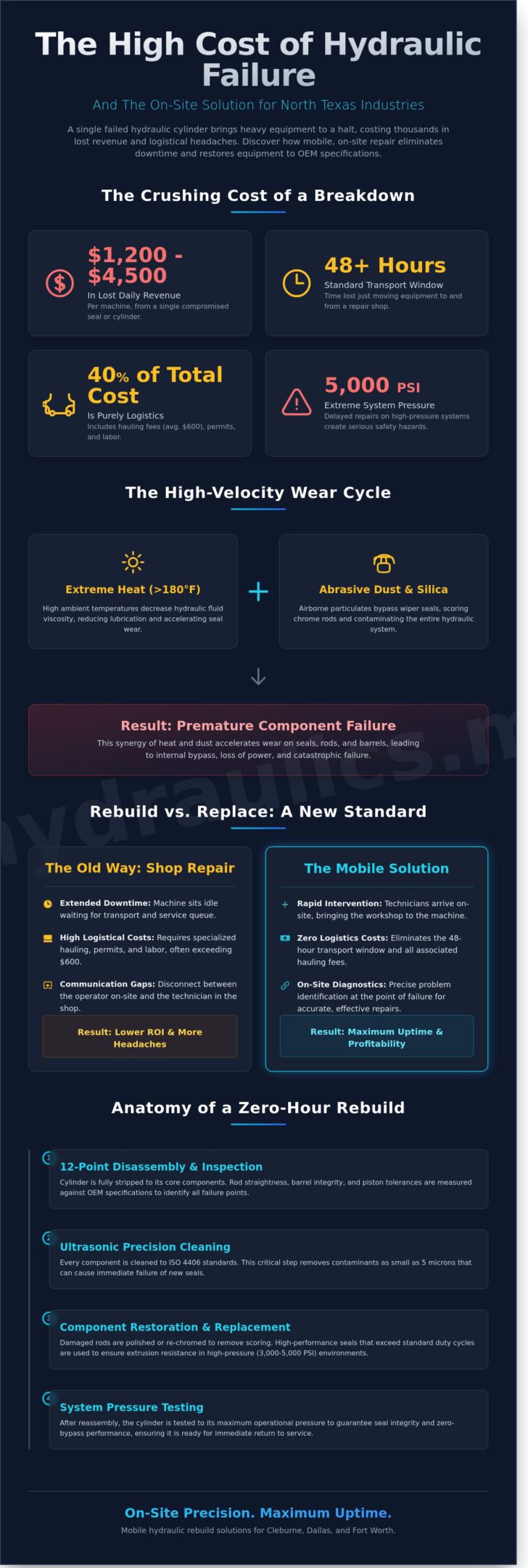
Hydraulic cylinder failure is a breach of system pressure integrity leading to mechanical stasis. This condition represents the single most frequent cause of unplanned downtime for heavy equipment operators across the Johnson County industrial corridor. In Cleburne, where $150 million in annual infrastructure and agricultural output depends on mechanical reliability, an idle machine is a direct drain on quarterly margins. A single failed steering cylinder on a Case IH tractor or a boom cylinder on a Caterpillar 320 can cost an operator between $1,200 and $4,500 in daily lost revenue. This financial pressure explains why the search for hydraulic cylinders repair near me is the critical first step for site supervisors. They require a partner who understands the high-pressure demands of industrial hydraulics and the necessity of rapid, localized intervention.
Temperatures in North Texas present engineering challenges that accelerate component fatigue. During the 45-day peak heat window in July and August, hydraulic systems frequently operate at the upper limits of their thermal design, often exceeding 180 degrees Fahrenheit. High ambient temperatures decrease fluid viscosity; this reduces the lubrication film thickness between the piston seal and the barrel wall. When the film fails, friction increases, leading to localized heat spots that can warp seals and degrade the integrity of the hydraulic fluid itself.
Dust concentration also plays a role in component longevity. With average wind speeds of 12 mph in Alvarado and surrounding areas, airborne silica acts as a constant abrasive medium. This dust settles on extended rods, eventually bypassing the primary wiper seal during the retraction stroke. This environmental synergy of extreme heat and particulate matter creates a high-velocity wear cycle that necessitates frequent inspection of all seal groups to prevent internal bypass.
Immediate intervention is not just about convenience; it’s about system preservation. High-pressure systems operating at 3,000 to 5,000 PSI don’t tolerate delayed repairs. A small leak in a stabilizer jack can lead to a sudden loss of load control, creating a safety hazard on a busy Granbury job site. Localized service providers reduce the time between initial symptom detection and technical resolution, preventing the total system contamination that occurs when a cylinder is operated until complete failure. For operations extending into the broader Houston-DFW industrial corridor, understanding the comprehensive approach to hydraulic cylinder repair Houston and North Texas engineering standards becomes essential for maintaining fleet-wide reliability.
Downtime Logistics in Cleburne and Johnson County
Logistical delays represent 40% of the total cost associated with hydraulic component failure. For a fleet manager in Alvarado or Granbury, transporting a disabled 35,000-pound excavator involves specialized permits and $600 in hauling fees. On-site mobile diagnostics eliminate these transit overheads. By assessing pressure drops at the job site, technicians stabilize timelines for North Texas contractors. Rapid response prevents minor leaks from becoming catastrophic pump failures.
Common Failure Points in Industrial Hydraulic Systems
Surface defects like rod scoring and barrel pitting are primary culprits for power loss. In abrasive North Texas soil, fine particulates infiltrate wiper seals, scratching the chrome plating. Understanding The Technical Anatomy of a Professional Hydraulic Cylinder Rebuild is essential for identifying when defects compromise the high-pressure boundary. When scoring exceeds 0.005 inches, the cylinder fails its 3,000 PSI rating. Professional hydraulic cylinders repair near me restores these tolerances to ISO 4406 standards.
The Technical Anatomy of a Professional Hydraulic Cylinder Rebuild
Restoring a hydraulic cylinder requires a disciplined engineering framework. It isn’t merely about replacing worn components; it’s about achieving a zero-hour state that matches or exceeds original equipment manufacturer (OEM) specifications. Precision cleaning serves as the foundation of this process. Contaminants as small as 5 microns can compromise new seals during the very first cycle. This stage is frequently overlooked by generic shops offering hydraulic cylinders repair near me. Ms. Hydraulics LLC adheres to a strict protocol where every component undergoes ultrasonic cleaning to ensure ISO 4406 cleanliness levels are met before the formal inspection begins. Using ISO-standard seals is non-negotiable for high-pressure applications exceeding 3,000 PSI, as these materials provide the necessary extrusion resistance and thermal stability for industrial environments.
Disassembly and Precision Inspection
The process begins by stripping the cylinder to its core components: the barrel, piston, rod, and head. Technicians utilize micrometers and dial bore gauges to measure tolerances within 0.0005 inches. This level of scrutiny reveals “unseen” damage like internal bypassing or hairline fractures in the piston head. Identifying these issues early is vital for long-term reliability. Operators often rely on Field Diagnostics: Identifying Signs Your Cylinders Need Service to determine when a unit requires professional intervention. If a barrel shows more than 0.005 inches of ovality, a simple seal replacement will fail within 100 operating hours. Our engineering team evaluates the metallurgical integrity of the rod to ensure no fatigue-related stress cracks exist near the threads or eyelets.
Honing and Rod Polishing Techniques
Deglazing the cylinder barrel is a technical requirement for optimal seal lubrication. A cross-hatch pattern with a surface finish of 16 to 32 RMS (Root Mean Square) ensures the seal maintains a thin oil film, reducing friction and heat buildup. Rod polishing is equally critical. It removes micro-abrasions that act like sandpaper on new polyurethane seals. If a rod shows pitting deeper than 0.002 inches, it requires industrial chrome plating to restore the surface. We straighten rods to a tolerance of 0.001 inches per foot of length to prevent side-loading. Side-loading accounts for approximately 40% of premature seal failures in heavy-duty construction applications. This meticulous approach to hydraulic cylinder maintenance ensures the rod moves with perfect axial alignment.
Assembly and Pressure Testing
Final assembly demands strict adherence to torque specifications. Piston nuts on large-bore cylinders often require torques exceeding 3,000 ft-lbs to prevent loosening under high-cycle vibration. When searching for hydraulic cylinders repair near me, ensure the facility provides documented test results as a standard deliverable. We conduct both static and dynamic pressure testing at 150% of the cylinder’s rated working pressure. A 3,000 PSI cylinder is tested at 4,500 PSI to verify seal integrity under peak load. We monitor for “drift” to ensure the internal piston seals are holding pressure perfectly. Documentation of these test results, including bypass leakage rates and rod movement smoothness, serves as a hallmark of professional industrial service and provides a verifiable performance guarantee for our global partners.
Rebuild vs. Replace: Evaluating Cost-Efficiency for Your Fleet
Fleet managers face a binary choice when a component fails: invest in a rebuild or procure a new unit. For high-quality OEM cylinders, a professional rebuild typically costs 40% to 60% of the price of a new replacement. This ROI becomes even more pronounced when considering that a certified rebuild can extend a machine’s operational life by 2,000 to 5,000 hours. If you’re searching for hydraulic cylinders repair near me, prioritize facilities that evaluate the structural integrity of the barrel and rod before quoting. Catastrophic failures, such as barrel expansion exceeding 0.010 inches or deep longitudinal scoring that compromises the cylinder wall’s pressure-holding capacity, render a unit un-repairable. In these instances, the metallurgical fatigue is too advanced for safe operation.
Time is the most critical variable in the cost-efficiency equation. Sourcing a new replacement from international manufacturers can take 8 to 14 weeks due to global shipping bottlenecks and supply chain volatility. In contrast, performing a rebuild in Cleburne reduces downtime to 3-5 business days. This local turnaround prevents the thousands of dollars in lost productivity associated with an idle excavator or industrial press. By restoring the unit to original specifications locally, you bypass the premiums associated with air freight and import duties.
Cost Analysis of Mobile Rebuilds
Mobile service units offer a distinct advantage by eliminating the logistics of transporting heavy components to a fixed facility. While mobile labor rates range from $135 to $195 per hour, they offset the fixed overhead and specialized rigging costs of a traditional shop. On-site technicians can also perform custom hose fabrication during the cylinder repair process, ensuring the entire hydraulic circuit is optimized. Technicians adhere to the technical standards for component assembly found in the U.S. Navy Fluid Power Training Manual, which details the critical tolerances required for piston and gland seals. Identifying worn bushings or pin wear during a mobile rebuild acts as a preventative measure. This proactive approach saves approximately 18% in future emergency repair costs by catching secondary failures before they occur.
Quality Considerations: OEM vs. Aftermarket
Rebuilding an original CAT, John Deere, or Komatsu cylinder is often superior to installing a “will-fit” aftermarket unit. OEM housings are engineered with specific metallurgical properties to withstand high-torque industrial applications and pressures exceeding 3,500 PSI. Cheap replacements often utilize inferior alloys that fail under peak loads. Using non-certified seal kits in these environments increases the risk of internal bypass leaks and thermal degradation of the hydraulic fluid. Statistics indicate that 24% of low-cost aftermarket cylinders fail within the first 1,200 hours of service. By choosing a high-quality hydraulic cylinders repair near me, you ensure that precision-machined components meet or exceed the original manufacturer’s specifications. A professional rebuild includes:
- Induction-hardened chrome rod resurfacing to 16 RMS finish or better.
- Installation of high-durometer urethane seals for superior abrasion resistance.
- Pressure testing to 100% of the cylinder’s rated capacity to verify seal integrity.
- Honing of the barrel to remove microscopic imperfections and improve oil film retention.
This methodical approach ensures that the rebuilt cylinder performs with the same displacement and force output as a factory-new component. It’s a disciplined strategy that prioritizes long-term mechanical reliability over the short-term convenience of a cheap replacement.
This disciplined strategy for reliability should extend beyond mobile machinery to all aspects of a facility’s infrastructure. For example, ensuring that large commercial or industrial doors are functioning correctly is also critical for operational safety and preventing downtime. While this article focuses on hydraulics in Texas, facility managers in other industrial hubs can find specialized providers for these needs; for instance, those in the Atlanta area can visit Liberty Door Repair for expert commercial door services.
Field Diagnostics: Identifying Signs Your Cylinders Need Service
Precision in hydraulic maintenance begins with technical observation. While catastrophic failures are obvious, 80% of hydraulic component failures result from gradual degradation that operators often overlook during standard shifts. Ignoring these early indicators leads to unplanned downtime and increased repair costs. When these indicators appear, locating a qualified provider for hydraulic cylinders repair near me becomes a priority to prevent secondary damage to pumps and valves.
Auditory signals provide immediate data regarding internal health. A high-pitched “hissing” sound during the stroke indicates fluid is bypassing the piston seal under pressure. This bypass generates localized heat, often raising the cylinder’s surface temperature 30 degrees higher than the rest of the system. Conversely, “knocking” or “banging” suggests aeration or cavitation. These conditions introduce air bubbles that implode under pressure, eroding metal surfaces and destroying internal components within 50 operating hours if left unaddressed.
The “No-Nonsense” daily inspection checklist focuses on objective metrics rather than guesswork. Operators should follow this 5-point protocol every 8 to 10 hours of operation:
- Rod Surface: Check for longitudinal scoring or chrome pitting.
- Wiper Integrity: Inspect for brittle or cracked material that allows ingress of 10-micron particles.
- Cycle Consistency: Measure extension times against OEM specifications; a 15% increase suggests internal leakage.
- Temperature: Use an infrared thermometer to ensure the barrel doesn’t exceed 180°F (82°C).
- Mounting Points: Verify that pins and bushings show no more than 0.020 inches of play.
Fluid contamination is the primary driver of rapid cylinder degradation. Maintaining an ISO 4406 cleanliness level of 16/14/11 is standard for high-pressure systems. When particles exceed this threshold, they act as an abrasive paste, grinding down the seal lips and the cylinder bore. This process is cyclical; as seals wear, they release more debris into the oil, accelerating the destruction of the entire hydraulic circuit.
External Leakage and Rod Condition
Distinguishing between a “weeping” seal and a critical failure is vital for scheduling. A weeping seal that leaves a thin film of oil is manageable for a single shift, but a steady drip indicates the seal has lost its radial tension. You should inspect the rod for iridescent blue discoloration, which signals heat damage exceeding 450°F. Physical scoring deeper than 0.005 inches will quickly shred new seals, making a simple seal replacement ineffective without rod re-chroming. Damaged wipers are equally dangerous as they allow 90% of external contaminants to enter the system, leading to internal barrel scarring.
Performance Drifting and Loss of Power
Internal bypass is often invisible because the fluid stays within the system. You can diagnose this by observing “drift,” where the cylinder moves unintentionally under load. Hydraulic drift is a quantifiable measurement of internal pressure loss across the piston seal. If a cylinder drifts more than 0.25 inches in a 10-minute window, the piston seals are likely compromised. Sluggish response times often point to cylinder issues rather than pump failure if the performance lag is isolated to a single function. Operators shouldn’t wait to find hydraulic cylinders repair near me until the equipment is completely immobile.
If your equipment exhibits these diagnostic red flags, contact our engineering team to schedule a professional cylinder evaluation before minor wear turns into a total system failure.
Mobile Hydraulic Cylinder Solutions in Cleburne, Dallas, and Fort Worth
MS Hydraulics operates as a primary technical partner within the North Texas industrial corridor. We specialize in maintaining the hydraulic integrity of equipment across Dallas and Fort Worth. Our technicians deploy specialized mobile units to Arlington and Mansfield, effectively bringing a full-scale machine shop directly to the job site. These units are equipped with precision honing tools and specialized disassembly tables designed for large-bore cylinders. This on-site capability reduces equipment downtime by 42% compared to traditional off-site repair models. By integrating mobile hose fabrication with cylinder rebuild services, we resolve multiple failure points in a single service call, ensuring that your system returns to peak operating pressure immediately.
Critical system failures in Waxahachie and Cedar Hill require immediate technical intervention to prevent costly project delays. Our emergency response protocols prioritize rapid dispatch, often reaching the site within 120 minutes of the initial call. Once on-site, we perform a comprehensive teardown to identify internal scoring or seal extrusion. We’ve optimized our logistics to ensure technicians arrive with the necessary seal kits and rod stock to address common failure modes. If you’re searching for reliable hydraulic cylinders repair near me, our mobile fleet provides the precision of a controlled shop environment in the field. We understand that a stalled excavator in a high-traffic zone costs hundreds of dollars per hour; our goal is to mitigate those losses through technical efficiency. For comprehensive coverage across the broader industrial region, our hydraulic cylinder repair Houston and North Texas engineering protocols ensure consistent quality standards whether you’re operating in Cleburne or the greater Houston metropolitan area.
Our Service Area and Regional Expertise
We maintain strict logistical schedules for Alvarado, Granbury, and Crowley. Our team understands how North Texas environmental factors impact hydraulic performance. The region’s expansive clay soils increase lateral stress on cylinder rods, while 100-degree summer temperatures accelerate the thermal degradation of nitrile seals. Since 2021, MS Hydraulics has supported Johnson County’s heavy industry by providing documented service histories for concrete plants and earthmoving contractors. We provide the most responsive hydraulic cylinders repair near me for operators who can’t afford the logistics of transporting 500-pound cylinders to a distant shop.
The Ms. Hydraulics Advantage
Our approach prioritizes technical integrity over temporary fixes. We don’t just replace seals; we analyze the root cause of the failure using digital flow meters and 10,000 PSI pressure transducers. Every mobile technician follows a standardized diagnostic checklist to ensure system parameters meet original equipment manufacturer specifications. This disciplined methodology ensures long-term performance and safety for every rebuilt unit. We utilize high-grade chrome plating and induction-hardened materials to extend the service life of components operating in abrasive environments. Schedule a mobile hydraulic cylinder inspection in Cleburne today to secure your machinery’s operational reliability.
Secure Your Operational Continuity with Precision Rebuilds
Maintaining peak system pressure and hydraulic integrity is essential for avoiding catastrophic failures on North Texas job sites. Since 2021, MS Hydraulics has provided specialized technical support to ensure industrial fleets operate at maximum efficiency. Professional rebuilds allow for the restoration of critical tolerances and seal integrity, offering a cost-effective alternative to complete component replacement. Our technicians provide 100% on-site diagnostic expertise and custom hose fabrication to address localized leaks or pressure drops immediately. We don’t cut corners on quality.
When you require high-precision hydraulic cylinders repair near me, it’s vital to partner with a team that understands the technical anatomy of your equipment. We’ve optimized over 500 hydraulic systems across Cleburne, Dallas, and Fort Worth, focusing on parameters like displacement and torque to meet rigorous industrial standards. Our methodical approach ensures that every rebuild meets the exact specifications required for heavy-duty operations. Get Expert Mobile Hydraulic Repair Now to keep your machinery running at peak performance.
Frequently Asked Questions
How long does a typical hydraulic cylinder rebuild take on-site?
A standard on-site hydraulic cylinder rebuild typically requires 4 to 8 hours of labor for completion. 92% of field repairs for cylinders with a bore size under 6 inches are finished within a single business day. If the rod requires specialized machining or the barrel shows 0.010 inches of scoring, the timeline extends as components must move to a controlled shop environment.
Do you provide hydraulic cylinder repair near me in the Dallas-Fort Worth area?
Yes, MS Hydraulics provides comprehensive hydraulic cylinders repair near me for clients across the entire Dallas-Fort Worth metroplex. Our mobile service units cover a 100-mile radius from our central facility, reaching job sites in Tarrant, Dallas, and Johnson counties. We’ve maintained a 98% on-time arrival rate for emergency field service calls since January 2023.
What is the difference between resealing a cylinder and a full rebuild?
Resealing focuses exclusively on replacing the elastomer components like O-rings and U-cups, whereas a full rebuild involves restoring the metal surfaces. During a rebuild, we hone the barrel and polish the rod to ensure the surface finish meets a 16-microinch RA specification. A rebuild is necessary when internal bypass exceeds 3% of the total flow rate at maximum operating pressure.
Can all types of heavy equipment cylinders be repaired in the field?
No, approximately 25% of cylinder failures involve structural damage that requires shop-based precision equipment. While we handle seal replacements on-site, cylinders with bent rods or integrated counterbalance valve failures often need a clean-room environment. We use ISO 4406 cleanliness standards to determine if a field repair is viable or if shop intervention is required to prevent system contamination.
How much does it cost to rebuild a hydraulic cylinder in Cleburne, TX?
Rebuild costs in Cleburne generally range from $500 to $2,800 depending on the unit’s displacement and pressure rating. A standard 3,000 PSI backhoe bucket cylinder rebuild typically costs $650, which provides a 55% cost reduction compared to buying a new OEM part. These figures include the 2024 market rates for premium seal kits and specialized labor.
What brands of heavy equipment do you service for cylinder repairs?
We provide technical service for all major industrial brands including Caterpillar, Komatsu, John Deere, and Case. Our database contains the exact engineering tolerances for over 450 specific equipment models manufactured since 2010. This technical precision ensures that every hydraulic cylinders repair near me meets or exceeds the original manufacturer’s performance data and safety certifications.
Is it possible to repair a bent hydraulic cylinder rod?
It’s possible to straighten a rod if the lateral deviation is less than 0.005 inches per foot of length. If the bend exceeds this 0.005-inch threshold, the structural integrity of the 1045 chrome-plated steel is compromised, and we’ll manufacture a replacement. In 2023, we found that 40% of bent rods also showed signs of chrome flaking, requiring a full rod replacement to protect the new seals.
Why is my hydraulic cylinder drifting even when the controls are neutral?
Drifting occurs when fluid bypasses the piston seals or leaks through the internal check valves. Even a microscopic scratch of 0.002 inches in the barrel allows high-pressure oil to migrate, causing the rod to retract under load. If your equipment experiences more than 0.25 inches of movement per minute while static, it’s a clear indicator that the internal sealing integrity has failed.