What to Do When a Hydraulic Hose Bursts: A Safety Guide for Cleburne Operators
A single hydraulic hose failure can discharge fluid at velocities exceeding 600 feet per second, creating an immediate risk of high-pressure injection injuries and environmental contamination. When a 3,000 PSI line ruptures on a Cleburne job site, the first 60 seconds determine whether you face a routine component replacement or a multi-day environmental cleanup. You recognize that unplanned equipment failure is more than an inconvenience; it’s a direct threat to your project’s profitability and site safety standards.
Understanding exactly what to do when a hydraulic hose bursts is essential for maintaining the mechanical integrity of your fleet and protecting your personnel from debilitating injuries. This guide provides a disciplined, step-by-step protocol to secure your machinery, contain hazardous fluids, and identify the root cause of the failure. We’ll examine the technical requirements for an emergency shutdown, the critical importance of system depressurization, and how to utilize mobile fabrication services to minimize downtime and return your equipment to service with certified reliability.
Key Takeaways
- Execute immediate shutdown procedures and lower all implements to stabilize the machine and prevent secondary mechanical failures.
- Identify the critical risks of high-pressure hydraulic injection injuries, which can occur even from microscopic pinhole leaks at velocities exceeding 600 feet per second.
- Learn exactly what to do when a hydraulic hose bursts by diagnosing root causes such as external cover abrasion or UV-induced thermal degradation common in North Texas.
- Compare the operational efficiency of on-site mobile repair versus traditional shop hauling to minimize costly downtime on DFW job sites.
- Understand the technical requirements for restoring equipment to OEM specifications through precision hose measurement and certified hydraulic crimping processes.
Immediate Emergency Response: Steps to Take When a Hose Fails
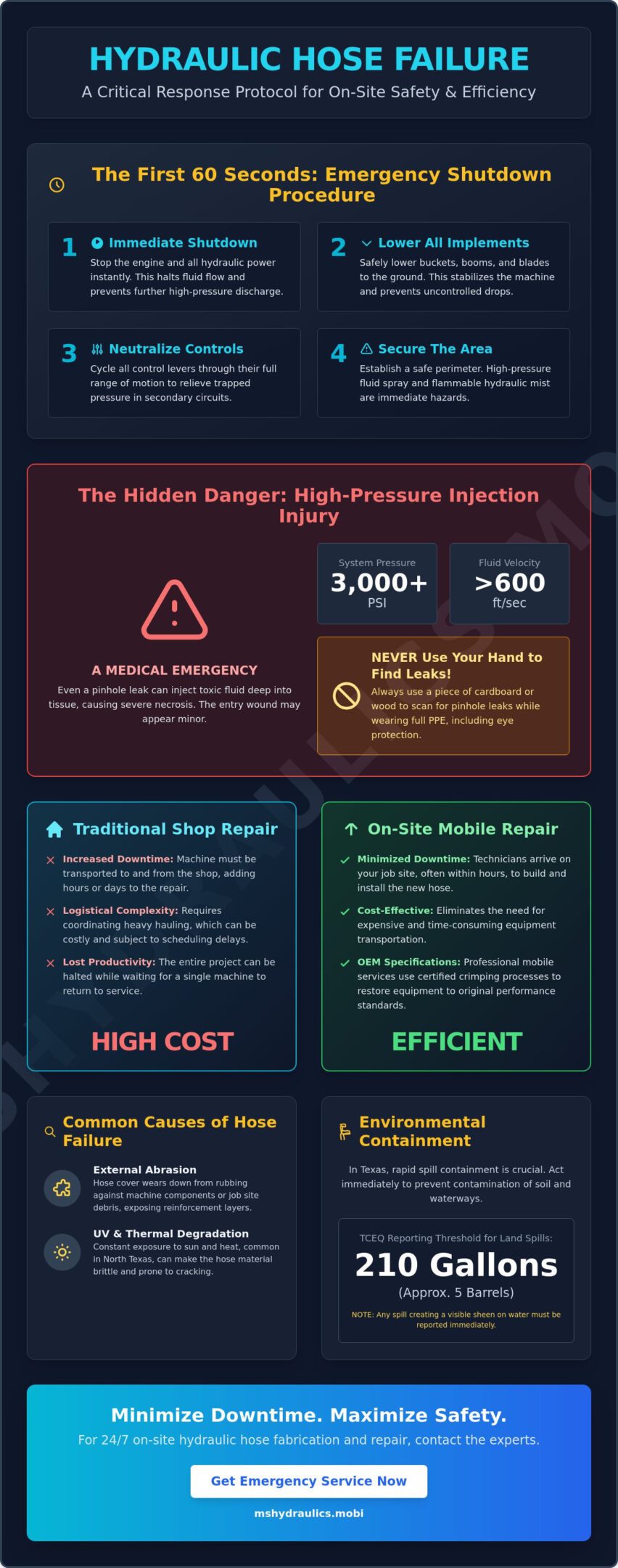
When a hydraulic failure occurs in the field, the operator’s first 60 seconds determine the severity of the outcome. Knowing what to do when a hydraulic hose bursts is critical for maintaining site safety and preventing environmental damage. The primary objective is to eliminate the energy source. Operators must shut down the engine and all hydraulic power immediately. This action stops the pump’s displacement and prevents additional fluid from being ejected under high pressure.
After the engine stops, the operator must lower all implements, such as buckets, booms, or blades, directly to the ground. Leaving equipment suspended relies on the integrity of the remaining hydraulic fluid; if a secondary hose fails, the load will drop without warning. Once the load is secure, neutralize the control levers by moving them through their full range of motion. This process relieves trapped pressure within the secondary circuits. Finally, secure the perimeter. A high-pressure spray can travel significant distances, and hydraulic mist is highly flammable.
The danger of fluid under pressure is often underestimated. Even a pinhole leak can cause High-Pressure Hydraulic Injection Injuries, which are medical emergencies requiring immediate surgical intervention. These injuries often appear as minor punctures but cause extensive internal tissue necrosis. Operators must never use their hands to check for leaks.
Depressurizing the System Safely
Relieving residual pressure requires strict adherence to the manufacturer’s technical manual. Many modern systems utilize an accumulator that stores energy even after the engine is off. Operators should verify that all system gauges read zero PSI before starting any visual inspection. Never attempt to “bleed” the system by loosening a fitting or connection. This practice can result in an explosive disconnection of the component, leading to mechanical failure or severe injury. Professional operators understand that 0 PSI is the only safe state for inspection.
Containing the Fluid Spill on Texas Soil
In Johnson County, operators must act quickly to contain hydraulic fluid to protect Texas soil. Deploy spill kits or absorbent socks immediately to create a barrier. If the fluid enters local waterways or storm drains in Cleburne or Alvarado, the environmental impact increases. The Texas Commission on Environmental Quality (TCEQ) requires reporting for oil spills on land that exceed 210 gallons, which is approximately five barrels. It’s important to remember that any spill creating a visible sheen on water must be reported to the State Emergency Response Center immediately. Quick containment prevents the fluid from migrating into the local water table. Knowing exactly what to do when a hydraulic hose bursts
The Hidden Danger: High-Pressure Hydraulic Injection Injuries
Hydraulic systems operate under extreme conditions, with many industrial machines in Cleburne maintaining pressures exceeding 3,000 PSI. When a breach occurs in the hose wall, the fluid doesn’t merely drip; it exits the orifice at velocities exceeding 600 feet per second. This velocity is sufficient to penetrate heavy work gloves and human skin instantly. This phenomenon, known as hydraulic injection, is a surgical emergency that requires immediate medical intervention. When operators consider what to do when a hydraulic hose bursts, they must prioritize physical distance from the equipment above all else.
A total hose rupture is loud and visually obvious, but a pinhole leak is often more lethal. While a large burst allows system pressure to drop rapidly, a pinhole maintains a concentrated, high-velocity stream. This stream acts like a needle, piercing through subcutaneous tissue without the operator even realizing the depth of the penetration. Understanding the Steps to Take When a Hose Fails is vital because the initial entry wound often appears as a small, harmless puncture. Never use your hand to search for a leak; always use a piece of cardboard or wood to sweep the area while wearing appropriate eye protection.
The technical mechanism of injury involves more than just physical trauma. Once the hydraulic oil enters the body, the chemical toxicity of the fluid begins to destroy human tissue from the inside out. The oil acts as a foreign contaminant that triggers an aggressive inflammatory response. This leads to rapid tissue necrosis, which is the death of body tissue, and the onset of compartment syndrome. In this state, internal swelling cuts off blood flow to the limb, often necessitating amputation if not treated within six hours of the initial exposure.
Symptoms of a Fluid Injection Injury
The initial sensation of an injection injury is deceptive. It often feels like a minor prick or a bee sting, leading many operators to ignore the wound. Within a few hours, the site will become swollen, pale, and intensely painful. Seek emergency medical care immediately, even if the wound looks like a tiny dot. Provide the medical team with the Safety Data Sheet (SDS) for the specific fluid to assist in the debridement process. Time is the most critical factor in preventing permanent disability.
Why Patching a Hose is Never an Option
When determining what to do when a hydraulic hose bursts, some operators attempt temporary fixes using electrical tape, duct tape, or industrial clamps. This is a dangerous violation of engineering protocols. No adhesive or external clamp can withstand the 3,000+ PSI required for standard hydraulic operation. A “secondary failure” often occurs when these patches fail, releasing the fluid with even greater unpredictability. The only safe solution is professional Hydraulic Hose Fabrication to ensure the new assembly meets or exceeds ISO standards. For long-term reliability, always consult an expert hydraulic service provider to perform a certified replacement.
Diagnosing the Cause: Why Did Your Hydraulic Hose Burst?
Identifying the root cause of a failure is the only way to prevent a repeat incident. Operators should first examine the hose cover for signs of abrasion. This typically occurs when lines rub against machine frames or vibrating components. In the North Texas climate, Cleburne operators face specific environmental challenges. Ambient temperatures frequently exceed 100°F during summer months. This intense heat, paired with high UV indices, leads to elastomer hardening and cover cracking. Once the outer layer is compromised, moisture penetrates the reinforcement layers, causing the steel wire to oxidize and weaken.
Installation errors are another primary driver of failure. A common issue is “hose twist.” If a technician torques the hose during fitting, the internal wire braid is forced out of its engineered alignment. This misalignment can reduce the assembly’s pressure capacity by as much as 90%. When analyzing the failure, technicians must inspect the burst site. A body burst often points to fatigue or a pressure spike that exceeded the system’s design limits. Conversely, a coupling blow-off usually indicates a mismatch between the hose and fitting or an improper crimp specification. Understanding these physical markers is essential when determining what to do when a hydraulic hose bursts on a job site.
External vs. Internal Failure Factors
External failures are often visible before the hose actually ruptures. Ozone degradation creates small, spiderweb-like cracks in the cover. Without protective textile or plastic sleeving, these cracks eventually expose the wire braid to the elements. Internal failures are more technical. They often involve fluid incompatibility or extreme pressure spikes that surpass the hose’s SAE J517 rating. A critical factor in these failures is the Minimum Bend Radius. The Minimum Bend Radius is the smallest radius at which a hydraulic hose can be operated without sustaining internal damage or restricting fluid flow. If this radius is exceeded, the hose wall experiences excessive tension on the outside and compression on the inside, leading to premature fatigue.
The Role of Preventative Maintenance
Consistent Heavy Equipment Maintenance allows operators to catch “weeping” at the couplings before it escalates into a catastrophic burst. Visual inspections are the most effective defense. Operators should look for specific indicators of impending failure:
- Bubbling or blistering: This suggests the inner tube has failed and fluid is trapped under the cover.
- Exposed wire braid: Any visible metal reinforcement is a sign that the hose must be replaced immediately.
- Kinking: A permanent deformation that creates a flow restriction and a localized stress point.
The OSHA Hazard Information Bulletin issued in July 1992 emphasizes that even small leaks can lead to fluid injection injuries or fire hazards. Beyond visual checks, regular fluid analysis is necessary. Contaminants such as silica or fine metal shavings act as internal abrasives. These particles erode the inner tube over time, thinning the wall until it can no longer contain the system pressure. When considering what to do when a hydraulic hose bursts, the best strategy is a proactive replacement schedule based on hours of service and environmental exposure.
Mobile vs. Shop Repair: Minimizing Downtime in the DFW Area
Deciding what to do when a hydraulic hose bursts involves a critical choice between transporting the machine to a facility or requesting field service. Moving a 20-ton excavator to a fixed shop requires a specialized lowboy trailer and often a permit for oversized loads. This logistical hurdle adds four to six hours of non-productive labor before any mechanical work begins. In contrast, mobile repair units bring the workshop to the machine, eliminating the need for complex transportation logistics.
The “Downtime Deficit” is a vital metric for project managers in Mansfield, Grandbury, and Waxahachie. It calculates the hourly loss of an idle machine, factoring in operator wages, project delay penalties, and the cost of rental replacements. On major infrastructure projects, this deficit can escalate quickly. Mobile service mitigates these costs by initiating repairs within the hour, ensuring the machine returns to its duty cycle without leaving the job site.
On-site diagnostics provide a technical advantage that shop repairs often miss. A technician observing the machine in its working environment can identify environmental stressors or mechanical misalignments that caused the failure. Fixing the hose without addressing the root cause, such as an abrasive contact point or a malfunctioning relief valve, leads to repeat failures.
The Logistics of On-Site Repair in Johnson County
Mobile units operating in the Cleburne and Fort Worth corridor prioritize rapid response, typically arriving at the equipment within 60 to 90 minutes. These technicians are trained to navigate active construction zones and remote agricultural fields where traditional towing is impossible. The “one-trip” advantage is a hallmark of professional mobile service. Service trucks carry a full inventory of high-pressure hoses, O-rings, and specialized fittings, allowing for immediate fabrication and installation regardless of the machine’s make or model.
Reducing Fleet Liability
When considering what to do when a hydraulic hose bursts, operators must prioritize safety documentation. Professional repair records aid in maintaining ISO standards and insurance compliance. Having a certified technician verify the integrity of the entire hydraulic circuit ensures that the system operates within its designated pressure parameters. For complex system failures involving multiple components, On-Site Diagnostic Services are utilized to prevent catastrophic pump or valve damage. This methodical approach protects the fleet’s long-term value and reduces the risk of future industrial accidents.
Secure your equipment’s performance by contacting MS Hydraulics for expert on-site assistance.
Professional Hose Fabrication: Restoring Your Machine to OEM Specs
Restoring a machine to its original equipment manufacturer (OEM) specifications requires more than a temporary fix. When you are determining what to do when a hydraulic hose bursts, the priority must be a high-precision fabrication process. We begin by measuring the overall assembly length with exactness, factoring in the specific fitting orientation and cut-off lengths. Our technicians use specialized hydraulic hose saws to produce a clean, square cut that prevents wire fraying and ensures a proper seat within the collar.
- Crimping Precision: We utilize calibrated crimping equipment to match the specific die and collar to the hose series. This ensures the compression meets the manufacturer’s exact diameter requirements down to the millimeter.
- Contamination Control: Every new assembly undergoes a rigorous cleaning process. We use high-velocity foam projectiles or dry nitrogen to remove metal shards and rubber dust that could otherwise damage sensitive valves or pumps.
- Final Verification: Technicians perform a visual inspection and pressure test to verify the integrity of the seals before the machine returns to the line.
Proper routing is the final step in the fabrication cycle. We install the hose with enough slack to accommodate pressure surges and ensure it doesn’t rub against sharp chassis edges. This attention to detail prevents 80 percent of premature failures caused by external abrasion.
Matching the Correct Hose and Fittings
Field identification of fittings is a technical task that requires precision tools like thread gauges and calipers. We accurately identify JIC 37-degree flares, ORFS (O-Ring Face Seal), and NPT threads to ensure a leak-free connection. Selecting the reinforcement layer is equally vital; we choose between 2-wire braided hoses for standard applications and 4-wire spiral reinforcement for high-impulse, high-pressure systems. Matching the “Dash Size” exactly is critical for flow rates, as even a minor reduction in internal diameter can cause excessive fluid velocity and heat generation. Understanding what to do when a hydraulic hose bursts involves recognizing that the replacement must match these technical parameters to maintain system balance.
Getting Back to Work with Ms. Hydraulics LLC
Ms. Hydraulics LLC provides the technical expertise needed to keep heavy equipment running across North Texas. Our mobile units serve a broad area including Alvarado, Crowley, and Cedar Hill. We prioritize integrity and technical accuracy to build long-term relationships with our industrial partners. We don’t just swap parts; we engineer solutions that last. If your project has stalled due to a failure, Contact Ms. Hydraulics LLC for Emergency Mobile Hose Repair to restore your system to peak performance with the reliability your operations demand.
Ensuring Operational Continuity and Site Safety
Understanding what to do when a hydraulic hose bursts is the difference between a routine repair and a hazardous medical emergency. Operators must immediately isolate the power source and depressurize the system to prevent high-pressure injection injuries. Since these injuries often appear minor but lead to severe internal damage, seeking specialized medical care within 6 hours is critical. Since 2021, MS Hydraulics has provided expert technicians to Johnson County to address these high-stakes failures with technical precision. Our team restores machines to OEM specifications using on-site fabrication of custom hydraulic hoses, ensuring your equipment’s torque and pressure parameters remain within safe tolerances.
We provide mobile repair for all major heavy equipment brands to minimize your project’s downtime. It’s vital to rely on disciplined engineering rather than temporary fixes that compromise system integrity. If you’re facing a burst line, don’t risk further damage or personnel injury by delaying professional service. Our mobile units are equipped to handle complex replacements directly at your job site in the DFW area.
Request Emergency Mobile Hydraulic Repair in Cleburne & DFW
Your fleet’s reliability is our priority, and we’re ready to get your operations back on track with industrial-grade solutions.
Frequently Asked Questions
Can I use a hydraulic hose repair kit for a permanent fix?
No, you shouldn’t use a hydraulic hose repair kit as a permanent solution. These kits are designed for emergency field use to prevent further fluid loss during transport or to finish a critical task. High-pressure systems often operate at 3,000 to 5,000 PSI, requiring factory-crimped fittings that meet SAE J517 standards to ensure long-term safety. Using a temporary patch on a high-pressure line increases the risk of a catastrophic failure.
How much hydraulic fluid loss is considered an environmental emergency in Texas?
In Texas, a discharge of 25 gallons or more of hydraulic fluid onto land is a reportable environmental emergency. According to Texas Commission on Environmental Quality (TCEQ) regulations, operators must report these spills within 24 hours. If the fluid enters a water source, you must report any amount that creates a visible sheen. Understanding what to do when a hydraulic hose bursts includes immediate containment to avoid these legal liabilities.
What is the most common cause of hydraulic hose failure on excavators?
External abrasion accounts for approximately 80% of hydraulic hose failures on excavators. This typically occurs when hoses rub against the boom or chassis during repetitive movement cycles. If the protective sleeve is compromised, the high-tensile steel reinforcement wires oxidize and weaken. Proper routing and the use of spiral guards or textile sleeves can extend the service life of these components by 50% in high-friction environments.
How do I identify the size and type of hydraulic hose I need?
You can identify the correct replacement by reading the layline printed on the hose exterior. This text provides the internal diameter in dash sizes, where -08 represents 8/16 or 1/2 inch. You must also follow the STAMPED acronym: Size, Temperature, Application, Material, Pressure, Ends, and Delivery. Measuring the thread pitch with a gauge ensures the fittings match ISO 12151 specifications for a leak-free seal.
Is it safe to drive a machine with a leaking hydraulic hose?
It isn’t safe to operate or drive a machine with a leaking hydraulic hose. Even a pinhole leak can lead to a 100% loss of system pressure in minutes, causing a total loss of steering or braking control. Additionally, hydraulic fluid has a flash point between 300 and 600 degrees Fahrenheit. If fluid sprays onto a hot exhaust manifold, it can ignite instantly, resulting in a total vehicle loss.
How long does a mobile hydraulic hose repair typically take?
A standard mobile hydraulic hose repair typically takes 1 to 2 hours from the technician’s arrival. This includes 15 minutes for site safety assessment, 20 minutes for hose fabrication, and 10 minutes for system testing. Knowing what to do when a hydraulic hose bursts involves calling a mobile service immediately to minimize this downtime. Our technicians arrive with fully equipped service vehicles to ensure the machine returns to service quickly.
What should I tell a doctor if I suspect a fluid injection injury?
You must inform the doctor that the injury involves a high-pressure fluid injection, not a standard puncture. Specify the fluid type, the estimated pressure, which can exceed 3,000 PSI, and the exact time the exposure occurred. These injuries require immediate surgical consultation to prevent compartment syndrome. Don’t wait for symptoms like swelling or discoloration, as internal tissue damage begins within minutes of the initial injection.
Does Ms. Hydraulics offer 24/7 emergency service in Fort Worth?
Yes, Ms. Hydraulics provides 24/7 emergency mobile repair services throughout Fort Worth and the surrounding Tarrant County area. Our technicians are available 365 days a year to handle critical system failures that occur outside of standard business hours. We maintain a fleet of service trucks stocked with over 1,000 different fittings and various hose grades to ensure we can resolve most on-site issues during a single service call.