Mobile Hydraulic Diagnostics in Fort Worth: Precision On-Site Troubleshooting (2026)
How much does a single hour of unplanned machinery downtime cost your operations when the global hydraulic repair market is projected to reach $1.23 billion in 2026? For many Fort Worth contractors, the true expense isn’t just the lost labor; it’s the thousands of dollars wasted on “parts-changing” guesses that fail to resolve the actual system failure. Professional mobile hydraulic diagnostics Fort Worth services replace this trial-and-error approach with disciplined field engineering. By deploying precision instrumentation to measure pressure and flow at the point of breakdown, you bypass the logistical burden of transporting heavy machinery to a specialized shop.
You already know that waiting for a tow is a liability your project schedule can’t afford. This article demonstrates how professional mobile diagnostics eliminate guesswork and minimize downtime for heavy equipment across the Fort Worth metroplex. We’ll outline the technical process for rapid root cause identification, the necessity of on-site repair validation, and the value of receiving a detailed technical report on your system health to ensure long-term mechanical reliability.
Key Takeaways
- Professional mobile hydraulic diagnostics Fort Worth utilize systematic failure analysis to identify root causes at the equipment location, eliminating the cost of “parts-changing” guesswork.
- Calibrated pressure testing and flow analysis under load allow for precise measurement of GPM and relief settings, ensuring components meet original engineering specifications.
- Bypassing the “Tow-and-Wait” trap of traditional shop backlogs significantly reduces the Total Cost of Ownership (TCO) and minimizes project delays.
- Understanding the impact of North Texas temperature fluctuations on fluid viscosity is critical for preventing common failure modes in excavators and skid steers.
- Engineering-led field diagnostics provide a detailed technical report on system health, validating on-site repairs and ensuring long-term operational reliability across the DFW metroplex.
The Role of Mobile Hydraulic Diagnostics in Fort Worth Operations
Mobile hydraulic diagnostics Fort Worth operations require more than a cursory glance at a leaking fitting; they demand a disciplined engineering approach to field failure analysis. We define these diagnostics as a systematic process of evaluating hydraulic circuits at the machine’s primary location to identify the root cause of performance degradation. In an era where the global hydraulic components repair market is projected to reach $1.23 billion in 2026, the demand for precision on-site troubleshooting has never been higher. For Fort Worth construction and industrial sectors, this service is a critical component of operational uptime.
Visual inspections are largely insufficient for modern high-pressure systems. A technician might see a weeping seal, but they can’t see the internal bypass in a valve or the loss of volumetric efficiency in a pump. Effective diagnostics rely on the fundamental hydraulic machinery principles of pressure, flow, and temperature. By integrating these field diagnostics into a broader preventative maintenance strategy, DFW fleet managers can transition from reactive “firefighting” to data-driven asset management. This shift ensures that every component, from high-torque motors to precision control valves, operates within its designed performance parameters.
Minimizing Downtime in the I-35 and Chisholm Trail Corridors
Transporting heavy equipment through the high-traffic corridors of Tarrant County, such as I-35W or the Chisholm Trail Parkway, presents a significant logistical challenge. The costs associated with heavy-haul permits and the time lost in transit often exceed the cost of the actual repair. On-site mobile hydraulic diagnostics Fort Worth services eliminate this burden by bringing the laboratory to the machine. Our focus on a high “First-Time Fix” rate is supported by precision instrumentation that prevents repeat service calls. This rapid-response technical expertise is vital for supporting local infrastructure projects where project deadlines are rigid and equipment availability is non-negotiable.
Technical Standards in Field Failure Analysis
Precision diagnostics require strict adherence to technical standards to ensure accurate data collection. We emphasize the following protocols during every field engagement:
- Fluid Cleanliness: Adherence to ISO 4406 standards during field sampling to detect particulate contamination that leads to accelerated wear.
- Data-Driven Evaluation: Utilizing digital flow meters and pressure transducers to measure system health rather than relying on subjective “feel” or sound.
- System Integrity: Validating the entire circuit after a catastrophic component failure to ensure debris hasn’t compromised downstream valves or cylinders.
This methodical transition from “parts swapping” to engineering-led evaluation ensures that we identify the actual failure point. If a pump has failed, we determine why it failed. Whether the cause was cavitation, aeration, or fluid degradation, identifying the source prevents the new component from suffering the same fate within hours of installation.
Core Diagnostic Procedures: From Pressure Testing to Flow Analysis
Identifying the root cause of a system failure requires a methodical application of data collection techniques. Professional mobile hydraulic diagnostics Fort Worth technicians rely on high-fidelity instrumentation to isolate variables within complex circuits. We utilize calibrated gauges to benchmark pump output and relief valve settings against the manufacturer’s original equipment (OE) specifications. This baseline data is essential for determining whether a component has suffered a catastrophic failure or is simply out of adjustment.
Flow testing provides the next level of insight by measuring Gallons Per Minute (GPM) under specific load conditions. This is the only reliable method to quantify internal component leakage. When a pump’s volumetric efficiency drops below 85 percent, heat generation increases and cycle times slow down significantly. Infrared thermography complements this by allowing for the non-invasive identification of localized heat signatures. These signatures often indicate internal valve bypass or excessive mechanical friction that isn’t visible to the naked eye. Finally, on-site fluid sampling detects metallic wear particles and particulate contamination, providing immediate insight into the health of the system’s internal surfaces.
Advanced Instrumentation for Field Technicians
Digital pressure transducers offer a superior sampling rate compared to analog gauges, allowing for the capture of erratic pressure spikes that occur in milliseconds. These transients often cause fatigue in high-pressure hoses and seals but remain invisible on standard needle gauges. Ultrasonic leak detection further enhances our capabilities by identifying high-frequency sound waves generated by internal valve bypass, enabling diagnosis without invasive disassembly. A flow meter serves as the primary tool for determining volumetric efficiency by measuring the actual fluid volume delivered against the theoretical displacement of the pump. These advanced hydraulic fault diagnosis techniques ensure that field evaluations match the accuracy of laboratory environments. For operators requiring immediate technical support, our team provides comprehensive on-site diagnostic services throughout the metroplex.
The Systematic Troubleshooting Workflow
Our technicians follow a rigid three-step workflow to ensure no variable is overlooked during an emergency call-out:
- Step 1: Symptom Documentation: We begin with a detailed operator interview to establish the failure timeline and document specific operational symptoms.
- Step 2: Low-Pressure Verification: We verify the integrity of suction lines and filters to rule out cavitation or aeration, which can mimic more expensive component failures.
- Step 3: Component Isolation: We perform high-pressure component isolation and performance benchmarking. This involves blocking off sub-circuits to measure the efficiency of individual pumps and motors under full operational pressure, typically ranging from 3,000 to 5,000 PSI.
This structured approach ensures that we don’t just find a fault; we find the specific fault that caused the downtime. By focusing on data rather than intuition, we provide a definitive path toward repair.
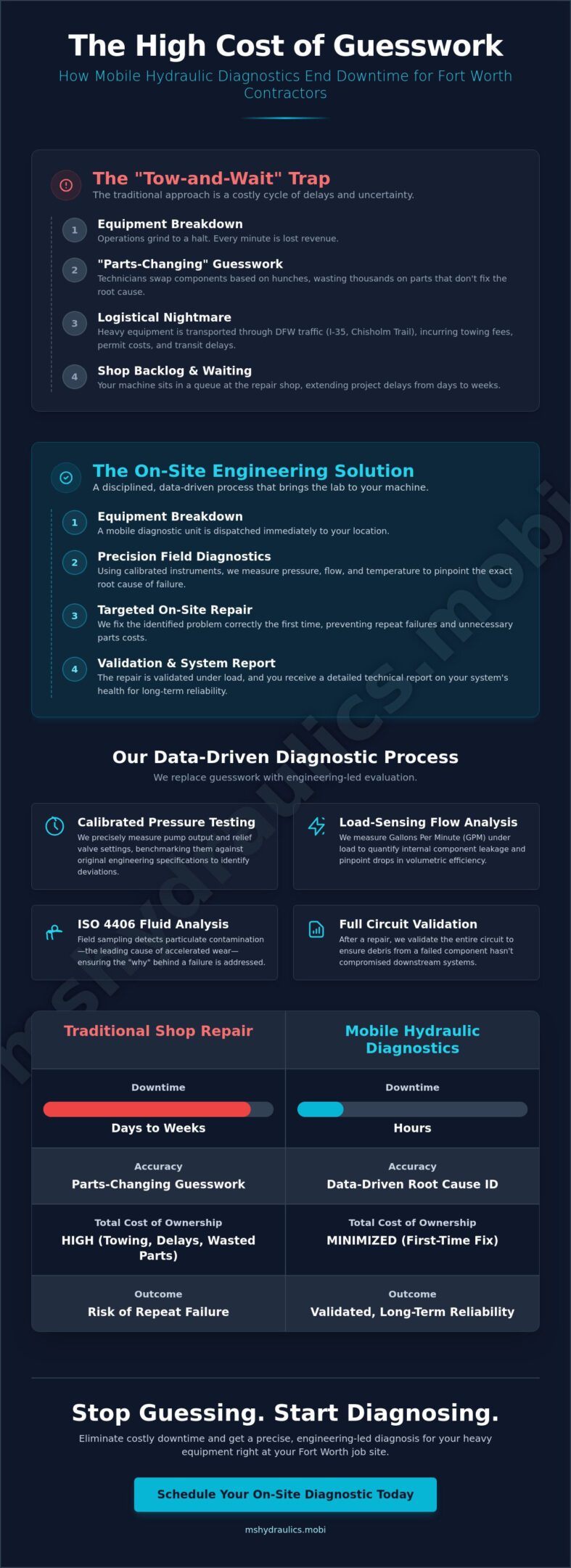
Comparing On-Site Diagnostics vs. Traditional Shop Repairs
Evaluating the Total Cost of Ownership (TCO) for heavy equipment maintenance requires looking beyond the hourly labor rate. Traditional shop repairs involve a “Tow-and-Wait” cycle that often extends downtime by 5 to 10 business days due to transportation logistics and shop backlogs. In contrast, mobile hydraulic diagnostics Fort Worth services allow for an immediate assessment of the machinery in its operational environment. This on-site approach eliminates the secondary costs of equipment hauling while providing a faster path to system restoration. While a specialized clean-room environment is occasionally necessary for high-precision component rebuilds, approximately 75 percent of hydraulic failures can be accurately diagnosed and often resolved without the machine leaving the job site.
Safety and environmental risks also decrease when diagnostics happen on-site. Moving a compromised machine with a high-pressure leak increases the risk of environmental contamination during transit. By performing a systematic failure analysis at the point of breakdown, technicians contain fluids and mitigate the risk of catastrophic failure that could occur during the loading process. This method ensures that the machine only moves when it’s technically sound or when the diagnosis confirms that a shop-based rebuild is the only viable engineering solution.
Logistical Cost Analysis for North Texas Operators
Transporting oversized machinery across the DFW metroplex involves significant logistical hurdles. Heavy-haul transport fees for a standard excavator can exceed several hundred dollars per trip, excluding the cost of required permits for wide loads on Tarrant County highways. The opportunity cost is even higher; every hour a machine spends on a trailer is an hour it doesn’t generate revenue. On-site diagnostics provide the unique advantage of real-world load testing. Technicians observe the hydraulic system’s performance under actual working conditions, such as the specific soil density of a North Texas job site, which a stationary shop test bench cannot perfectly replicate.
Data Integrity and Reporting
Modern field engineering relies on digital diagnostic reports that provide fleet managers with verifiable system data. These reports serve as a technical bridge between the field and the office, documenting pressure readings, flow rates, and thermal signatures. Utilizing professional On-Site Diagnostic Services is essential for maintaining accurate warranty documentation. When a component fails, manufacturers require documented proof that the rest of the system was operating within specified parameters. By establishing these baseline performance metrics during a field visit, we ensure long-term reliability and provide a clear history of the machine’s mechanical health. This data-driven approach transforms a simple repair into a strategic asset management tool.
Critical Failure Points for North Texas Heavy Equipment
North Texas heavy equipment operates under extreme environmental stressors that demand specialized maintenance protocols. The volatility of the regional climate directly impacts hydraulic system integrity, particularly concerning fluid chemistry and component tolerances. Professional mobile hydraulic diagnostics Fort Worth technicians frequently identify failures rooted in the region’s sharp temperature shifts. When ambient temperatures exceed 100°F, hydraulic fluid viscosity often drops below the minimum threshold required for adequate lubrication. This thinning leads to increased friction and accelerated wear in high-speed components like piston pumps and motors, eventually resulting in a loss of volumetric efficiency.
Specific industries in the metroplex face unique mechanical challenges. Drill rigs operating in the Barnett Shale area encounter high-torque loads and relentless duty cycles that place immense strain on relief valves and telescopic cylinders. In contrast, excavators and skid steers working in the rocky terrain of Alvarado and Cleburne often suffer from abrasive wear on external components. Intense UV radiation in North Texas further complicates matters by causing the outer rubber compounds of hydraulic hoses to crack and lose flexibility. When these weakened hoses are exposed to abrasive Texas soil, the risk of a high-pressure burst increases significantly, potentially leading to catastrophic fluid loss and environmental contamination.
Heat-Induced Component Degradation
Fort Worth summers, where temperatures consistently surpass 100°F, accelerate the hardening of nitrile and Viton seals. Once these seals lose their elasticity, they can no longer maintain a positive seal under pressure, leading to both external leaks and internal bypass. The efficiency of the machine’s cooling system is directly proportional to the longevity of its hydraulic components; a clogged oil cooler can raise system temperatures by 30°F in less than an hour of operation. Thermal expansion in precision valves can reduce internal clearances to the point of mechanical interference, causing spools to bind or stick during critical maneuvers. To prevent these heat-related failures, operators should schedule a field diagnostic review before the peak summer season begins.
Contamination Control in Rugged Environments
Dust and particulate ingress are constant threats on active construction sites in Mansfield and Arlington. Fine silica dust acts as a lapping compound when it enters a hydraulic circuit, quickly destroying the polished surfaces of valve spools and cylinder rods. Breather filters serve as the primary defense against atmospheric contaminants, yet they’re often overlooked during routine inspections. High-efficiency return-line filtration is equally critical for capturing wear debris before it reaches the reservoir. During on-site repairs, technicians must utilize capped hoses and clean-room practices to prevent cross-contamination, ensuring that the mobile hydraulic diagnostics Fort Worth process doesn’t introduce new pollutants into a sensitive system.
Ms. Hydraulics LLC: Precision Field Diagnostics for the DFW Metroplex
Ms. Hydraulics LLC serves as a disciplined technical partner for industrial entities across North Texas. Our methodology prioritizes factual accuracy and engineering expertise over the trial-and-error methods common in the repair industry. By providing mobile hydraulic diagnostics Fort Worth, we ensure that heavy machinery remains operational without the logistical burden of shop transport. Our service coverage is extensive. We support operations from the urban centers of Fort Worth and Arlington to the critical industrial hubs of Cleburne and Waxahachie. This regional presence allows for rapid response times. Such speed is essential for maintaining project schedules in competitive sectors.
The approach used by Ms. Hydraulics LLC is rooted in a tradition of reliability and modern efficiency. We recognize that industrial players require a partner that values performance above evocative marketing. Every diagnostic call is treated as a technical audit of the system’s health. We provide clear, declarative findings that allow fleet managers to make informed decisions regarding their equipment. This “no-nonsense” standard ensures that your operations stay on track, backed by data and professional decorum.
Our Mobile Diagnostic Capabilities
Our field units function as mobile laboratories. We are equipped for comprehensive high-pressure system analysis and mobile hydraulic repair Cleburne TX. Beyond simple troubleshooting, our technicians perform on-site hose fabrication. This capability allows for the immediate restoration of service after a line failure. Ms. Hydraulics LLC maintains deep technical expertise in cylinder, pump, and motor troubleshooting for all major global brands. Our team analyzes specific parameters like displacement and torque to identify internal wear before it results in a total system collapse. This cross-platform proficiency ensures that the diagnostic data remains precise and actionable regardless of the equipment manufacturer.
Securing Your Industrial Assets
Reliability in the hydraulic industry is built on adherence to established standards. Our commitment to ISO-aligned service protocols ensures that every field engagement meets rigorous quality and safety benchmarks. Ms. Hydraulics LLC provides direct access to expert technicians for job sites in Alvarado, Granbury, and Crowley. This service bridges the gap between high-level engineering and field-level execution. We don’t just fix symptoms; we solve the root cause. This disciplined approach secures your industrial assets against the recurring costs of improper diagnosis. Our long-term partnerships with DFW fleet managers are built on this foundation of technical integrity and predictable performance. Contact Ms. Hydraulics LLC for professional on-site diagnostics today.
Advancing Operational Reliability Through Precision Field Engineering
Effective fleet management in the DFW metroplex requires transitioning from reactive parts-swapping to a disciplined, data-driven methodology. By utilizing professional mobile hydraulic diagnostics Fort Worth, you ensure that every pressure transient and volumetric inefficiency is identified at the source. This systematic approach eliminates the logistical burden of transporting heavy machinery while providing verifiable system data that validates the health of your hydraulic circuits. As established, the North Texas climate accelerates component wear, making precise, on-site troubleshooting an essential component of any preventative maintenance strategy.
Ms. Hydraulics LLC has provided specialized high-pressure system analysis across the entire DFW Metroplex since 2021. Our technicians utilize ISO-standard compliant procedures to measure performance parameters and restore machine uptime directly on the job site. You don’t have to accept the “Tow-and-Wait” cycle as an operational standard. We provide the technical expertise and engineering precision required to maintain a competitive advantage in the industrial sector. Schedule Your On-Site Diagnostic Call Now and secure the long-term reliability of your heavy equipment fleet. Ms. Hydraulics LLC stands ready to support your next project with technical excellence.
Frequently Asked Questions
What is included in a mobile hydraulic diagnostic service call?
A standard service call includes a comprehensive evaluation of the hydraulic circuit, including pressure benchmarking, flow analysis, and a visual inspection of all high-pressure conduits. Our technicians utilize calibrated instrumentation to measure system performance against original equipment manufacturer specifications. Every engagement concludes with a technical report that documents pressure readings, flow rates, and identified failure points to ensure a transparent repair path.
Can you diagnose a hydraulic pump failure without removing it from the machine?
Technicians accurately diagnose pump health while the unit remains installed by utilizing digital flow meters and pressure transducers. We measure the pump’s volumetric efficiency under full operational load to determine if internal bypass exceeds the standard 15 percent tolerance. This on-site approach identifies whether the issue resides within the pump itself or stems from a downstream valve malfunction, preventing unnecessary component removal.
How quickly can a technician arrive at a job site in Fort Worth or Arlington?
Response times for the Tarrant County area typically range from 2 to 4 hours depending on current field deployments and traffic conditions. Our dispatch protocols prioritize emergency breakdowns on major infrastructure projects to mitigate the high cost of machinery downtime. We maintain a fleet of fully equipped service vehicles to ensure that a technician arrives with the necessary diagnostic tools for immediate system analysis.
What information should I have ready before calling for mobile diagnostics?
Please provide the machine’s make, model, and serial number along with a detailed description of the operational failure. It’s helpful to note if the symptom is constant or intermittent, such as performance degradation that only occurs after 30 minutes of operation. This data allows our technical team to prepare specific circuit diagrams and select the appropriate transducers for your machine’s pressure ratings.
Are your on-site diagnostic tools as accurate as those in a repair shop?
Our field instrumentation maintains the same precision and calibration standards as stationary shop test benches. We utilize digital pressure transducers with high sampling rates to capture transient spikes that analog gauges often miss. By adhering to ISO 9001-aligned protocols for data collection, we ensure that every field measurement is technically sound and provides a reliable basis for engineering decisions.
Do you provide diagnostic services for specialized equipment like drill rigs or pavers?
We provide specialized troubleshooting for complex industrial machinery, including foundation drill rigs, asphalt pavers, and high-capacity cranes. Our technicians possess the technical expertise required to analyze load-sensing systems and closed-loop hydrostatic drives. This specialized knowledge is critical for maintaining the tight tolerances and sophisticated control logic found in modern infrastructure and energy sector equipment.
What happens if a component is found to be non-repairable on-site?
If the diagnostic process confirms that a component requires a clean-room rebuild, we provide a detailed failure report and coordinate the removal of the unit. The machine remains at your job site while the specific pump, motor, or valve is transported to our facility for restoration to OE specifications. This strategy minimizes transport costs while ensuring the core repair meets the highest engineering standards.
How do mobile diagnostics help with long-term heavy equipment maintenance?
Regular mobile hydraulic diagnostics Fort Worth establish a performance baseline that allows fleet managers to track wear trends over time. Identifying a 5 percent drop in flow during a scheduled check can prevent a catastrophic failure later in the project. This proactive, data-driven approach has been shown to reduce unplanned mechanical downtime by 25 percent to 35 percent across industrial fleets.