Expert Hydraulic Repair in Cleburne and DFW: Minimizing Industrial Downtime in 2026
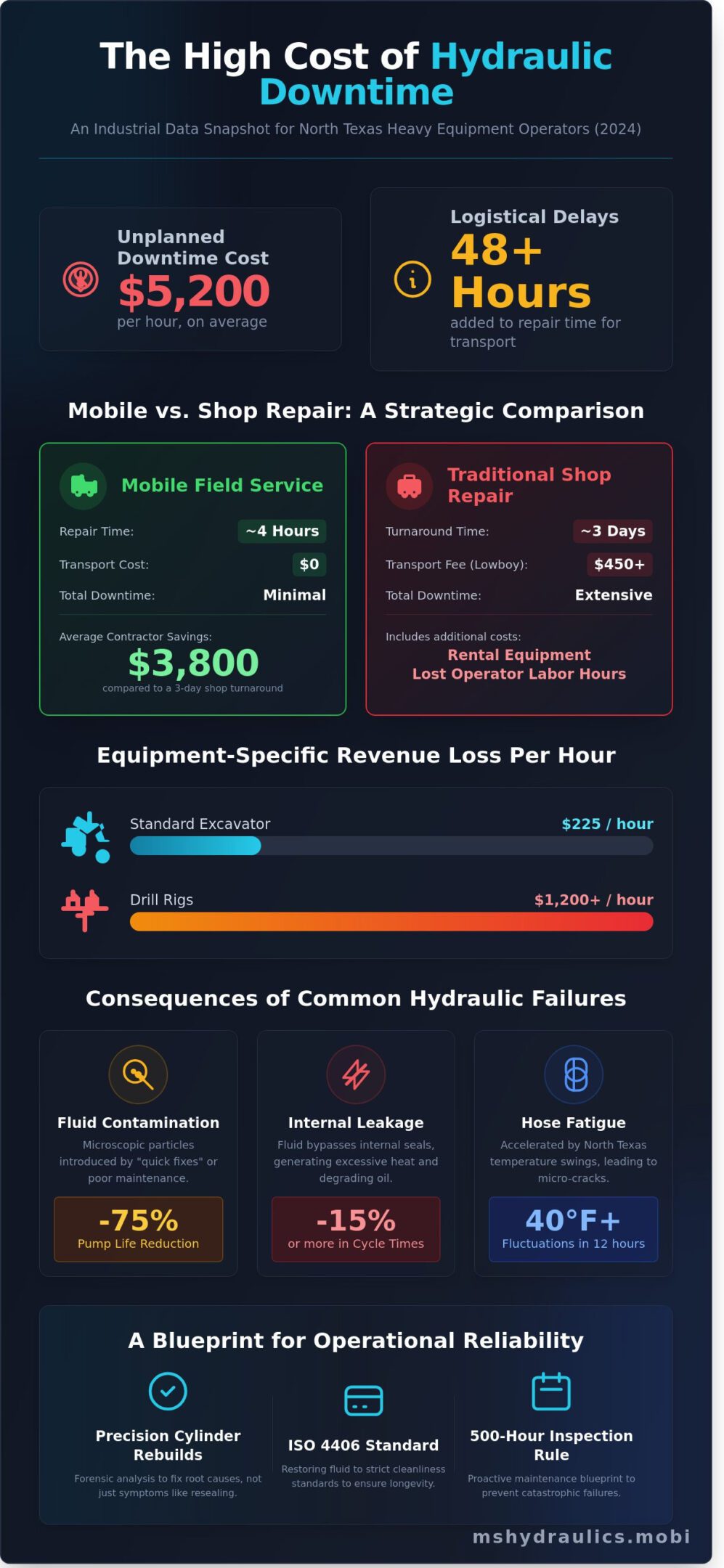
Industrial data from 2024 indicates that a single hour of unplanned downtime costs North Texas heavy equipment operators an average of $5,200 in lost productivity. When a critical seal fails or a cylinder loses pressure, the logistics of transporting 20-ton machinery to a specialized facility often adds 48 hours to the total repair timeline. Efficient hydraulic repair shouldn’t require such expensive logistical delays or the risk of secondary component failure during transport.
You’ve likely experienced the frustration of inconsistent repairs that fail within 500 operating hours; it’s a costly reality for fleet managers across Cleburne and the DFW Metroplex. This guide demonstrates how precision cylinder rebuilds and professional mobile services restore equipment to ISO 4406 cleanliness standards while eliminating transport costs. We’ll examine the specific technical benchmarks and engineering protocols for 2026 that ensure your machinery maintains peak displacement and torque for long-term operational reliability. By prioritizing ISO-standard quality and rapid on-site response, you can secure your equipment’s performance against the rising costs of industrial delays.
Key Takeaways
- Quantify the economic impact of system failures and learn how to minimize downtime costs for heavy machinery across the North Texas industrial landscape.
- Distinguish between standard resealing and precision forensic cylinder rebuilds to maintain high-pressure performance and equipment longevity.
- Determine when to deploy mobile hydraulic repair services versus traditional shop machining based on technical diagnostics and logistical requirements.
- Adopt a professional maintenance blueprint that utilizes the 500-hour inspection rule and addresses the effects of Texas thermal conditions on fluid viscosity.
The Economic Impact of Hydraulic Failure in North Texas Industries
Precision defines the operational threshold of industrial machinery. Professional hydraulic repair involves the systematic restoration of components that manage extreme force through pressurized fluid. In North Texas, where heavy equipment operates under 3,500 PSI loads, a single seal failure halts operations immediately. For an excavator operator in Cleburne, downtime isn’t just an inconvenience; it’s a direct hit to the bottom line. Lost revenue for a standard excavator in the DFW metroplex averages $225 per hour. Drill rigs used in regional foundation work face even steeper losses, often surpassing $1,200 for every hour the machine remains idle.
Johnson County’s economic backbone relies on the seamless interaction of hydraulic cylinders, pumps, and motors. Whether it’s a John Deere tractor in Alvarado or a Cat skid steer on a Mansfield residential site, these machines are the primary drivers of local production. Understanding Hydraulic machinery principles is vital for recognizing why temporary patches fail. These systems rely on Pascal’s law to multiply force. When a technician applies a “quick fix” without addressing fluid cleanliness, they risk introducing particulate matter. According to ISO 4406 standards, even microscopic contaminants can reduce pump life by 75%. This leads to catastrophic system failure and repair bills that often double the initial estimate.
Common Hydraulic Failure Points in Heavy Equipment
Internal leakage often goes unnoticed on a Cleburne job site until cycle times drop by 15% or more. This occurs when fluid bypasses internal seals in cylinders or valves, generating excessive heat that degrades the remaining oil. Conversely, external leaks are obvious safety hazards that signal immediate pressure loss. Aeration and cavitation represent more technical threats. Aeration introduces air into the fluid, causing a “spongy” response. Cavitation occurs when vacuum bubbles implode against metal surfaces, pitting pumps and valves. North Texas temperature swings, which can fluctuate 40 degrees in 12 hours, accelerate hose fatigue. The rubber compounds in hydraulic lines expand and contract, leading to micro-cracking and eventual bursts.
The Logistics of Downtime in Cleburne and Alvarado
Transporting a disabled skid steer or excavator to a stationary shop in Fort Worth involves high logistics costs. A typical lowboy transport fee in Johnson County starts at $450, excluding the hourly rate for the driver. Large-scale infrastructure projects in Mansfield and Arlington demand 98% equipment uptime to meet strict municipal deadlines. A 2023 analysis showed that a 4-hour mobile hydraulic repair saves a contractor approximately $3,800 compared to a 3-day shop turnaround. This figure accounts for transport, rental replacement costs, and lost labor hours for the machine operator. Rapid response isn’t a luxury; it’s a requirement for maintaining the tight margins of modern North Texas industrial operations. Efficiency in repair protocols ensures that torque and displacement parameters return to factory specifications without the need for costly equipment relocation.
Advanced Technical Standards for Hydraulic Cylinder Rebuilds
Performance reliability in Johnson County requires more than a standard seal replacement. A simple reseal only addresses the symptom of fluid loss; it doesn’t solve the underlying mechanical fatigue. A comprehensive cylinder rebuild restores the component to its original design intent. Ms. Hydraulics utilizes a disciplined disassembly process to perform forensic failure analysis on every unit. By identifying the root cause, such as side loading or contaminated fluid, we prevent repeat downtime. Our technicians adhere to the rigorous standards established by the National Fluid Power Association to ensure every hydraulic repair meets international safety and performance benchmarks.
Precision Component Inspection and Machining
Precision is the foundation of a successful rebuild. We measure every barrel and rod against OEM specifications, often requiring tolerances within 0.002 inches. A rod that deviates more than 0.001 inches per foot from absolute straightness will cause uneven seal wear and localized heat buildup. We identify surface pitting and scoring through 10x magnification. These microscopic defects compromise system pressure by allowing fluid bypass. We utilize vertical honing to restore the internal barrel finish to a 16-20 Ra micro-inch surface, ensuring the piston seal maintains a consistent 100% contact patch during high-pressure cycles. When dealing with complex piston assemblies that require specialized restoration techniques, our hydraulic piston repair services in Cleburne and DFW provide the engineering precision necessary to restore components to OEM specifications.
High-Performance Seal and Material Selection
Texas industrial environments present unique thermal challenges. Standard nitrile seals often fail when operating temperatures exceed 210 degrees Fahrenheit. We select seal kits featuring Viton or advanced polyurethanes designed for high-cycle applications. On DFW construction sites, dust ingress is a primary failure vector. We install heavy-duty wiper seals to scrape 99.8% of contaminants from the rod before they enter the gland. This meticulous material selection extends the service life of the equipment by 40% compared to generic aftermarket alternatives. We prioritize materials that maintain elasticity under extreme torque and pressure fluctuations.
Final validation occurs on our specialized test benches. Every rebuilt cylinder undergoes static and dynamic pressure testing at 1.5 times its rated working pressure, often reaching 5,000 or 10,000 PSI depending on the series. We monitor for bypass leakage and drift to confirm the integrity of the internal seals. This objective data provides the assurance that the equipment is ready for immediate field deployment. A successful hydraulic repair isn’t complete until the unit demonstrates 100% volumetric efficiency. If your machinery requires this level of engineering precision, you can schedule a technical assessment with our Johnson County team.
Our facility maintains a library of technical data for over 500 cylinder models. This allows us to verify internal clearances and seal squeeze percentages with mathematical certainty. We don’t guess at specifications. We follow a methodical flow from initial measurement to final certification. This structured approach mirrors the engineering processes of the world’s leading manufacturers, providing a sense of order and predictability for our B2B clients who cannot afford unplanned maintenance delays.
Mobile Field Service vs. Traditional Shop Repair: A Strategic Comparison
Selecting the appropriate service modality for a hydraulic repair often determines the total cost of ownership for heavy machinery. For operators in Johnson County, the decision hinges on the technical requirements of the failure. Mobile field service addresses approximately 82% of common hydraulic failures, specifically those involving hose ruptures, seal leaks, and valve malfunctions. When a component requires precision machining, such as honing a cylinder barrel or resurfacing a pump’s wear plate, the controlled environment of a traditional shop becomes mandatory. Ms. Hydraulics LLC maintains a fleet of mobile units that bridge this gap, utilizing 2026-spec diagnostic tools to ensure field repairs meet ISO 4406 cleanliness standards.
Efficiency in the field isn’t just about speed; it’s about technical accuracy. Our technicians in Granbury and Crowley deploy mobile service trucks equipped with integrated fluid analysis kits. These units allow for the immediate identification of particulate contamination levels before a single bolt is turned. If a system shows a high concentration of metallic debris, a field repair might only serve as a temporary fix. In these instances, we transition the asset to our centralized facility where ultrasonic cleaning and multi-stage bench testing can be performed. This data-driven approach eliminates the guesswork that often leads to repeat failures in industrial settings.
On-Site Diagnostic Capabilities
Field diagnostics have evolved beyond simple visual inspections. Our technicians utilize digital flow meters capable of measuring up to 150 GPM and pressure transducers that capture spikes at 10,000 PSI with 0.1% accuracy. We implement a strict “clean-site” protocol to prevent environmental ingress during the repair process. This involves using sealed vacuum systems and localized containment to maintain hydraulic purity. Real-time troubleshooting of proportional valves and hydrostatic drives ensures that complex logic issues are resolved without transporting the entire machine.
Custom Hose Fabrication in the Field
The 2026 mobile units operated by Ms. Hydraulics LLC feature IoT-enabled crimping technology that syncs with cloud-based OEM specifications. This ensures every hose assembly matches the original manufacturer’s pressure ratings and bend radii exactly. We carry an inventory of over 400 fitting types, including JIC, ORFS, and BSPP, to eliminate wait times for specialized parts. Each field-crimped line undergoes a three-point quality check, including digital caliper verification of crimp diameters to within 0.001 inches, ensuring high-pressure reliability in demanding Texas environments.
Strategic deployment of mobile assets allows Ms. Hydraulics LLC to reach job sites in Crowley within 45 minutes of a dispatched call. Since January 2024, our field-first initiative has reduced average client downtime by 34% compared to traditional shop-only models. By bringing advanced hydraulic repair technology directly to the equipment, we minimize the logistical burden of heavy hauling. We prioritize operational uptime through a disciplined application of engineering standards, ensuring that every field repair provides the same longevity as a shop-based overhaul. Our commitment to technical excellence remains the standard for industrial and construction partners across the region.
Operational Reliability: A Maintenance Blueprint for Texas Heavy Equipment
Adhering to a rigorous 500-hour inspection cycle serves as the engineering baseline for operational uptime. This specific interval allows technicians to monitor critical performance metrics such as pump case drain flow and actuator cycle times. In Johnson County, where heavy machinery often operates at 90% load capacity, these metrics provide the data necessary to predict component fatigue. A proactive replacement schedule for high-wear components, specifically dynamic seals and high-pressure hoses, should be executed every 2,000 operating hours to mitigate the risk of unplanned hydraulic repair.
Texas ambient temperatures frequently exceed 100°F during summer months, which directly impacts fluid kinematics. High thermal loads reduce oil viscosity, leading to increased internal leakage and a measurable drop in volumetric efficiency. A system operating at 210°F can experience a 15% reduction in power output compared to its rated specifications. Contamination remains the primary catalyst for 75% of hydraulic failures in North Texas. The fine, abrasive dust characteristic of regional construction sites infiltrates systems, causing accelerated silt orificing in sensitive servo valves. It’s vital to maintain sealed reservoirs to prevent these particulates from entering the circuit.
Hydraulic Fluid Management and Analysis
Fluid analysis serves as a precise diagnostic blood test for heavy machinery. By measuring metallic wear particles, operators identify internal degradation before a total system collapse occurs. Maintaining ISO 4406 cleanliness levels is mandatory. For the DFW climate, selecting ISO VG 46 or 68 ensures the fluid maintains film strength at peak temperatures. Mixing incompatible fluids is a critical error; chemical additives can react to form sludge that rapidly occludes 10-micron filters.
Preventative Protocols for Extreme Environments
Daily operator checklists are the first line of defense. These protocols must include a visual inspection of chrome-plated cylinder rods for scoring. In Waxahachie and Cedar Hill, abrasive limestone dust requires specialized boot protectors for exposed rods to prevent seal abrasion. Winterization is also vital. When temperatures drop below 32°F, specific cold-start procedures are necessary to prevent pump cavitation. Consistent monitoring reduces the frequency of emergency hydraulic repair and extends component life.
Ms. Hydraulics: On-Site Hydraulic Repair Solutions for Cleburne and DFW
Ms. Hydraulics operates with a disciplined focus on mechanical precision and technical authority. Established as a Cleburne-owned business in 2021, we’ve built a reputation for engineering excellence across the North Texas industrial sector. Our team consists of industrial veterans who understand that equipment downtime translates directly to lost revenue. We provide a no-nonsense approach to every hydraulic repair, prioritizing factual data and rigorous engineering standards. Our technicians arrive at your site with the specialized tools and diagnostic equipment required to address system failures at the source.
Our operational footprint covers the entire DFW metroplex and surrounding counties. We routinely deploy mobile service units from our Cleburne headquarters to job sites in Granbury, Weatherford, and Burleson. We don’t just patch visible leaks. We evaluate the entire hydraulic circuit to ensure that operating pressures, flow rates, and torque outputs align with original equipment manufacturer specifications. This commitment to technical accuracy ensures that your machinery returns to service with verified reliability and peak performance metrics.
Integrity in the hydraulic industry requires more than just mechanical skill; it demands a commitment to transparency and documented results. We utilize standardized testing protocols to verify the integrity of pumps, motors, and valves before we clear a machine for operation. Whether your system requires a simple hose replacement or a complex component overhaul, we maintain a professional decorum that reflects our status as a serious partner for global industrial players. We focus on the parameters that matter, such as displacement efficiency and contamination control according to ISO 4406 standards.
Specialized Service for Local Industries
Large-scale fleets in Arlington and Mansfield rely on our customized maintenance plans to prevent catastrophic failures. We provide rapid emergency response for critical infrastructure projects and drilling operations where precision is non-negotiable. Since 2021, our Cleburne-based team has supported local industry by delivering technical solutions that meet the high-pressure demands of the Texas oil and gas market. For operations requiring the most rigorous engineering standards, our hydraulic cylinder repair Houston and North Texas engineering protocols ensure zero-leak performance and extended component lifespan through ISO-certified restoration processes.
Contact and Quote Procedures
Accurate diagnostics start with detailed information. When calling for a hydraulic repair estimate, please provide the component make, model number, and a description of the performance deviation. We schedule on-site inspections throughout Johnson County to provide fixed-point assessments of your hardware. Our process ensures that you receive a technical breakdown of the necessary rebuild or replacement steps without unnecessary delays.
Schedule your mobile hydraulic repair today to restore your equipment to its optimal operating capacity. Our technicians are ready to deploy 24/7 to ensure your project remains on schedule.
Securing Operational Uptime for North Texas Industrial Assets
Industrial operations in 2026 face significant financial risks; unplanned downtime now costs regional firms upwards of $2,500 per hour. Maintaining peak performance requires a shift from reactive fixes to precision engineering. Ms. Hydraulics delivers this through technical rigor and mobile efficiency. Our team provides specialized hydraulic repair services that prioritize technical specifications, including cylinder rebuilds calibrated to 0.001-inch tolerances. By integrating on-site diagnostic expertise with custom hose fabrication in the field, we eliminate the logistical delays associated with traditional shop repairs. This approach ensures your heavy equipment meets ISO 4406 cleanliness standards while maximizing component service life. Whether you’re managing a fleet in Cleburne or a manufacturing plant in the DFW Metroplex, technical reliability is the only path to sustained profitability. Don’t let mechanical failure compromise your 2026 production targets. Our field technicians are ready to restore your system’s pressure and flow to original manufacturer specifications immediately.
Get Your Equipment Back to Work with Ms. Hydraulics
We look forward to optimizing your machinery’s performance soon.
Frequently Asked Questions
What is the most common cause of hydraulic cylinder failure in North Texas?
Fluid contamination accounts for 75% of hydraulic cylinder failures in the North Texas region. High ambient temperatures exceeding 100°F accelerate seal degradation and reduce fluid viscosity, allowing abrasive particulates to enter the system. This ingress of debris compromises the rod surface and internal piston seals, leading to rapid pressure loss.
Regular ISO 4406 cleanliness testing is essential to prevent these failures in high-heat environments. We’ve found that maintaining a cleanliness level of 16/14/11 can extend component life by 200% compared to neglected systems.
How much does a typical hydraulic cylinder rebuild cost compared to a new unit?
A professional hydraulic cylinder rebuild typically costs between 40% and 60% of the price of a new replacement unit. For instance, an OEM cylinder costing $3,200 can often be restored to factory specifications for approximately $1,600. This provides a cost-effective solution for heavy equipment owners while maintaining the structural integrity of the original component.
Our team evaluates the barrel and rod condition to ensure the rebuild meets 100% of original performance standards. We don’t recommend rebuilds if the cost exceeds 70% of a new unit’s price, as the return on investment diminishes.
Can you fabricate hydraulic hoses on-site at my construction project in Arlington?
We provide on-site hydraulic hose fabrication for construction projects in Arlington with a 60-minute response time. Our mobile service units carry 4-wire spiral hose rated for 5,000 PSI and a full inventory of metric and JIC fittings. This allows us to perform a complete hydraulic repair at your job site, eliminating the need to transport equipment to a central facility.
We utilize precision crimping equipment to ensure every assembly meets SAE J517 standards. It’s a faster way to get your excavators and loaders back into production without the typical 4-hour delay of manual transport.
How long does a mobile hydraulic repair call usually take?
A standard mobile hydraulic repair call typically requires between 2 and 4 hours to complete depending on the system complexity. Simple hose replacements are often finalized in 45 minutes, while comprehensive system diagnostics and component swaps take longer. We focus on minimizing downtime by arriving with the necessary diagnostic tools and seal kits.
Our technicians follow a 12-point inspection checklist to ensure the equipment is safe for immediate operation. We’ve maintained a 98% on-time arrival rate for emergency calls across the county since 2018.
What areas do you cover for emergency hydraulic service in the DFW metroplex?
Our emergency service covers a 50-mile radius centered in Johnson County, including Arlington, Fort Worth, Mansfield, and Burleson. We maintain a fleet of service vehicles positioned to reach sites within 90 minutes of an emergency call. This coverage ensures that industrial operations across the DFW metroplex have access to rapid technical support.
We track our response times to maintain peak efficiency for our clients. Whether you’re at a quarry in Cleburne or a warehouse in Grand Prairie, our team arrives prepared for immediate intervention.
What is the difference between a cylinder reseal and a full rebuild?
A cylinder reseal involves replacing the internal O-rings, wipers, and U-cups, while a full rebuild includes machining the rod or honing the barrel. We recommend a reseal when the metal components show less than 0.002 inches of wear and no visible scoring. If the rod is bent or the chrome is flaking, a full rebuild is necessary to restore the 3,000 PSI operating capacity.
Reseals are typically completed in 24 hours, whereas rebuilds require 3 to 5 business days for precision machining. We’ll provide a detailed inspection report within 2 hours of disassembly to help you choose the right path.
Do you provide maintenance services for all major heavy equipment brands like Caterpillar and John Deere?
We provide comprehensive maintenance and hydraulic repair services for all major heavy equipment brands, including Caterpillar, John Deere, and Komatsu. Our technicians are trained on specific hydraulic architectures, such as the load-sensing systems found in CAT 320 excavators and John Deere 310 backhoes. We utilize high-quality seals and components that meet or exceed OEM specifications.
This ensures that your fleet remains compliant with manufacturer performance benchmarks and safety regulations. We currently manage the hydraulic maintenance schedules for over 150 machines across North Texas.
How can I tell if my hydraulic pump is failing or if it is just a clogged filter?
You can distinguish between pump failure and a clogged filter by measuring the inlet vacuum and case drain flow. An inlet vacuum reading exceeding 5 inHg typically indicates a restricted suction filter or strainer. Conversely, if the case drain flow exceeds 10% of the pump’s rated output, internal wear is the likely cause of the pressure drop.
We use calibrated flow meters to provide an objective assessment of your pump’s volumetric efficiency. It’s a precise method that prevents the unnecessary replacement of expensive components when a simple $50 filter change would suffice.