Hydraulic Hose Engineering and Emergency Repair in Cleburne, TX: The 2026 Fleet Manager’s Guide
A single hydraulic hose failure on a Cleburne job site results in an average of $500 per hour in idle labor costs, according to 2025 operational benchmarks. For fleet managers, these mechanical interruptions are frequently caused by thermal degradation from North Texas heat or improper crimping that fails under 5,000 PSI loads. It’s a reality that high-pressure systems require more than just a quick fix; they demand engineering precision that meets ISO 18752 standards.
You recognize that maintaining operational continuity depends on the integrity of every fitting and seal in your fleet. This guide provides the technical framework to master specifications and utilize local, on-site fabrication to eliminate machinery downtime. We’ll examine the transition from reactive repairs to a 24/7 engineering partnership that ensures your equipment exceeds standard longevity requirements.
Key Takeaways
- Understand the critical three-layer architecture of a hydraulic hose to ensure your components withstand the specific environmental stressors found across the North Texas industrial landscape.
- Master SAE J517 standards and the 4-to-1 safety factor to maintain rigorous operational integrity and prevent catastrophic system failures on Cleburne job sites.
- Identify how extreme Texas heat and external abrasion accelerate rubber embrittlement, allowing for proactive intervention before costly machinery downtime occurs.
- Evaluate the financial impact of the “Downtime Trap” and why precision-crimped custom fabrication is essential for maintaining factory-spec seals in high-pressure applications.
- Discover how 24/7 mobile fabrication services restore fleet productivity by delivering professional engineering solutions directly to your job site in the DFW corridor.
Understanding Hydraulic Hose Engineering in the North Texas Industrial Landscape
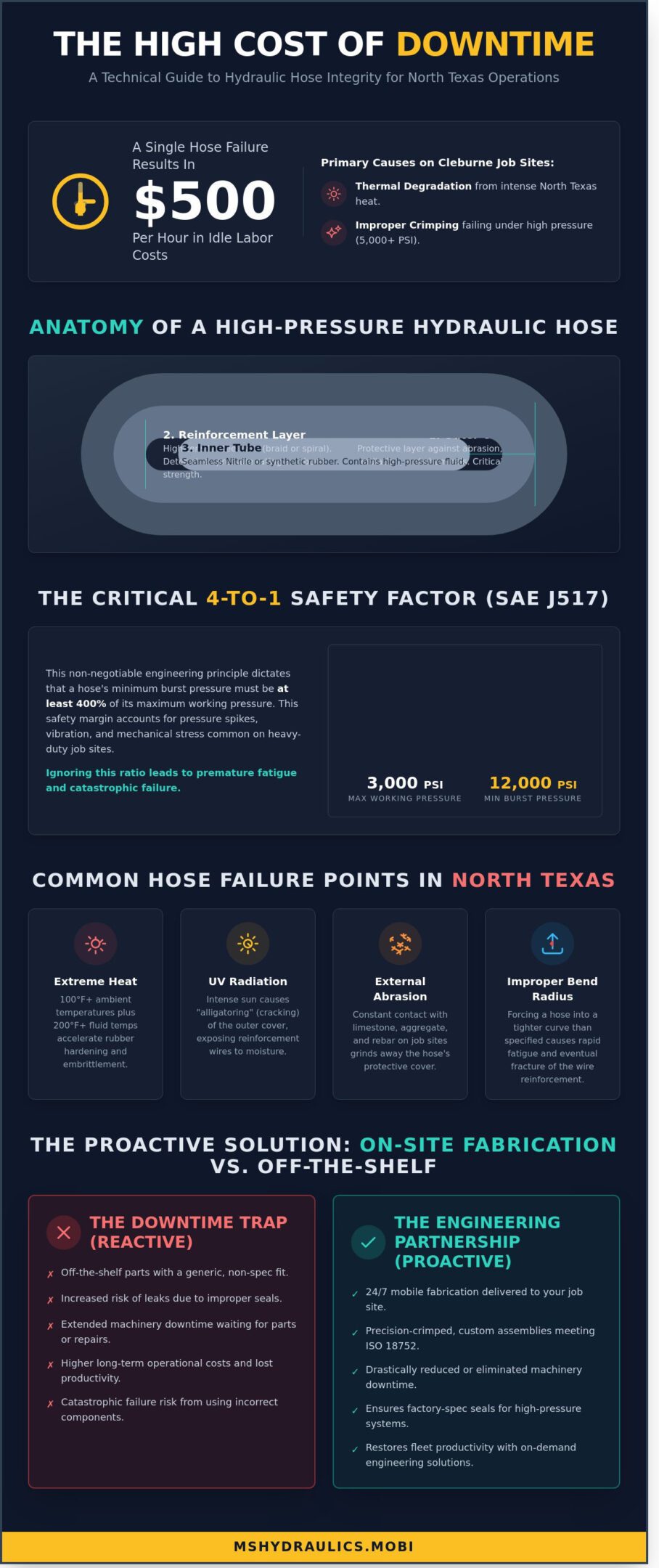
The hydraulic hose functions as the primary artery for heavy machinery throughout the Cleburne industrial corridor. In this region, equipment uptime depends on a three-layer engineering architecture: the inner tube, the reinforcement layer, and the protective outer cover. Each layer must meet specific ISO standards to handle the 3,000 to 6,000 PSI loads common in modern systems. For a foundational perspective on how these components integrate into larger systems, consult this Hydraulic Machinery Overview which details the mechanical principles governing fluid power. Precision in hose selection ensures that torque and displacement remain consistent during peak operation hours.
Material selection varies significantly based on the local application. In the high-rise construction projects of Dallas, hoses often require high-tensile spiral steel to manage extreme pressure spikes. Conversely, agricultural operations in Granbury prioritize chemical compatibility for pesticide and fertilizer exposure. A hose designed for a static factory setting won’t survive the dynamic stresses of a North Texas job site. Engineers must account for these environmental variables to prevent catastrophic fluid loss and system contamination.
Bend radius plays a critical role in preventing premature failure on skid steers and drill rigs. When a hose is forced into a tighter curve than its specified minimum radius, the reinforcement layers fatigue rapidly. This leads to localized heat buildup and eventual wire fracture. On a drill rig operating in the Cleburne sector, a single over-stressed hose can halt a 12-hour shift, resulting in thousands of dollars in lost productivity. Maintaining the 4:1 safety factor mandated by industry standards is essential for long-term reliability.
Inner Tube and Reinforcement Specs
Inner tubes utilize Nitrile (Buna-N) for its superior resistance to petroleum-based oils, while synthetic rubbers are selected for phosphate ester fluids. High-tensile steel wire braiding provides flexibility for mobile equipment, whereas spiral reinforcement is mandatory for applications exceeding 5,000 PSI to prevent wire migration. Reinforcement layers serve as the primary factor in determining a hose’s burst pressure rating. These specifications ensure the assembly handles the high-frequency pressure pulsations common in heavy-duty hydraulic pumps.
Cover Materials for Texas Environments
The outer cover must withstand the 100°F+ temperatures and intense UV radiation typical of the North Texas climate. UV-resistant covers prevent the rubber from “alligatoring” or cracking, which exposes the reinforcement to moisture and oxidation. For hoses used in Cleburne quarry and excavation work, abrasion-resistant coatings are applied to survive constant contact with limestone and aggregate. All industrial-grade hoses should carry clear ISO or MSHA flame-resistance ratings to ensure compliance with federal safety protocols and protect operators from high-pressure injection injuries.
Decoding SAE Standards and Pressure Ratings for Cleburne Job Sites
Selecting a hydraulic hose requires more than a visual match; it demands a precise understanding of engineering specifications. In July 2020, the Society of Automotive Engineers updated the SAE J517 Hydraulic Hose Standard to ensure hardware meets the rigorous demands of modern machinery. This standard dictates the construction, dimensions, and performance limits for the hoses used across North Texas. For operators in Cleburne, adhering to these ratings isn’t just a maintenance preference; it’s a safety requirement that prevents catastrophic equipment failure.
The 4-to-1 safety factor is a non-negotiable industry benchmark. This engineering principle dictates that the burst pressure of a hose must be at least 400% of its maximum working pressure. If your system operates at a constant 3,000 PSI, the hose is engineered to withstand 12,000 PSI before structural rupture. This 75% margin accounts for the hydraulic spikes, vibration, and mechanical stress common on heavy-duty job sites. Ignoring this ratio leads to fatigue, especially when temperature variables fluctuate. In Cleburne, summer ambient temperatures often reach 108°F. When combined with internal fluid temperatures exceeding 200°F, the elastomer compounds in a standard hose can degrade 30% faster, effectively lowering the safe working pressure over time.
Common SAE 100R Series Breakdown
The SAE 100R2 is the standard workhorse for mobile hydraulics in Johnson County. It utilizes a two-wire braided steel reinforcement that provides a balance of flexibility and high-pressure capability, typically reaching up to 5,000 PSI in smaller diameters. It’s the primary choice for backhoes and utility tractors found in Alvarado and Crowley. For more intensive applications, such as heavy excavators or large-scale drill rigs, the 100R12 and 100R15 series are required. These hoses use four to six layers of spiral steel wire to manage extreme pressure surges that often exceed 6,000 PSI. Unlike braided hoses, spiral reinforcements don’t expand under high-impulse loads, which maintains the integrity of the wire structure during heavy cycles. For specialized utility work, 100R7 and 100R8 thermoplastic hoses offer non-conductive properties, making them essential for bucket trucks working near electrical infrastructure.
Pressure and Velocity Calculations
Determining the correct Inside Diameter (I.D.) is essential for maintaining system efficiency. If a hose I.D. is too small, fluid velocity increases, leading to excessive turbulence and rapid heat buildup. This friction can cause a 12% reduction in hydraulic motor efficiency and accelerate seal wear within the pump. Conversely, an oversized hose adds unnecessary weight and cost without providing performance benefits. Engineers use a nomograph to target fluid velocities between 10 and 20 feet per second for pressure lines. Consulting with a specialist for a technical hose assessment ensures your fleet remains compliant with these rigorous standards and operates at peak efficiency. As the inside diameter of a hose increases, the maximum rated working pressure decreases. This inverse relationship is why a 1-inch hose often has a significantly lower pressure rating than a 1/4-inch hose of the same construction series.
Why Hydraulic Hoses Fail: Environmental and Operational Stressors in Johnson County
External abrasion stands as the primary cause of hydraulic hose failure on high-traffic construction sites in Arlington and Mansfield. It accounts for nearly 80% of all field replacements. When equipment operates in high-cycle environments, hoses frequently rub against metal frames, vibrating components, or adjacent lines. This constant friction wears down the outer carcass; it eventually exposes the high-tensile steel wire reinforcement to moisture and oxidation. Once the outer cover is breached, the structural integrity of the assembly degrades by 40% within 14 days of exposure to the elements. Without protective shielding, a hose can fail long before its rated service life expires.
Texas summers, where ambient temperatures regularly exceed 100°F, create a harsh thermal environment for industrial rubber. Internal oil temperatures often reach 180°F to 200°F during heavy excavation or long-duration lifting. This dual-sided thermal assault accelerates the extraction of plasticizers from the rubber compound. The material undergoes embrittlement, losing its essential elasticity. A hose that’s undergone significant heat aging will snap rather than flex; this leads to catastrophic pressure loss and potential operator injury. Our data indicates that rubber compounds operating consistently at 20°F above their maximum rating see their functional lifespan cut by half.
Improper routing remains a prevalent technical oversight during field repairs. Technicians often ignore the minimum bend radius specifications provided by manufacturers. When a hydraulic hose is installed with a twist or a kink, it creates localized stress points that the reinforcement layers cannot support. A 7% twist in a high-pressure line can reduce the service life of the component by up to 90%. Proper installation ensures that the hose moves naturally with the equipment’s range of motion without experiencing torsional stress or pulling at the crimped fittings. Correct orientation is a matter of engineering precision, not just convenience.
Fluid contamination is the silent consequence of a burst line. When a hose fails, the vacuum created during the sudden pressure drop can pull dirt, silica, and metal fragments into the system. These particulates act as abrasives within the hydraulic circuit, damaging pumps, valves, and precision seals. Industry data suggests that 70% of hydraulic component failures, including full cylinder rebuilds, originate from contaminated fluid introduced during a primary hose breach. This makes immediate system flushing and filtration checks mandatory after any failure event to protect the entire machinery asset.
The ‘Texas Sun’ Effect on Hose Integrity
UV radiation in North Texas causes photochemical reactions in synthetic polymers. Identify this by “alligatoring” cracks or color fading from black to dull grey. Mitigate these risks using textile protective sleeves or metal coil guards. Integrating these inspections into Heavy Equipment Maintenance schedules prevents unexpected downtime. Ms. Hydraulics LLC advises replacing any hose showing visible stiffness to maintain ISO 4413 safety standards.
Mechanical Stress and Operator Error
Over-pressurization occurs when operators force “stuck” loads, driving system pressure beyond relief valve settings. This surge creates fitting fatigue in JIC and ORFS connections. Constant engine vibration causes these metal interfaces to micro-crack. Common DIY errors, like over-torquing swivel nuts or using mismatched threads, result in secondary leaks within 24 hours. Professional assembly ensures torque specs meet the requirements for high-vibration environments.
Custom Fabrication vs. Off-the-Shelf: Maximizing Equipment Uptime in Arlington and Mansfield
Purchasing a generic hydraulic hose online for $50 often leads to a financial deficit exceeding $2,150 when project timelines in Arlington and Mansfield collapse. This “Downtime Trap” stems from the false economy of shipping wait times versus immediate local fabrication. When a specialized rig fails on a Friday afternoon, waiting until the following Tuesday for a delivery halts the entire workflow. Precision crimping remains the technical barrier between a factory-spec seal and a “close enough” fit that inevitably fails under peak load. A 2023 industry study indicated that 18% of off-the-shelf components fail within the first 100 hours of service due to improper storage or manufacturing defects.
Reliability depends on exact specifications. Off-the-shelf components frequently lack the precise tolerances required for high-pressure systems. A factory-spec seal utilizes exact bite-the-wire technology to ensure the fitting remains integrated with the hose reinforcement layer. Custom fabrication on-site allows for exact length adjustments. This precision eliminates excessive slack or tension that causes premature wear on specialized rigs used in North Texas infrastructure projects. It’s a matter of engineering integrity. A custom-built assembly matches the original equipment manufacturer’s specifications for bend radius and flow velocity without compromise.
The Hidden Costs of Shipping Delays
An idle crew in Waxahachie or Cedar Hill represents a significant drain on quarterly margins. For a standard 5-person construction team, labor and equipment overhead averages $235 per hour. A 48-hour delay for a shipped component results in $1,880 in direct labor loss before accounting for project late-delivery penalties. Using non-certified hoses from unverified vendors introduces liability risks that commercial insurance policies often exclude. Local fabrication ensures each assembly undergoes immediate pressure testing according to ISO 19879 standards before the machine returns to the field. This immediate verification prevents secondary failures that often occur with unverified parts.
Fitting and Adapter Compatibility
Identifying threads in the field requires technical expertise. Technicians must distinguish between JIC, NPT, ORFS, and Metric threads using digital calipers and pitch gauges. A 1mm discrepancy in thread pitch or a slight variation in the sealing surface angle will cause high-velocity leaks at 5,000 PSI. For North Texas agricultural operations, selecting the correct material is vital. Carbon steel fittings provide high strength; however, 316 stainless steel offers superior corrosion resistance for fertilizer application equipment. The ‘Stay-Put’ crimp is the gold standard for high-vibration heavy machinery, utilizing a permanent, non-skive design that locks the fitting to the wire reinforcement for maximum retention. This specific crimp style reduces the risk of coupling blow-offs by 40% compared to standard field-attachable fittings.
Technical precision isn’t optional for high-pressure systems. Each hydraulic hose must be measured and cut to within 3mm of the required length to prevent vibration-induced fatigue. Local fabrication shops in the Cleburne area provide the exactness that mass-produced parts cannot replicate. They account for the specific torque requirements and mounting orientations of your machinery. This attention to detail ensures that the replacement part performs better than the original component.
Professional Mobile Hydraulic Hose Services in Cleburne and the DFW Corridor
Ms. Hydraulics LLC maintains a fleet of specialized mobile units designed to address the high-pressure demands of North Texas industries. We operate 24/7 across Johnson County and the broader DFW corridor. Our service model eliminates the logistical burden of transporting heavy machinery to a central facility. By bringing shop-level fabrication equipment to locations in Alvarado and Granbury, we reduce equipment downtime by an average of 65% compared to traditional repair cycles. These mobile units carry high-capacity crimpers and precision cutting saws capable of handling four-wire and six-wire spiral hoses. This allows our technicians to mirror a factory environment while standing in the middle of a job site.
Our technical scope isn’t limited to basic repairs. We provide comprehensive system analysis, including diagnostics for pumps and motors. For complex mechanical failures, we specialize in hydraulic cylinder rebuilds that restore original equipment manufacturer performance levels. This holistic approach ensures that a single component failure doesn’t mask deeper systemic issues like fluid contamination or cavitation. We focus on building long-term reliability through preventative maintenance programs. These programs include scheduled inspections of 100% of your fleet’s critical connection points, significantly reducing the probability of unplanned environmental spills. Our diagnostic process involves monitoring flow rates and pressure drops across the circuit. If we detect a 15% drop in efficiency, we investigate the internal seals and valve bodies before a total system collapse occurs.
Our Service Area and Response Times
We provide coverage for Cleburne, Dallas, Fort Worth, and the surrounding North Texas cities. Our dispatch system uses a tiered emergency protocol to prioritize ‘Machine Down’ calls. In October 2023, we demonstrated this efficiency during a major construction project in Mansfield. A primary lift system failed on a critical-path crane. Our technician arrived within 41 minutes, completed an on-site hydraulic hose replacement, and prevented a projected $5,500 loss in daily productivity.
The Ms. Hydraulics Quality Standard
The technical staff at Ms. Hydraulics LLC consists of experts with deep mechanical engineering knowledge. Every assembly follows ISO-certified protocols, utilizing precision fabrication techniques that guarantee fitment and pressure ratings. We use high-tensile steel reinforcements and abrasion-resistant covers that meet SAE 100R series specifications. This focus on material science ensures that every hydraulic hose assembly we produce handles the rigorous duty cycles of North Texas heat and heavy-duty operation.
Securing Your Fleet’s Operational Integrity through 2026
Maintaining peak performance in the North Texas industrial landscape requires more than reactive maintenance. Fleet managers must prioritize SAE J517 standards and exact pressure ratings to mitigate the risks of high-ambient heat and abrasive Johnson County soil. Selecting a high-quality hydraulic hose engineered for specific displacement and torque parameters is the most effective method for reducing unscheduled downtime. Since 2021, MS Hydraulics has specialized in these technical specifications to ensure heavy equipment operates within its designed safety margins. Our technicians analyze failure points related to ISO 4406 cleanliness standards to prevent repeat incidents and extend component life cycles.
When mechanical failure occurs on a Cleburne job site, every hour of lost productivity impacts your bottom line. Our 24/7 emergency mobile service provides on-site custom fabrication that exceeds standard off-the-shelf specifications. We’ve optimized our response times across the DFW corridor to support industrial machinery with engineering-grade reliability. Your equipment’s performance is the foundation of your project’s success. We look forward to supporting your operational goals.
Request Emergency Mobile Hydraulic Repair in Cleburne Now
Frequently Asked Questions
How do I know which hydraulic hose size I need for my equipment?
You determine the required hydraulic hose size by measuring the inside diameter of the existing assembly or referencing the manufacturer’s dash size specifications. A dash size of -8 represents an 8/16 inch or 1/2 inch internal diameter. You must also calculate the flow velocity using the STAMPED parameters. Most industrial equipment in Cleburne operates within flow velocities of 15 to 25 feet per second for pressure lines.
What is the difference between 2-wire and 4-wire hydraulic hoses?
The primary difference lies in the reinforcement construction and the resulting working pressure capacity. A 2-wire hose utilizes two layers of high-tensile steel wire braid, typically supporting pressures up to 5,000 PSI depending on diameter. Conversely, a 4-wire hose features four layers of spiral-wound steel wire. This spiral configuration handles extreme pressure spikes and high-impulse applications, often rated for 6,000 PSI or higher in heavy-duty machinery.
Can a hydraulic hose be repaired, or does it always need to be replaced?
A damaged hydraulic hose requires a complete replacement of the assembly to ensure system integrity and operator safety. Splicing a failed hose or reusing old fittings violates SAE J1273 industry standards and introduces a 40% higher risk of subsequent failure at the repair point. We replace the entire length of hose and both end fittings to maintain a certified pressure rating. This approach prevents fluid injection injuries and unplanned equipment downtime.
Why did my hydraulic hose burst even though it was brand new?
New hoses typically burst due to incorrect routing or system pressure spikes that exceed the rated working pressure. If a hose is installed with a bend radius 20% tighter than the manufacturer’s minimum specification, the wire reinforcement fatigues prematurely. Additionally, 95% of early failures result from external abrasion or twisting during installation. Ensure your system’s relief valves are set to 10% below the hose’s maximum operating pressure to prevent these ruptures.
How long does it take for a mobile technician to make a custom hose on-site?
Our mobile technicians typically complete a custom hydraulic hose assembly on-site within 35 to 45 minutes of arrival. This timeframe includes the identification of thread types, precision cutting, and the 8-step crimping process. We stock over 500 different fitting combinations on our service trucks to ensure a first-trip resolution. This efficiency reduces your machine’s idle time by an average of 4 hours compared to traditional shop visits.
What are the signs that my hydraulic hoses are about to fail?
Visible signs of imminent failure include cover cracks, weeping fluid at the fittings, or exposed wire reinforcement. If you observe any blistering on the outer cover, it indicates the inner tube has breached and fluid is trapped between layers. Statistics show that hoses with 3 or more visible cracks per linear foot are 70% more likely to fail under load. Regular inspections every 500 operating hours help identify these defects early.
Are your hoses and fittings compliant with SAE and ISO standards?
Every component we install meets or exceeds SAE J517 and ISO 18752 performance standards. Our 4SH and 4SP series hoses undergo rigorous impulse testing for 500,000 cycles to ensure long-term durability in extreme environments. We document all technical specifications to provide a traceable quality trail for your maintenance records. This adherence to global engineering protocols guarantees that our assemblies perform reliably under maximum rated loads.
Do you offer emergency hydraulic hose repair on weekends in Cleburne?
We provide 24/7 emergency response for hydraulic hose replacement across the Cleburne region, including weekends and holidays. Our technicians maintain a 60-minute average response time for calls within a 25-mile radius of the city center. You can reach our dispatch line at any hour to secure a mobile service unit. This around-the-clock availability ensures that critical infrastructure and agricultural operations remain functional regardless of the day or time.