Hydraulic Quick Disconnect Guide for Cleburne & North Texas Operators
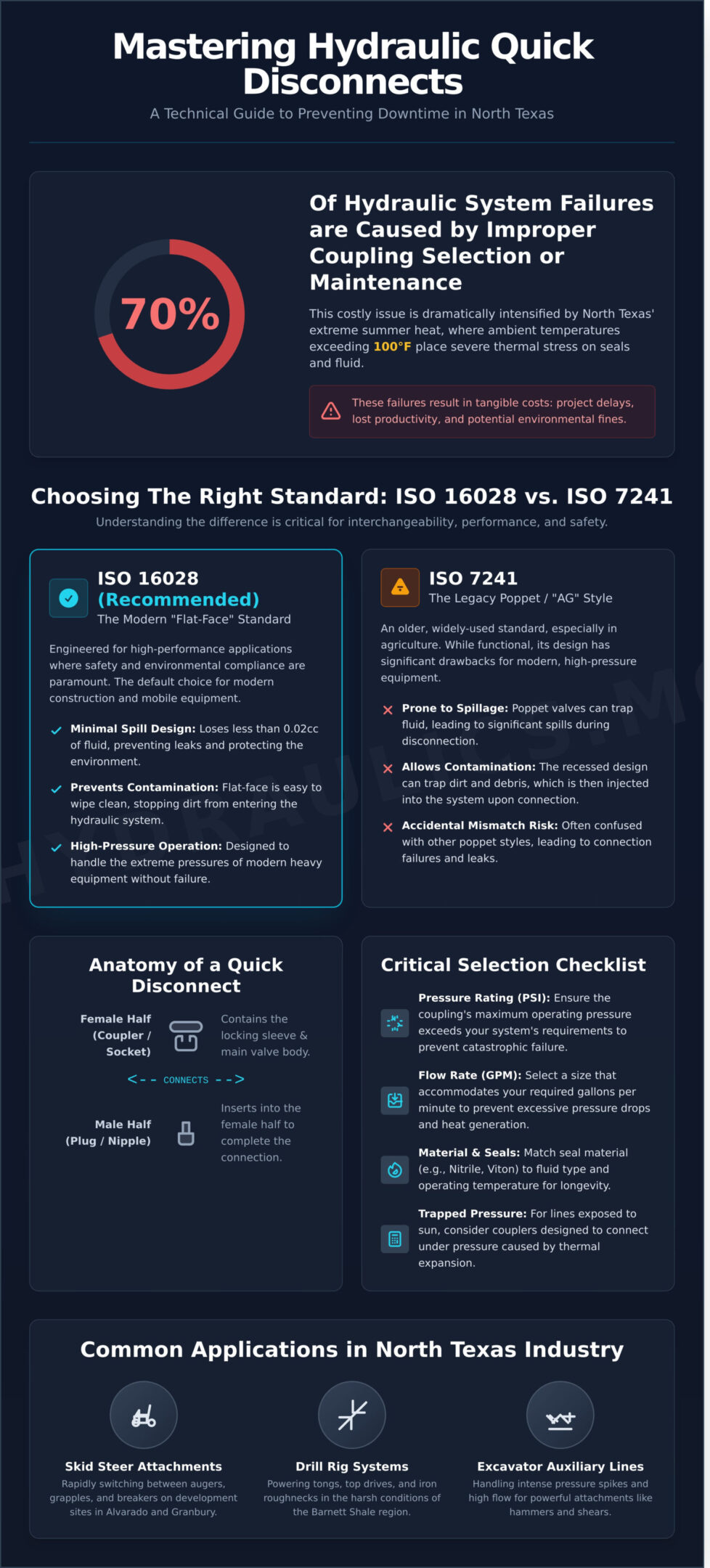
Industry analysis indicates that up to 70% of hydraulic system failures in the DFW Metroplex are directly attributable to improper coupling selection or maintenance. This figure escalates significantly during North Texas summers, where ambient temperatures regularly exceed 100°F and place extreme thermal stress on seal materials. For operators in Cleburne and the surrounding counties, these aren’t just statistics; they represent tangible costs in the form of project delays, lost productivity, and potential environmental fines from fluid leaks.
This definitive guide provides the necessary engineering criteria to master the selection, application, and maintenance protocols for your hydraulic quick disconnect systems. By understanding the technical specifications that govern performance under pressure and heat, you can mitigate the primary causes of machinery downtime. We will examine the critical ISO standards that ensure interchangeability across your fleet, detail the material science behind seal integrity, and provide a direct path to securing a reliable local partner for all your emergency hose and fitting requirements.
Key Takeaways
- Understand the critical differences between ISO 16028 and ISO 7241 standards to ensure universal compatibility and prevent connection mismatches.
- Learn to calculate required flow rates (GPM) and pressure ratings (PSI) to prevent excessive pressure drops and catastrophic system failure.
- Master a step-by-step protocol for safely relieving trapped pressure in hydraulic lines, a common issue caused by thermal expansion.
- Evaluate the technical specifications required to select the correct hydraulic quick disconnect, focusing on factors like flat-face design for leak-free operation.
What is a Hydraulic Quick Disconnect and Why Does Standard Choice Matter?
A hydraulic quick disconnect is a specialized, two-part coupling engineered for the rapid, tool-free connection and disconnection of high-pressure fluid lines. Its design is fundamental to the operational efficiency of modern heavy equipment. While a general overview of what a quick coupler is provides context for various machinery, a hydraulic quick disconnect is specifically built to manage the extreme forces inherent in fluid power systems, often exceeding 3,000 PSI. For operators on North Texas construction sites, these components are not just conveniences; they are critical enablers of equipment modularity, allowing a single prime mover to perform multiple tasks by quickly switching between attachments.
The selection of the correct coupling is not a trivial decision. An incorrect or poorly matched coupling introduces a restriction in the hydraulic circuit, leading to a significant pressure drop. This inefficiency forces the system’s pump to work harder to achieve the required flow, which directly translates into increased heat generation. This excess thermal load can degrade hydraulic fluid, damage seals, and ultimately cause premature component failure, leading to costly downtime on a job site.
Furthermore, environmental compliance is a major operational factor. In Johnson County and surrounding areas, regulations mandate strict control over fluid spillage. Modern “no-spill” or flat-face style couplings are designed to meet these requirements by minimizing fluid loss during connection and disconnection cycles to less than 0.02 cubic centimeters. Choosing an older, poppet-style coupling can result in unacceptable spills, risking environmental fines and project delays.
The Mechanics of a Quick Disconnect Coupling
Every coupling assembly consists of two distinct halves: the male component (often called the plug or nipple) and the female component (the coupler or socket). Inside each half, a precision valve, typically either a poppet or flat-face design, controls fluid flow. When disconnected, these valves are spring-loaded to seal the hydraulic line instantly. Upon connection, the valves mate and open, creating a secure flow path. A robust locking sleeve mechanism, usually a ball-lock or threaded design, is essential for preventing accidental disconnection in the high-vibration environments common to heavy equipment operation.
Common Applications in North Texas Industry
The practical necessity for high-quality hydraulic couplings is evident across the region’s key industries. System integrity and rapid changeovers are paramount in these demanding applications:
- Skid Steer Attachments: On development sites in Alvarado and Granbury, operators frequently switch between augers, grapples, and breakers. A reliable quick disconnect system allows a single operator to make these changes in under a minute, maximizing the machine’s utility and project productivity.
- Drill Rig Hydraulic Systems: In the Barnett Shale region, drilling operations depend on complex hydraulic systems for power tongs, top drives, and iron roughnecks. Couplings here must withstand continuous high-pressure cycles and harsh environmental conditions without failure.
- Excavator Auxiliary Lines: For heavy demolition and excavation, auxiliary hydraulic lines power attachments like hammers and shears. The couplings must handle intense pressure spikes and high flow rates associated with these powerful tools.
Technical Standards: ISO 16028 vs. ISO 7241
In hydraulic systems, interchangeability isn’t a convenience; it’s a fundamental requirement for operational efficiency and safety. The International Organization for Standardization (ISO) provides the universal language that ensures a coupler from one certified manufacturer can connect with a nipple from another. For operators in Cleburne and across North Texas, understanding the distinction between the two most prevalent standards, ISO 16028 and ISO 7241, is critical for minimizing downtime and preventing system contamination.
These standards dictate the precise dimensional tolerances, performance benchmarks, and testing protocols for hydraulic couplings. Selecting the correct standard ensures proper system function, pressure handling, and attachment compatibility, particularly when managing a diverse fleet of equipment from manufacturers like Caterpillar, Bobcat, and John Deere.
Flat Face Couplers: The Modern Standard
The ISO 16028 standard defines the specifications for modern flat-face couplers. This design is engineered for high-performance applications and has become the default for the skid steer industry and other construction machinery where fluid containment is paramount. The primary advantage is its minimal-spill design, which limits fluid loss to less than 0.02 cubic centimeters per connection cycle. Its flat mating surfaces are easily wiped clean, drastically reducing the introduction of dirt, dust, and moisture into the hydraulic circuit. Leading manufacturers are engineering solutions that are not just compliant but are exceeding ISO 16028 standards for pressure and flow. As fleet managers prepare for stricter 2026 environmental regulations, the shift to ISO 16028 is accelerating to mitigate ground contamination from hydraulic fluid spillage. In the Dallas-Fort Worth metroplex, operators will most frequently encounter ISO 16028-compliant fittings from brands such as Parker (FEM Series), Stucchi (FIRG Series), and Faster (FFH Series).
Poppet Style Couplers: When to Use Them
The older ISO 7241 standard governs traditional poppet-style couplers, which remain prevalent in North Texas agricultural equipment and legacy industrial machinery. This design uses a retractable poppet valve to control fluid flow. While reliable for many applications, its primary limitation is fluid loss. A typical ISO 7241 connection can spill between 0.5 and 2.5 cubic centimeters of oil per cycle, a significant figure over the life of a machine. This design is also more susceptible to air ingestion during connection, which can cause pump cavitation and spongy actuator performance. The standard is divided into two primary series:
- ISO 7241 Series A: Often considered the agricultural standard, it’s identifiable by its rounded poppet and is globally interchangeable for agricultural applications.
- ISO 7241 Series B: Known as the industrial standard in North America, it typically features a more conical poppet design and is not interchangeable with Series A.
Finally, identifying the correct port thread is essential when replacing any hydraulic quick disconnect. Equipment manufactured for the U.S. market predominantly uses one of three types: NPT (National Pipe Taper), which seals on the threads; JIC (Joint Industry Council), which uses a 37-degree flared seating surface; and ORB (O-Ring Boss), which provides a superior high-pressure seal with an integrated O-ring. Misidentifying a thread type can lead to persistent leaks and irreparable component damage. If you’re facing a worn or unidentifiable fitting, our technicians can precisely match your system’s requirements to ensure a secure, leak-free connection.
Selecting the Right Quick Disconnect for High-Pressure Systems
The operational integrity of any high-pressure hydraulic system depends fundamentally on the correct specification of its components. Selecting an appropriate quick disconnect is not a matter of simple compatibility; it’s a critical engineering decision that directly impacts system efficiency, component longevity, and operator safety. A mismatch between the coupling and the system’s operational parameters can lead to catastrophic failure, costly downtime, and significant performance degradation on demanding North Texas job sites.
Pressure and Flow Considerations
An undersized coupling is a primary source of hydraulic inefficiency. Forcing a high volume of fluid, for example, 35 gallons per minute (GPM), through a coupling designed for 20 GPM creates a significant pressure drop. This restriction generates excessive heat, which can raise hydraulic fluid temperature by 20-30°F, accelerating fluid degradation and causing premature wear on pumps and seals. For high-flow attachments like mulchers or cold planers, calculating the “Effective Orifice” of the coupling is essential to ensure it can handle the required flow without inducing thermal stress. Furthermore, hydraulic systems are subject to surge pressures, momentary spikes that can exceed the maximum working pressure by 50% or more. A coupling’s burst pressure rating must be at least four times its maximum working pressure to safely absorb these surges, a principle reinforced in standards like the SAE AS25427 Standard, which provides a technical benchmark for coupling performance.
Environmental Factors in North Texas
The unique operational environment of North Texas presents distinct challenges. On job sites from Crowley to Burleson, the fine, abrasive dust of the Blackland Prairie soil can easily infiltrate hydraulic systems. This particulate contamination compromises sealing surfaces and accelerates component wear. Using a quality quick disconnect with integrated dust caps is a non-negotiable first line of defense. Corrosion is another significant factor, driven by high humidity and exposure to the elements. For equipment that operates outdoors year-round, material selection is paramount.
- Carbon Steel: Often plated with Zinc-Trivalent Chromate, it offers robust performance and good corrosion resistance for most general applications. It is the standard for construction and agricultural equipment.
- Stainless Steel (316): Provides superior corrosion resistance, making it ideal for applications involving corrosive chemicals, wash-down environments, or prolonged exposure to moisture.
- Brass: Offers excellent corrosion resistance but has a lower pressure rating than steel, typically limiting its use to lower-pressure pneumatic or water lines, not high-pressure hydraulics.
Finally, the intense summer heat, with ambient temperatures regularly exceeding 100°F, directly impacts seal performance. Elastomeric seals lose their elasticity and degrade under sustained high temperatures. This necessitates careful selection of seal material.
- Nitrile (Buna-N): The industry standard, suitable for temperatures up to 250°F. It provides excellent resistance to petroleum-based hydraulic fluids but is less effective with synthetic fluids like Skydrol.
- Viton (FKM): A superior choice for high-temperature applications, rated for continuous service up to 400°F. It also offers broader chemical compatibility, making it a requirement for systems running certain synthetic or high-temperature fluids.
Troubleshooting: Solving the “Trapped Pressure” Problem
One of the most frequent operational challenges for equipment operators in North Texas is the inability to connect a hydraulic quick disconnect. The cause is almost always trapped pressure, a direct result of thermal expansion. Hydraulic fluid, like any liquid, expands when heated. With a coefficient of thermal expansion around 0.0004 per degree Fahrenheit, a sealed hydraulic hose left in the summer sun can experience a significant pressure increase. A 50°F temperature rise from a cool Cleburne morning to a hot afternoon can elevate trapped pressure by more than 700 PSI, effectively locking the coupling.
Attempting to force a connection under these conditions can damage the poppet valves and seals, leading to premature failure. Safely relieving this pressure is a non-negotiable step for maintaining system integrity.
Follow this precise protocol to safely relieve pressure before connection:
- System Deactivation: Ensure the host machine is shut down and all hydraulic controls are cycled to release system pressure.
- Personal Protective Equipment (PPE): Always wear ANSI-rated safety glasses and hydraulic-resistant gloves.
- Utilize Built-in Relief: If the coupler is equipped with a pressure-relief mechanism (a small button or sleeve), actuate it until the pressure is audibly released.
- Expert Intervention: If no relief mechanism is present, a qualified technician may need to carefully loosen an upstream fitting to bleed the pressure. This procedure carries significant risk and should not be attempted by untrained personnel.
- Clean and Inspect: Once pressure is normalized, thoroughly clean both coupling halves with a lint-free cloth before attempting connection.
During inspection, differentiate between minor seal wear and catastrophic failure. A brittle, cracked, or deformed O-ring can be replaced. However, if the metal valve seat shows scoring or the coupling body is visibly damaged, the entire component must be replaced to guarantee performance and safety.
Field Repair vs. Shop Replacement
A leaking coupler with a compromised O-ring can often be serviced on-site in Mansfield or Arlington, minimizing downtime. However, symptoms like difficulty locking, visible wear on the locking balls, or a weak spring mechanism signal internal fatigue. These issues compromise the coupling’s pressure rating and require a full shop replacement. Safety Warning: A pinhole leak from a faulty coupler can cause a hydraulic injection injury. Fluid at 2,000 PSI can penetrate skin as fast as 600 ft/sec, requiring immediate emergency medical attention.
Connecting Under Pressure (CUP) Technology
Modern engineering provides a solution: Connect Under Pressure (CUP) couplings. These specialized fittings, often compliant with ISO 16028 standards, feature an internal valving system that automatically vents residual pressure as the connection is made. For operators in Waxahachie and Cedar Hill running equipment with frequent attachment changes, this technology can reduce connection time by up to 90%, eliminating manual pressure bleeding. While the initial component cost is 25-35% higher than standard couplers, the reduction in labor and downtime delivers a clear return on investment, often within the first year for high-cycle applications. Explore our catalog of certified pressure-relief couplings to upgrade your fleet’s efficiency.
Mobile Hydraulic Support and Fitting Supply in Cleburne
Operational continuity in North Texas depends on the immediate availability of reliable hydraulic components and expert field support. Ms. Hydraulics provides a comprehensive solution, extending beyond simple parts supply to include custom hydraulic hose fabrication and emergency on-site services. Our mobile units are equipped to build hose assemblies to exact OEM specifications, incorporating premium, high-pressure fittings and couplings designed for demanding industrial and construction applications. We understand that a failed component isn’t just a part; it’s a direct cause of project delays and revenue loss. That’s why our service is engineered for rapid, precise intervention.
Chronic coupling failures are often symptomatic of deeper system issues, such as excessive pressure spikes, fluid contamination, or incorrect component specification. Our on-site diagnostics are designed to identify the root cause of these recurring problems. A technician doesn’t just replace a failed quick disconnect; they analyze the operational parameters of your machinery to prevent future breakdowns. By assessing system pressure, inspecting for abrasive contaminants, and verifying component compatibility, we provide a permanent fix, not a temporary patch. This analytical approach protects your equipment investment and ensures the long-term integrity of your hydraulic systems.
As your local partner for hydraulic integrity, Ms. Hydraulics maintains a robust inventory of ISO-certified components. Our commitment to quality is non-negotiable. Every hose, fitting, and adapter we supply meets or exceeds stringent international standards, including ISO 9001 for quality management. This guarantees that every repair performs reliably under the intense operational stress typical of construction and agricultural work in the Cleburne area. Operators can trust that a Ms. Hydraulics repair restores their equipment to factory-level performance and safety standards.
Our Service Area and Response Times
Our mobile service fleet is strategically positioned for rapid dispatch to job sites across the Dallas-Fort Worth metroplex, including Cleburne, Burleson, and surrounding areas, typically arriving within 90 minutes of your call. We carry an extensive inventory of specialized fittings for heavy equipment from leading manufacturers like Caterpillar, John Deere, and Bobcat. The Ms. Hydraulics commitment is clear: deliver expert technical support and the correct components to minimize your operational downtime.
Request On-Site Service
To ensure the fastest possible repair, please have the following technical specifications ready when you call for service. This information allows our technicians to arrive with the precise components required for your equipment.
- Equipment Brand and Model: (e.g., Caterpillar 336)
- Hose Assembly Details: Inside diameter (ID), length, and type of ends.
- System Pressure Rating: The maximum operating PSI of the system.
A durable repair often involves more than just the hose assembly. The condition of connected components is critical for total system health. We offer professional hydraulic cylinder rebuilds to restore full functionality and prevent pressure loss that can strain other parts of the system. For immediate assistance with a failed hose or fitting, don’t hesitate.
Optimize Your Hydraulic Operations with Expert Support
Understanding the technical distinctions between ISO 16028 and ISO 7241 standards is critical for preventing leaks and ensuring system compatibility. Likewise, knowing how to properly diagnose and resolve common issues like trapped pressure can directly impact your project timelines and profitability. Selecting the correct hydraulic quick disconnect is not merely a component choice; it’s a strategic decision that underpins the reliability of your entire high-pressure system.
This same strategic approach applies to the full scope of vehicle upkeep; for those managing entire fleets, it’s beneficial to explore Truck Repair services that cover everything from specialized components to complete upfitting.
For operators in Cleburne and across North Texas, MS Hydraulics provides a definitive solution. Our team, founded in 2021, leverages years of direct North Texas field experience to deliver on-site technical labor for your heavy machinery, reducing costly transport and downtime. We specialize in the fabrication of mission-critical, ISO-certified components, ensuring every fitting meets precise engineering requirements for pressure and flow. When you need reliable parts and immediate field service, don’t let a faulty connection disrupt your project schedule. Get Mobile Hydraulic Repair in Cleburne Now.
Your operational uptime is our primary objective.
Frequently Asked Questions About Hydraulic Quick Disconnects
Can I mix different brands of flat-face quick disconnects?
No, mixing different brands of flat-face quick disconnects is not advised, even if they comply with the same ISO 16028 standard. Manufacturing tolerances can vary by up to 0.005 inches between brands, leading to poor sealing, premature wear, or connection failure under pressure. For guaranteed performance and system integrity in demanding North Texas conditions, it’s critical to match the male and female halves from the same manufacturer and series.
What is the most common reason for a hydraulic quick disconnect to leak?
Seal damage or contamination is the primary cause for over 85% of hydraulic coupler leaks. Abrasive particles, often found in dusty Cleburne job sites, can score the O-rings or poppet valve seals. Another frequent cause is brinelling, where high-impulse pressure cycles create indentations on the valve seats. Regular inspection and maintaining fluid cleanliness to ISO 4406 standards can prevent the majority of these failures and extend component life.
How do I identify the thread size of my existing hydraulic coupling?
Identify the thread size of your coupling by using a digital caliper to measure the outside diameter (OD) of the male thread and a thread pitch gauge for the threads per inch. For example, a male NPT thread with an OD of approximately 1.050 inches is a 3/4-14 NPT. Compare your measurements against a standard thread identification chart for NPT, JIC (SAE J514), or ORB (SAE J1926). MS Hydraulics provides detailed charts to ensure accurate identification.
Is there a difference between a pneumatic and a hydraulic quick disconnect?
Yes, there is a fundamental difference in design and pressure rating. Hydraulic couplers are engineered for high-pressure liquid systems, typically rated from 3,000 to 10,000 PSI, and constructed from high-strength steel. In contrast, pneumatic couplers are designed for low-pressure air systems, usually under 300 PSI, and are often made from lighter materials like brass. Using a pneumatic fitting in a hydraulic application is a critical safety hazard that can lead to catastrophic failure.
What should I do if my quick disconnect is stuck and won’t release?
A stuck quick disconnect is almost always caused by trapped hydraulic pressure, which can exceed 500 PSI even in a static line. Do not use excessive force. First, ensure the machine is off and safely bleed the pressure from the line using the equipment’s designated procedure. If pressure is released and it remains stuck, check for physical damage or debris obstructing the locking sleeve. A light tap with a rubber mallet may dislodge it, but never strike the fitting with a steel hammer.
How often should I replace the O-rings in my hydraulic couplers?
O-ring replacement frequency depends on operating conditions, but a preventative schedule is recommended. For equipment operating 40+ hours per week in high-cycle applications, inspect and replace seals every 6 months or 1,000 hours of operation. For less demanding use, an annual replacement during routine system maintenance is sufficient. Using genuine OEM seals made from materials like Viton or NBR rated for your specific hydraulic fluid is essential for reliability.
Can I use a quick disconnect for a suction line application?
No, using a standard valved quick disconnect on a suction line is not recommended. The internal poppet valves create a pressure drop that can exceed the 2-5 PSI maximum recommended for most hydraulic pump inlets. This restriction can lead to pump cavitation, causing severe damage and premature failure. For suction applications, it’s critical to use full-flow ball valves or specialized, non-valved couplings to ensure unrestricted flow to the pump.
Are there specific quick disconnects for high-temperature hydraulic oil?
Yes, specific couplers are engineered for high-temperature hydraulic systems. Standard quick disconnects use Nitrile (Buna-N) seals, typically rated up to 212°F (100°C). For systems operating above this temperature, you must use couplers fitted with high-temperature seals like Viton (FKM), which are rated for continuous service up to 400°F (204°C). Always verify the temperature rating of both the coupler body and its internal seals to prevent component failure.